Grief Work 2026: Balancing Solitude and Isolation

I’ve always loved my alone time.

As an introvert (who can, if pressed pretend not to be!) my energy is restored when I interact with one or two folks or no one at all.  A dream afternoon is writing while listening to nothing louder than the wind chimes outside my door.

I treasure solitude.

Since Dominic ran ahead to Heaven, I find I need even more alone time than before.

That quiet place is where I do my most effective grief work, undisturbed by interruptions and distractions.

But I need to be careful that solitude doesn’t shift into isolation. 

I have to remind my heart that spending time with others keeps me from falling so deeply down the well of despair that all I see is darkness.

I need human interaction to keep me connected to a world that, quite frankly, I might sometimes just as soon leave behind.

So how can I tell the difference between solitude and isolation?

Here are a few questions that help me figure that out:

  • Do I feel lonely, neglected or abandoned? If my alone time feels less like a gift and more like an unwelcome burden then it may be isolation rather than solitude.
  • Where are my thoughts taking me? Being alone is often the only way to “hear” my own thoughts without having to block out the noise and activity of other people. If I am sitting with myself, processing hard things or even beautiful things, resolving internal conflict, conjuring new ways to deal with difficult relationships or situations then solitude is doing its work. If, instead, I find my mind tangled up in fearful knots, filled with negative self-talk or unable to break a downward spiral into despair then I probably need to find someone to talk to.
  • Am I getting stronger or being drained? After the holidays or other hectic seasons I need time alone to recharge my batteries. Often it is almost a day-for-day exchange. I can feel tension melting away and strength returning. My mind begins to clear and life doesn’t feel so overwhelming. Solitude grants space for my body, mind and soul to be refreshed. When it slides into isolation I can feel the shift. Instead of waking refreshed and eager to greet a free day, I wake to dreading another long one alone. Instead of energy rising in my spirit, I can feel it draining away. Instead of thinking kindly of friends and family who choose to leave me be, I’m resentful no one has checked up on me.
  • Is there a helpful rhythm to my days alone or am I counting the hours until sundown? When I’m enjoying solitude, the hours feel like a welcome opportunity to do things (or not do things!) at my own pace and according to my own preferences. I sit with pen in hand and jot down a list knowing that if I complete it or if I don’t the only person I have to answer to is myself. No pressing appointments and no worrisome commitments. When I’m isolating, the hours feel like a long march through deep mud-every step tedious, treacherous and exhausting. I’m alone but I’m not getting any benefit from it. If I’m enduring instead of enjoying then I’m isolating.
  • Do I have an endpoint in mind? When I look ahead at a week on my calendar, I try to balance alone time with social commitments. A day or two alone (or with limited human interaction) is solitude. A week holed up in the house is isolation. If I find myself pushing off needed outings (to the grocery store, to run errands) then I ask myself, “why?”. Often it’s because I’ve drifted from solitude (helpful alone time) to isolation (unhelpful hiding).

I can shift myself out of isolation by choosing just one small social interaction.

I might text or message a friend, go to the grocery store and make a point of speaking to the clerk, call someone or show up at a church or community event even if I sit in the back and slip out early.

I’m never going to be that person who is up for every outing. That’s just not how I’m made and child loss has intensified my need for solitude.

But I don’t want to be alone and lonely, sinking deeper and deeper into a pit of my own making.

Some days it’s harder than others.

But I keep trying.

Father’s Day 2026: Seven Ways to Honor Grieving Fathers

Holidays are hard on bereaved parents’ hearts.

Even though our children are always on our minds, holidays act as megaphones, amplifying the missing, sorrow, grief and lost opportunity to build more memories.

So it’s particularly helpful when friends and family step up and step in, showing extra support on and around those extra hard days.

Here are seven ways you can bless a bereaved dad this Father’s Day:

MEET THEM WHERE THEY ARE IN THEIR GRIEF

Sometimes friends and family let their expectations of how parents should grieve and for how long influence the quantity and quality of the help they’re willing to give. I can’t emphasize enough that no one outside the child loss community really understands how very, very difficult and how very, very much time it takes for a parent to even wrap his or her mind around the fact their child is truly gone. Instead of pushing or pulling a grieving dad forward, simply accept where he is, meet him there and let him take the lead in conversation, activity and whether or not he can join in a Father’s Day celebration.

LET YOUR FRIEND KNOW YOU’RE THINKING OF THEM

This is probably the most important and the simplest way to make a difference in a bereaved dad’s life! I know we all get busy and let days and dates slip by. But set an alarm on your phone if you have to as a reminder. Send a text or make a call. Tell him you haven’t forgotten he will be missing his child and wishing his family was complete this Sunday, especially.

SAY THEIR CHILD’S NAME

As the years go by it is often more and more unlikely for a parent to hear their missing child’s name spoken aloud. Yet it’s something we all long to hear. Sometimes friends and family are afraid that mentioning the child will make a dad “sad” or “remind him” the child is gone. Trust me, “sad” is something he feels often and he never forgets. Knowing someone else is willing to remember too is a great blessing.
SHARE MEMORIES OR DO SOMETHING TO HONOR THEIR CHILD-IF YOUR FRIEND IS READY

Not every grieving parent wants to talk about their child though many do. And even if they are ready, they may not want to talk about him or her right now. Pay attention and let them lead. If a bereaved dad is receptive, share a memory or photograph you might have of his child. Write a card and include details of how his child influenced your life. There are many ways to honor a child’s memory on important dates: make a meaningful donation, place a book in his honor, add to a foundation or scholarship that bears her name or send a small token that speaks of a child’s interests or personality.

SUPPORT SURVIVING SIBLINGS

Surviving siblings can be forgotten mourners. Grieving parents are frequently caught between their own needs and the needs of the children still with them. Child loss changes everything-for the whole family. So when friends come alongside and encourage and care for surviving siblings it helps everyone. Our family’s first Mother’s and Father’s Days were spent in company of friends of our children. It took a huge load off me and my husband to know the day was still special without all the focus being on us.

ENCOURAGE SELF-CARE

Grief from child loss is so overwhelming that often parents find themselves in a downward spiral where self-care is practically impossible. Even parents years into this journey sometimes say holidays and milestone days bring back the intense feelings of those first days. When that happens we need friends and family outside our immediate grief circle to help us find a path out of the darkness. Father’s Day is a great opportunity to offer a dad a healthy meal, take him on a hike or fishing expedition, or just sit and watch a ball game.

STAY IN THE PICTURE

Everyone gets busy and it’s completely natural that over time people forget days and dates. But Father’s Day doesn’t necessarily become easier for bereaved dads over time. So don’t assume because it’s been years that a dad isn’t still in need of extra support. Commit to checking in and helping keep his child’s memory alive.

Sometimes we just don’t know what to do for a grieving friend and often they aren’t able to express what might be helpful.

I hope these seven suggestions encourage you to try.

Father’s Day 2026: Insights From a Bereaved Dad

I belong to a number of closed online bereaved parent groups.  

I’m not sure if it is a function of gender or not, but the moms seem to be a bit more willing to share their feelings and to respond to the feelings of others.  

Every now and then, a dad speaks up. When he does, I usually pay close attention to this male perspective.

Wes Lake is a bereaved dad in our group who often has thoughtful posts that touch my heart.  This one in particular was a beautiful, true and helpful reflection so I asked him for permission to share.

He graciously agreed.  

” [I was] just thinking about 5 years down this road and some of the things I’ve learned:

Grief doesn’t usually kill you.

For a long time I wished the Lord would take me but apparently he had other plans because I’m still here. So if I’m still alive what choice do I have but to pick up the pieces of a shattered life and learn to live again. Yes, I’m severely disabled but I need to make the best of what I have.

It is not the hand your dealt, it is about how you play the cards.

world-doesnt-stop-for-your-grief

I have learned not to trust my emotions.

I will have the blackest of black days and a day later the world will look like there is hope. Nothing in child loss good or bad is forever other than the loss of our child.

On the bad days I hold out hoping for a better day.

good day bad day god is in all days lucado

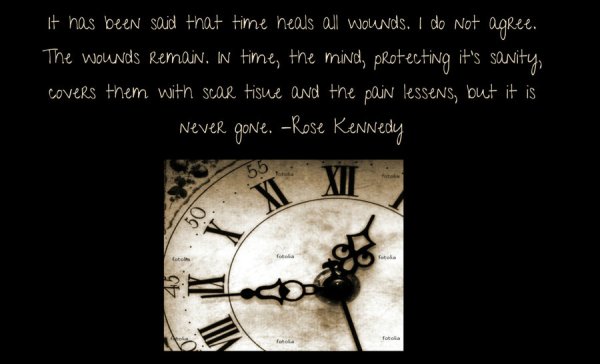
Time does heal but not in a way that most people think.  

Time shows you all the sides of grief. Time teaches you your limitations.  Time helps you to stuff the grief so you can function again.  Time shows you how to interact with a non-grieving world.

You don’t grieve any less, but your life gets easier.

it has been said that time heals all wounds rose kennedy clock

One other one not part is of the OP [overall process]-I had to come to grips with being happy.

For a long time I felt that experiencing the slightest sliver of joy was somehow being unfaithful to my daughter. I’m here to tell you that is a huge lie of grief. Just because you are experiencing good things does not mean you miss your child any less.

Being a martyr gets you no place good.”

~ Wes Lake, bereaved dad

grieving person is going to laugh again

Father’s Day 2026: The Silent Struggle of Fathers

I can’t pretend to understand exactly what it feels like to be a father who buries a child. I’ve only been able to watch from the outside as my husband absorbed the impact of that great wound.

But I can tell you this:  for dads, like moms, each holiday is another mile marker on the road of grief.

It is another poignant reminder that things are not as they were-they are not as they should be.  

father hurts too

Many men keep the hurt bottled up inside, don’t talk about it, don’t seek out fellow bereaved fathers, and don’t cry as much as their wives.

It is easy to forget and overlook the ongoing pain of child loss for fathers-especially when outward signs are few.  

But I promise you-that dad in the pew on Sunday-he’s hurting.

That man shaking hands and joking-he remembers.

He hasn’t forgotten that one of the special people that called him “Daddy” is no longer around to do it.

Tell him you remember too.

Speak his child’s name and share a special memory.

Acknowledge the pain.  Let him express his grief.  

And honor him as a father to ALL his children-those that walk the earth with him and those that don’t.  

good father unsung

Grief Work 2026: Some Choices Can Help My Heart Heal

I know that when I first stumbled onto a bereaved parent group, it was one of the things I was looking for: evidence that the overwhelming pain of child loss would not last forever.  

Some days I was encouraged as those who had traveled farther down this path posted comments affirming that they could feel something other than sorrow.

Some days I was devastated to read comments from parents who buried a child decades ago asserting that “it never gets better”.

Who is right?  

What’s the difference?

Do I have any control over whether or not this burden gets lighter?

It has been over twelve years since Dominic ran ahead to Heaven and I’ve learned a few things since then.

letting-go

Time, by itself, heals nothing.  But time, plus the work grief requires, brings a measure of healing.  
If I cling with both hands to my loss, I can’t take hold of the good things life still has in store for me.  

Longing for the past all the time only brings sorrow.  I cannot turn back time.  Days, weeks, years will keep coming whether or not I choose to participate in them.  I will rob my heart of potential joy by focusing exclusively on the sorrow I can’t undo.

Daily choices add up.  When I lean into the small things required each day, I build confidence that I can do the bigger things that might still frighten me.  Making phone calls eventually helps me show up to a meeting or to church.  I strengthen my “can do” muscle every time I use it.

Doubt doesn’t disappear. Facing my doubt forces me to explore the edges of my faith.  It does no good for me to stuff questions in a drawer and hope they go away.  They won’t.  I have to drag them into the light and examine them.  Doubt is not denial.  If God is God (and I believe that He is!) then my puny queries don’t diminish His glory.  He knows I’m made of dust and He invites me to bring my heart to Him-questions and all.

My mental diet matters more than I might think.  I have to be very careful what I feed my mind.  If I focus on sadness, tragic stories, hateful speech and media that feeds my fears and despair then those feelings grow stronger.  If instead I focus on hopeful stories, good conversation with faithful friends and inspiring quotes, verses and articles I feed the part of my heart that helps me hold onto hope.

I need a space where I can be completely honest about what this journey is like.  Bereaved parents’ groups have been that space for me and have been an important component of my healing.  But even there I must be cautious about how much time I spend reading other parents’ stories if I notice that I’m absorbing too much pain and not enough encouragement.

me too sharing the path

Grief is hard.  

It’s work. 

And that work is made up of dozens of daily choices that are also often difficult.  

I don’t expect to be healed and whole this side of eternity.  But I do know that if I consistently do the work grief requires I will be stronger, more whole and better able to lean into the life I have left than if I don’t.

I want to live. 

I want to honor my son by living a life that’s more than just limping along, barely making it, struggling for each step.  

So I do the work grief asks of me.  

Even when it’s hard.  

give yourself space to do the work grief requires

Grief Work 2026: Breaking Free From Shame

Shame is one of the most crippling aspects of child loss.

Depending on the circumstances surrounding your child’s last days on earth, it can be compounded by friends, family and even strangers who speculate, comment or simply give a parent “that look”.

It’s true that we all MAKE mistakes but none of us ARE mistakes.

Grief work is, in part, embracing this life we didn’t choose.

But it is also letting go of feelings, identities and burdens placed upon our broken hearts by ourselves and others.

Shame tells us we are unworthy of love and belonging and that is simply a lie.

Shame is a shackle as sure as any chains forged from iron.  

And it often finds its home in the hearts of those who bury a child.

Bereaved parents may feel shame for lots of reasons:

  • Circumstances surrounding the death of their child-suicide, alcohol, drug abuse;
  • Inability to provide the funeral or burial they want due to financial constraints;
  • Missing signs or symptoms of an illness that may have led to death;
  • Family dynamics that pushed a child away from home or relationship.

The list could be endless-on the other side of child loss our brains pick apart every interaction, every choice, every moment that could have gone one way but went another.

Grief is WORK.

But it is impossible to make my way through the pile of emotions if I’m shackled by shame.  I can’t move freely and effectively if I’m bound hand and foot by things I can’t control and can’t change.

In the midst of all this work, some bereaved parents find they are immobilized by depression and/or anxiety and need medication to help them through.

woman looking through rainiy window.jpg

And they feel ashamed.  

Can I just say this? 

There is NO shame in seeking help.

There is nothing shameful about using whatever tools are available to make this awful journey more manageable.

A wise and kind doctor friend said, “Medication does not make the sorrow and pain go away, but it can calm the mind and create space so you can do the work grief requires.”

You are not a failure if you need medical help to quiet your mind.  You are not weak if you take a pill to keep from feeling like you’re going to come out of your skin.  You have done nothing wrong if you can’t sleep and require a sleep aid to allow your body the rest it needs to carry on.

Don’t compare your journey to anyone else’s.

You are unique.  Your path through this heartache is your own.

Do what you need to- for YOU.  

Shake off the shame.  

grief-is-not-linear

Grief Work 2026: Letting Go of Offense

There are lots of opportunities for offense surrounding the death of a child.

Once your heart is broken open wide with great sorrow, there’s no defense against the bumps and bruises that are a natural product of human relationship and interaction.

  • Friends and family that didn’t show up.
  • Friends and family that showed up but said or did the wrong thing.
  • Friends and family that abandoned me as soon as the casket closed.
  • People that make me feel guilty for grieving or question my sanity or my “progress”.

But I’m learning to let go of offense.

Not only because it is too heavy to carry in addition to my grief, but because the Lord has commanded it.

I grew up reciting what’s commonly called, “The Lord’s Prayer” without much thought to the individual phrases or their meaning. It wasn’t until adulthood that I read it in context and continued on to the rest of the chapter.

What I found there was chilling.  

These are some of the hard words of Christ that most lay persons and many theologians prefer to gloss over.

“For if you forgive other people their failures, your Heavenly Father will also forgive you. But if you will not forgive other people, neither will your Heavenly Father forgive you your failures.”

~Jesus (Matthew 6:14-15 PHILLIPS)

WOW!  The plain reading of this text tells me that if I refuse to forgive others, I place myself outside the forgiveness of my Father.

It makes sense though-if my sins were borne by Christ on the cross, then so were yours.  

If His grace covers me, it covers you.  

If I want to be seen through the eyes of mercy, then I must be willing to look through those same eyes at my fellow man.

At first this feels like bondage instead of freedom.  

But the truth is, forgiveness is liberating.  

It sets me free to operate in the fullness of who I am in Christ.  It forces me to trust Him with my pain, with my sorrows, with my offenses and with balancing the scales of justice.

forgiveness-quote-charles-stanley

Forgiveness opens the path to relationship and community.  It testifies to the mercy and grace of God.  

It shines like a beacon of light in a dark world.  

It is the power of Christ in me.

To forgive another person from the heart is an act of liberation. We set that person free from the negative bonds that exist between us. We say, “I no longer hold your offense against you” But there is more. We also free ourselves from the burden of being the “offended one.” As long as we do not forgive those who have wounded us, we carry them with us or, worse, pull them as a heavy load. The great temptation is to cling in anger to our enemies and then define ourselves as being offended and wounded by them. Forgiveness, therefore, liberates not only the other but also ourselves. It is the way to the freedom of the children of God.

~Henri Nouwen

forgiveness_is_the_fragrance_that_the_violet_sheds_on_the_heel_that_has_crushed_it-385646

Grief Work 2026: Being Real When it Matters Most

I’ll be honest-there are definitely times when “faking it” is the easier path. Chatty neighbors, standing in line, professional meetings or chance encounters lend themselves to light conversations that don’t need to include ALL my feelings or current grief experience.

But there are other times when being real, honest and authentic is not only preferable, it’s necessary.

I cannot fake it forever.

It took me awhile to figure that out.

Child loss is hard. Child loss impacts a family forever. Child loss is not “curable” or “solvable” and it’s not helpful to pretend it is.

So for the relationships that matter, I try to be transparent.

❤ Melanie

There’s a common bit of advice in grief circles:  Fake it until you make it.

It’s not bad as far as it goes and can be pretty useful-especially just after the initial loss and activity surrounding it.

Like when I met the acquaintance in the grocery store a month after burying Dominic and she grabbed me with a giant smile on her face, “How ARE you?!!! It’s SO good to see you out!!!”

I just smiled and stood there as if I appreciated her interest, a deer caught in headlights, silently praying she’d live up to her talkative past and soon move on to another target.

Faked it.

Boom!

BUT there comes a time when faking it is not helpful.  In fact, it’s downright dangerous.

Because if I fake it long enough and get good enough at it, I can convince myself that I have done the work grief requires.

Grief will not be ignored forever.

It bubbles up in physical symptoms and sleepless nights. It boils over in anger and impatience and anxiety and nervous habits.

There is no way through but through.  It has to be faced head on.

Life circumstances kept me distracted and busy for the first four or five months after Dominic ran ahead to heaven.

IMG_1790

I cried, screamed and was heartbroken-I definitely had my moments. But for the most part I functioned at a pretty high level.

It wasn’t until things slowed down that I had my come apart. And it caught me by surprise.

I was forced to sit in silence and face the feelings.  I was compelled to hear my heart shatter-over and over again.

I’ve now had 33 months of this burden of sorrow.  Almost three years to think about, work on and pray through the pain.  

I’m learning to pay attention to my own heartbeat, to my body, to my triggers, to my joy-bringers, my joy-stealers and my limitations.  I’m beginning to accept the bellycrawl progress through this tunnel of darkness by focusing on the bright light at the end.  

I still fake it sometimes-it’s not worth it to me to get into a long conversation with that person I only see every year or so.  Too much time, too much energy and too little reward.

But I’m learning to be more genuine with the people that matter most.  I’m learning to be honest about how I feel, what I need and how much I can do.

And I refuse to allow busyness to creep up on me so that I don’t have the time and energy to continue doing the work grief requires.  

not-required-set-yourself-on-fire-life-daily-quotes-sayings-pictures

Grief Work 2026: God’s Power to Endure

A little review: Trying to stuff or hide my pain from myself, God and others is fruitless and unhelpful.

I’ve got to breathe out the sorrow, doubts, angst and disappointment to make room for the life-giving breath of Truth and the Holy Spirit.

And then I need to do one more thing. I must appropriate the strength and courage of my Savior-the Author and Finisher of my faith.

It is possible to endure. It is possible to finish well. It is possible to hold onto hope and follow the Light and Love of Jesus through this Valley.

❤ Melanie

My friend and fellow bereaved mom, Margaret Franklin, Ryan’s mom, shared a beautiful Dutch word with me “Sterkte” (pronounced STAIRK-tah).

It literally translates “strength” or “power” but culturally means much more.  It means bravery, strength, fortitude and endurance in the face of fear and insumountable odds through the empowering strength of God in me.

Not MY strength, but HIS.

It’s the strength Isaiah meant when he wrote:

But they that wait upon the Lord shall renew their strength; they shall mount up with wings as eagles; they shall run, and not be weary; and they shall walk, and not faint.

Isaiah 40:31 KJV

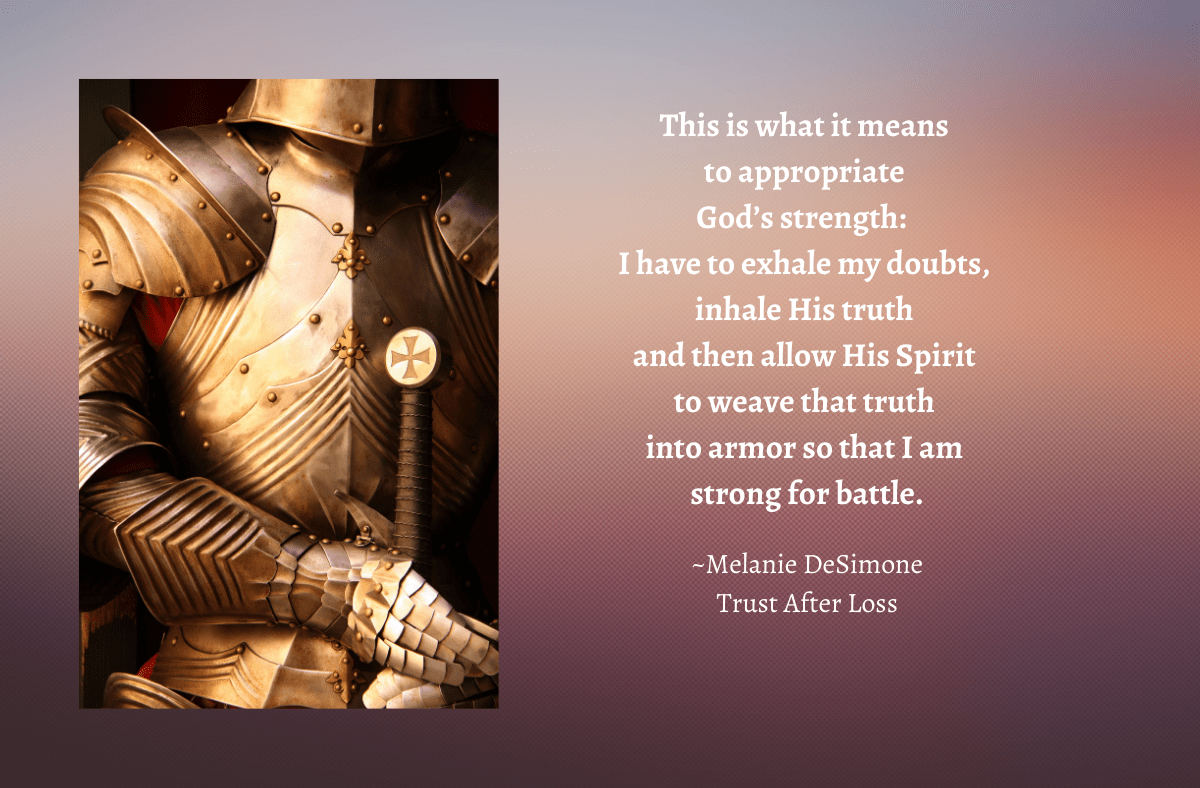
This is what it means to appropriate God’s strength:  

I have to exhale my doubts, inhale His truth and then allow His Spirit to weave that truth into armor so that I am strong for battle.

armor-of-god

There were twelve spies that scouted out the Promised Land.

All twelve had experienced the parting of the Red Sea, all twelve had seen the pillar of fire by night and cloud by day,  all twelve saw God conquer the Egyptians.  But ten of them never allowed that experience to go further than head knowledge.

Only Caleb and Joshua embraced that truth and allowed God to use it to change their hearts.  Those two were willing to fight the giants because they knew it would be God fighting for them and through them and they did not have to depend on their own strength for victory.

That’s what “sterkte” is-it’s inviting God’s power to dwell inside me so that I am strong for battle in HIS strength.   It’s letting His Spirit speak courage to my heart so I have the endurance to live this life NONE of us chose.

In my own strength I am doomed.  In His strength I am guaranteed enduring to the end.

When I was searching for a verse to help explain sterkte-because it is such a lovely and succinct expression of how hearts can and do endure this awful pain, the dark nights of doubt and yet remain strong in this journey-I found it in Habakkuk.

It’s a tiny book tucked into the back of the Old Testament and begins with the prophet asking God questions:

“Do You know what Your priests and leaders are doing?  Are You going to DO something?”

And God says, “Yep.  Going to use the Babylonians to wipe them out.”

Habakkuk answers, “THAT’S Your plan???”

God responds, “Yes-but see, I’m going to be sending a Messiah to make all this right.  I’m doing something you can’t understand.  I’m working my plan for history and eternity.”

Habakkuk ends his book with these verses:

16 I heard and my [whole inner self] trembled; my lips quivered at the sound. Rottenness enters into my bones and under me [down to my feet]; I tremble. I will wait quietly for the day of trouble and distress when there shall come up against [my] people him who is about to invade and oppress them.

17 Though the fig tree does not blossom and there is no fruit on the vines, [though] the product of the olive fails and the fields yield no food, though the flock is cut off from the fold and there are no cattle in the stalls,

18 Yet I will rejoice in the Lord; I will exult in the [victorious] God of my salvation!

19 The Lord God is my Strength, my personal bravery, and my invincible army; He makes my feet like hinds’ feet and will make me to walk [not to stand still in terror, but to walk] and make [spiritual] progress upon my high places [of trouble, suffering, or responsibility]!

Habakkuk 3:16-19

Nothing changed!

Bad stuff was coming!

But Habakkuk appropriated God’s strength for himself and knew that would be enough to see him through. 

He was broken but trusting.

god uses broken things

There is no shame in being broken.

Here’s the deal:  God loves the broken.  Christ came for the broken.  It’s the broken and breathless who long for the Spirit to blow llife across their wounded hearts.

It’s the hopeless and fearful that run faster to the safety of their Shepherd.

It’s the worried and weary who are thankful for a Burden-bearer.

Hallelu-Yah!

This is NOT a once and done kind of thing- I m here to testify that it is most certainly NOT.  I am assaulted repeatedly by pain and doubt.  I circle back around and revisit places I thought had healed over and over and over.  A sound, a sight or a memory can bring me back to Day One in a heartbeat.

So what does faith really look like?

Is it always a never-ending, wild “Hallalujah!”?

I don’t think so.

I think faith is essentially this:  turning my face toward the God I love even when (especially when!) I’ve stopped expecting an answer and maybe even when my heart has despaired of help.

I would argue that faith is precisely that step forward into the dark unknown, onto the broken road, lifting the unbearable heaviness as an offering and trusting that

God sees,

that He hears

and that He will not abandon me.

Each time I doubt I am quicker to acknowledge the pain and admit my doubt– I take my questions to God.  My mind is more likely to access TRUTH and my heart is more inclined to appropriate God’s strength, my personal bravery, my invincible army.

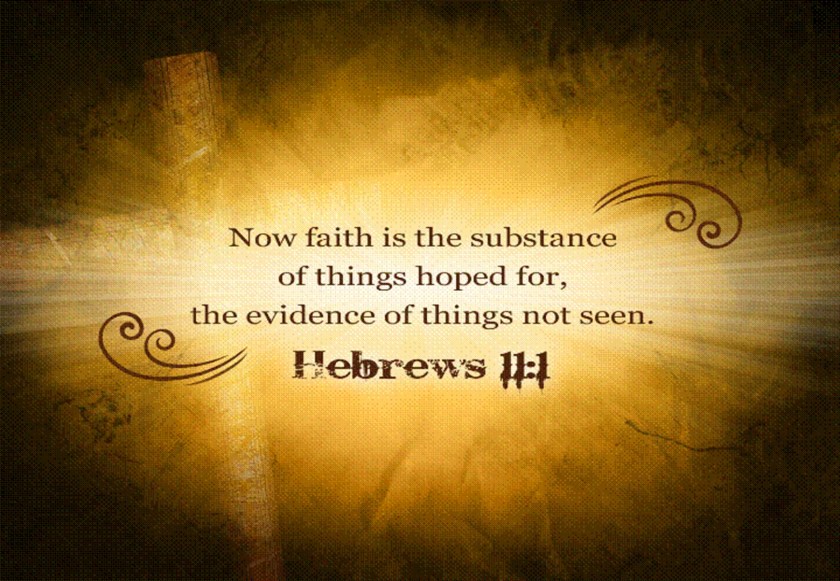
hebrews-11_1.jpg

I used to think that Hebrews 11:1 was essentially a personal verse-my faith confirmed to ME that God was working.  But now I see it in a different light.  I think it is a corporate verse leading my heart to emulate lives that exemplified enduring faith-that “great cloud of witnesses” cheering us on from Heaven.

I did not choose this life but it is the one I’ve been given.  My prayer in this Valley for myself and all of us who are broken is this:

“God to mold me and make me into the masterpiece You designed me to be as a testimony to the fact that You are who You say You are.”

I long for my faith to be evidence to a doubting world that there is MORE than the eye can see.  I want my endurance to be an invitation for others to join me in pursuing what lasts for eternity and not just for this short mortal life.

Full redemption will have to wait for Heaven, but God is working even now to bring some redemption from my pain. 

He [Christ] said not, ‘Thou shalt not be tempested, thou shalt not be trevailed, thou shalt not be dis-eased,’ but He said, ‘Thou shalt not be overcome.’

Julian of Norwich

courage and perseverance

Grief Work 2026: Finding Hope in Truth

Have you ever walked away from a conversation and thought, “My goodness! I talked WAY too much”?

I have.

I can become so wrapped up in sharing my own experience, spilling my own feelings, trying to communicate my own point of view that I don’t leave space for the other person to get a word in edgewise.

Sometimes I do the same thing when talking to God-I can’t stop chattering long enough to hear what He wants to speak into my pain.

When I choose to listen, He is faithful to remind me of truth. He is faithful to lead me to the green pastures of His word where I can feast on His promises and be filled with hope.

❤ Melanie

“I wake before the morning light.  Every. single. morning.

I get my coffee, sit in my chair and wait for sunrise.

I never worry that today it might not happen.

I’m never concerned that after all these years of faithfulness, this day may be the one where daylight fails to make an appearance.

There is no fear in this darkness because I know it will not last forever.

Morning is coming.

Morning. Is. Coming.

And that’s the hope I cling to in this longer darkness of the Valley of the Shadow of Death-no matter how many years it may be, the Valley has an end.

The same God Who keeps the earth in orbit around the sun has ordained that death will not have the last word.

Light will triumph.

Darkness will have to flee.”

From Morning Is Coming

sunrise trees

I have loved Scripture as long as I can remember.  When I was in second grade I got the notion to read the whole Bible straight through-in the King James Version.  I made it to Leviticus before I threw in the towel.

By the time my kids were grown I had read and studied Scripture for decades. 

But three years before Dominic ran ahead to Heaven I realized my reading had become rote-I felt like I “knew” all the stories.  So I slowed my study to a crawl-only one chapter a day-and I usually copied the whole chapter plus my notes into a journal.  I had just finished this time through the Bible in January before Dom was killed in April.

And all that truth stored in my mind and heart was what I “read” for months when my eyes were too full of tears to see print on a page.

Many verses stung-some still do-but I was committed to bathe my broken heart in what I knew was true.  I would take it like medicine, even when it tasted awful.  I knew-in the end-it was my only hope for help.

It’s easy when doubt creeps in to let my heart hold onto it-even in the face of Truth that puts the doubt to rest.

But if all I do is question, question, question and never still my soul to receive God’s answers or His comfort, then I will simply run out of oxygen and faith.  I will lay prostrate with the enemy’s foot on my neck.

I will lose all hope and give up and give in.

I let my feelings, questions and doubts OUT, but I also choose to take the Word of God IN.

And when I can’t do anything else, I recite and cling to the names of God:

Jehovah-Roi-the God Who Sees Me.  This is the name Hagar gave God in the desert.  He didn’t change her circumstances but He assured her that she was seen, not overlooked and not abandoned.

Jehovah-Nissi–the LORD my Banner.  God is the One I look to in the battle.  He will not always save me from the fight, but He has guaranteed the victory.

Jehovah-Shalom-The LORD my Peace.  Jesus is Sar Shalom-the Prince of Peace Who promises Himself to every heart that will turn in faith to Him.  This peace is inner certainty that He is Lord over all, even when the evidence I can see is telling me that’s not true.

THE NAME OF THE LORD IS A MIGHTY TOWER.  THE RIGHTEOUS RUN TO IT AND ARE SAVED.

I leaned hard on the Word stored in my heart. I was too broken (and some days still am too broken) to open my Bible.

God had prepared David for years as a shepherd to lean hard on Him.  David’s Psalms don’t end with “Where are You, God?” they progress to a recitation of the character of the LORD, to an enumeration of His past faithfulness, to a true understanding that sometimes there’s NO understanding what He is doing.

And David leaned in, hung on and recited truth to his heart even when his head couldn’t figure out how what he was experiencing squared with what he knew to be true.

The whole book of Job is full of questions but it is also contains Job’s declaration he was firmly convinced that “as for me, I know that my Redeemer lives, and He will stand upon the earth at last.”  (Job 19:25)

hallelujah1

“You can’t hold your breath forever.

But when you first learn your child is dead you want to–oh, how you want to.

I don’t know if it was defiance or hope that made me certain that if I could just stop breathing, I could freeze time.

I could undo the truth.

I could stop the creeping terror that seized my heart.

But it was impossible.  My body insisted that my lungs release the poison of carbon dioxide and refresh my oxygen supply.

There is a spiritual counterpart to the physical desire to stop breathing. 

Most bereaved parents will tell you that at some point in their grief journey, whether they would describe themselves as “believers” or not, they have had to examine their notion of God.

They have to ask, “How am I to relate to this Person that controls the Universe–this Being that could have saved my child–but chose not to?”

I am a Christ follower.  I believe in Jesus and I trust His Word.

But I will honestly confess that burying my child has made me reexamine just what that means and just Who He is.

Before my son was killed, I gave mental assent to the idea that “God is in control” but wasn’t forced to reconcile His control with my heart’s desire to guarantee my family’s safety.

But His existence, and His character does not depend on my understanding.  And to be frank, a God I can comprehend wouldn’t be much of a God at all.

I could not will my body not to stop breathing.

And what I am learning in this grief journey is that I can’t hold my spiritual breath forever either.

The poison of doubt and the insistence that I be able to comprehend the fullness of God will suffocate my soul as surely as lack of oxygen will stop my heart.

So, “Hallelujah” is my exhale.

It is my letting go-my drawing in again the life-giving truth that God is God and I am not.

And acknowledging that while I cannot understand His ways, I can choose to trust His Father love.” 

From Hallelujah is an Exhale

There is no easy answer for why children die-no sweet saying that can wash away the pain and the sorrow and the regret of burying your son.

But I know this:  If my healing depends on me, I am lost.

If the God of heaven is not the god of all, then I have no hope.

If Jesus didn’t really come, and die and rise again,  I have nothing to look forward to. 

Ann Lamott recounts this tale in her book, Plan B:  Further Thoughts on Faith:

There is a lovely Hasidic story of a rabbi who alwasy told his people that if they studied the Torah, it would put Scripture on their hearts.  One of them asked, “Why on our hearts, and not in them?”  The rabbi answered, “Only God can put Scripture inside.  But reading sacred text can put it on your heart, and then when your hearts break, the holy words fall inside.”

My heart is already broken-burying my son did that. 

Now I’m waiting

and trusting

that the holy words will fall inside.  

band-aid-and-heart