Coping with Child Loss: Why Silence Hurts

At first everyone talked about him.

It’s what people do just after a person leaves this world and leaves behind only memories.

It comes natural before the unnatural fact of child loss settles in and begins to make everyone uncomfortable.

But at some point after the funeral and way before the tears dried up, people stopped feeling easy mentioning his name.

Read the rest here: Help! My Family Won’t Talk About My Missing Child.

Grief Work 2025: Forgiving Others

There are lots of opportunities for offense surrounding the death of a child.

Once your heart is broken open wide with great sorrow, there’s no defense against the bumps and bruises that are a natural product of human relationship and interaction.

  • Friends and family that didn’t show up.
  • Friends and family that showed up but said or did the wrong thing.
  • Friends and family that abandoned me as soon as the casket closed.
  • People that make me feel guilty for grieving or question my sanity or my “progress”.

But I’m learning to let go of offense.

Not only because it is too heavy to carry in addition to my grief, but because the Lord has commanded it.

❤ Melanie

I grew up reciting what’s commonly called, “The Lord’s Prayer” without much thought to the individual phrases or their meaning. It wasn’t until adulthood that I read it in context and continued on to the rest of the chapter.

What I found there was chilling.  

These are some of the hard words of Christ that most lay persons and many theologians prefer to gloss over.

“For if you forgive other people their failures, your Heavenly Father will also forgive you. But if you will not forgive other people, neither will your Heavenly Father forgive you your failures.”

~Jesus (Matthew 6:14-15 PHILLIPS)

WOW!  The plain reading of this text tells me that if I refuse to forgive othersI place myself outside the forgiveness of my Father.

It makes sense though-if my sins were borne by Christ on the cross, then so were yours.  

If His grace covers me, it covers you.  

If I want to be seen through the eyes of mercy, then I must be willing to look through those same eyes at my fellow man.

At first this feels like bondage instead of freedom.  

But the truth is, forgiveness is liberating.  

It sets me free to operate in the fullness of who I am in Christ.  It forces me to trust Him with my pain, with my sorrows, with my offenses and with balancing the scales of justice.

forgiveness-quote-charles-stanley

Forgiveness opens the path to relationship and community.  It testifies to the mercy and grace of God.  

It shines like a beacon of light in a dark world.  

It is the power of Christ in me.

To forgive another person from the heart is an act of liberation. We set that person free from the negative bonds that exist between us. We say, “I no longer hold your offense against you” But there is more. We also free ourselves from the burden of being the “offended one.” As long as we do not forgive those who have wounded us, we carry them with us or, worse, pull them as a heavy load. The great temptation is to cling in anger to our enemies and then define ourselves as being offended and wounded by them. Forgiveness, therefore, liberates not only the other but also ourselves. It is the way to the freedom of the children of God.

~Henri Nouwen

forgiveness_is_the_fragrance_that_the_violet_sheds_on_the_heel_that_has_crushed_it-385646

So, What Exactly IS Forgiveness?

Recently someone asked me for my definition of forgiveness.

It caught me off guard.

She had been sharing details of a very painful situation with someone who is clearly intent on making her life difficult “just because”.

I had to think about it.

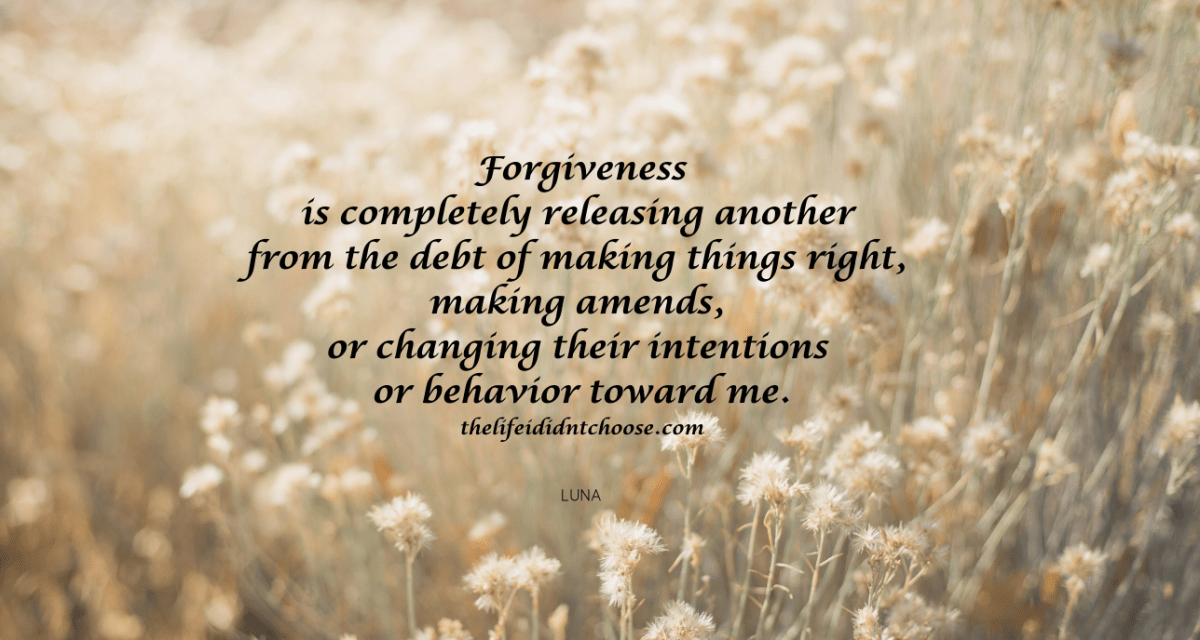
After a few seconds I told her that at its most basic level, I thought forgiveness was completely releasing another from the debt of making things right, making amends or changing in their intentions or behavior toward me.

And then I realized it was precisely what I thought even though I’d never framed it exactly like that before.

I’ve sat with my words for a several days now and I have a few more thoughts.

My definition may lack precision in terms of theology but it is absolutely congruent with lived experience.

It bridges the gap I (and many others) feel between what feels like real forgiveness (releasing the debt) and also still not trusting a particular individual enough to allow them in my life.


I can’t imagine a single soul walking in this world for very long without having at least someone wound them deeply. And it’s no good just trying to ignore the pain or paper it over or distract yourself from it. I eventually find it gnaws a hole in my heart.

When that happens, it’s necessary (for my own mental, emotional and spiritual health) to face it and deal with it.

That’s when the choice to forgive can release the energy that will otherwise be expressed in bitterness or anger or sarcasm or avoidance or unfulfilling and often harmful choices.

If I forgive-release another from the debt of making things right or making amends or changing in their intentions or behavior toward me-then I am no longer held hostage to what they do or don’t do, say or don’t say.

It is real and freeing.

Doing that, I can more accurately evaluate whether the individual is a safe one whom I can allow back into my life:

  • Is their behavior consistent?
  • Are their intentions good and loving or hurtful and mean?
  • Can I trust them?

You do not have to allow them back in if they are not worthy of that privilege.

So, so many bereaved parents have been wounded in so, so many ways.

Sometimes by those they love. Sometimes by strangers who contributed to the death of their child. Sometimes by others who have made it difficult or impossible to do the work grief requires.


Those that inflict the wounds may be repentant or they may not.


That’s outside our control.

But we all have the opportunity to make the choice to release the debt and free ourselves of the ongoing burden of caring whether they are sorry or not.

And that is work well done.


Grief Work 2024: Forgiving Others

There are lots of opportunities for offense surrounding the death of a child.

Once your heart is broken open wide with great sorrow, there’s no defense against the bumps and bruises that are a natural product of human relationship and interaction.

  • Friends and family that didn’t show up.
  • Friends and family that showed up but said or did the wrong thing.
  • Friends and family that abandoned me as soon as the casket closed.
  • People that make me feel guilty for grieving or question my sanity or my “progress”.

But I’m learning to let go of offense.

Not only because it is too heavy to carry in addition to my grief, but because the Lord has commanded it.

❤ Melanie

I grew up reciting what’s commonly called, “The Lord’s Prayer” without much thought to the individual phrases or their meaning. It wasn’t until adulthood that I read it in context and continued on to the rest of the chapter.

Read the rest here: Forgive Us Our Trespasses, As We Forgive Those Who Trespass Against Us

There Is NO Shame in Being Human

If you, like me, have had a less-than-stellar recent record dealing with those you love, those you meet and those you pass on the street or in your car, accept this truth:

You are absolutely, positively NOT perfect.

And that’s OK.

Read the rest here: No Shame In Being Human

Grief Work: Forgiving Others

There are lots of opportunities for offense surrounding the death of a child.

Once your heart is broken open wide with great sorrow, there’s no defense against the bumps and bruises that are a natural product of human relationship and interaction.

  • Friends and family that didn’t show up.
  • Friends and family that showed up but said or did the wrong thing.
  • Friends and family that abandoned me as soon as the casket closed.
  • People that make me feel guilty for grieving or question my sanity or my “progress”.

But I’m learning to let go of offense.

Not only because it is too heavy to carry in addition to my grief, but because the Lord has commanded it.

I grew up reciting what’s commonly called, “The Lord’s Prayer” without much thought to the individual phrases or their meaning. It wasn’t until adulthood that I read it in context and continued on to the rest of the chapter.

Read the rest here: Forgive Us Our Trespasses, As We Forgive Those Who Trespass Against Us

Healthy Boundaries and Forgiveness

I do not believe that in offering genuine forgiveness I am required to again submit myself to another person’s hurtful or sinful behavior.  

I do believe that forgiveness releases that person from past offenses against me but it does not release them to continue to wound my heart.

And I will stand up any time, anywhere and defend my. right to create healthy boundaries between my heart and someone who has proven, time and again, that they intend to do just that.

Read the rest here: Forgiveness and Healthy Boundaries

Lenten Reflections: Refusing Shame-Christ Died For This

If you’ve ever woken in the night only to have every thing you’ve left undone or done poorly or done selfishly line up like pointing fingers across your eyelids then you know the power of shame.

If you, like me, have buried a child, you know the long hours between when you hear the news and can once again touch the earthly shell of your loved one drag on and are fertile ground for what ifs, should haves and could haves.

Shame is a powerful emotion. It declares me unworthy of love, affection and even consideration.

Shame is undoubtedly what drove Peter back to his old fishing habits having denied the Master he swore to love unto death.

And shame can keep me prisoner behind walls of self-protection that aren’t really effective at all.

But I don’t have to accept those feelings, I don’t have to listen to those voices and I don’t have to live behind a stone rolled in front of my past.

Christ died for this…He not only bore my sin but also my shame. He not only died to bear my punishment, He rose to declare the debt has been paid in full!

Jesus did not merely dust me off and iron out a few of the more stubborn wrinkles in my life. He saved me because I was in desperate need of saving. I am alive only because He lives.

Alicia Britt Chole

When the women went to the tomb only to find the stone rolled away and an angel declaring the Good News, their lives were changed in an instant. There was no longer any need to live in the despair of death and fear.

And when I receive the new life God offers me in Christ, I am changed in precisely the same way. It certainly isn’t as earth shattering (literally-there was an earthquake!) nor as dramatic (no angelic visitor here) but it is just as real.

The women didn’t feel like they needed to keep visiting that tomb repeatedly to prove to themselves Jesus had risen. It was fact and they lived in light of what they knew to be true from that moment forward.

I don’t need to keep revisiting my dead sins and past mistakes either.

Jesus has carried them away.

I am free to live in the resurrected life I share with Him.

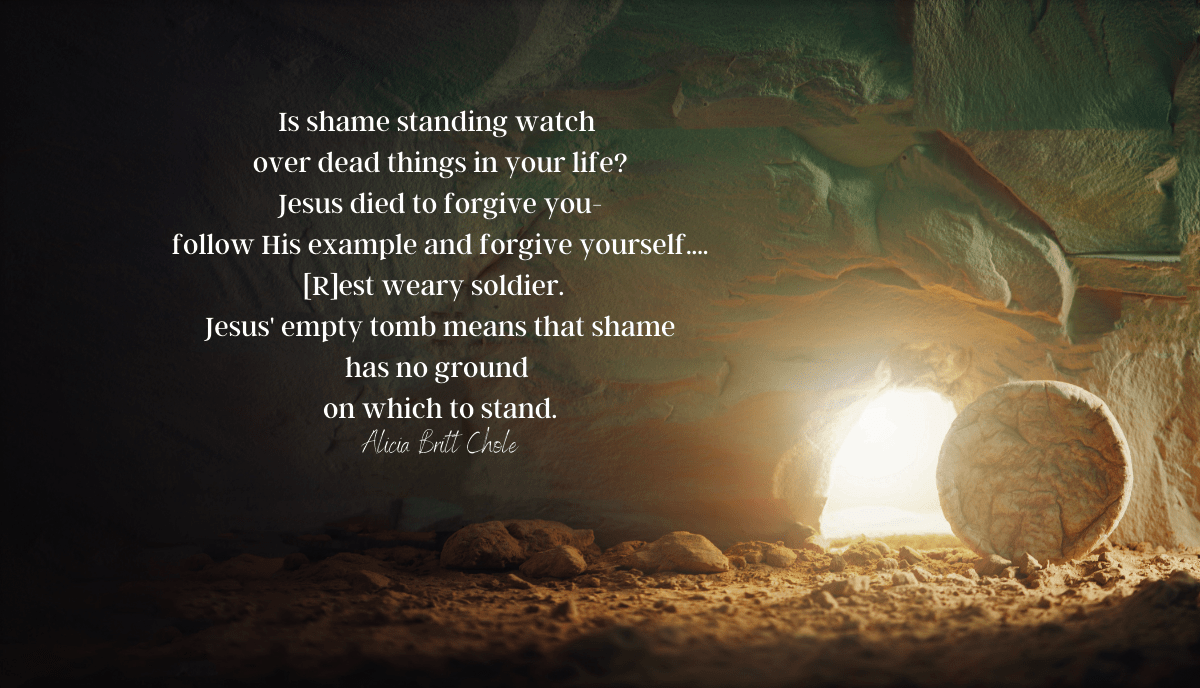
Is shame standing watch over any dead things in your life? Jesus died to forgive you-follow His example and forgive yourself. Fast guarding that tomb. Let an earthquake or an angel roll away the stone so that you can see that nothing is there anymore. It is empty. Jesus conquered it. Jesus removed it. All that is there now is light and hope.

Alicia Britt Chole

Lenten Reflections: Letting Go of Bitterness, Embracing Servanthood

I’ll be honest-it’s not that often that after three plus decades of in-depth Bible study that I hear or read a unique insight into familiar passages.

But today’s devotion and reflection helped me think of Jesus’ service to His disciples in a new way.

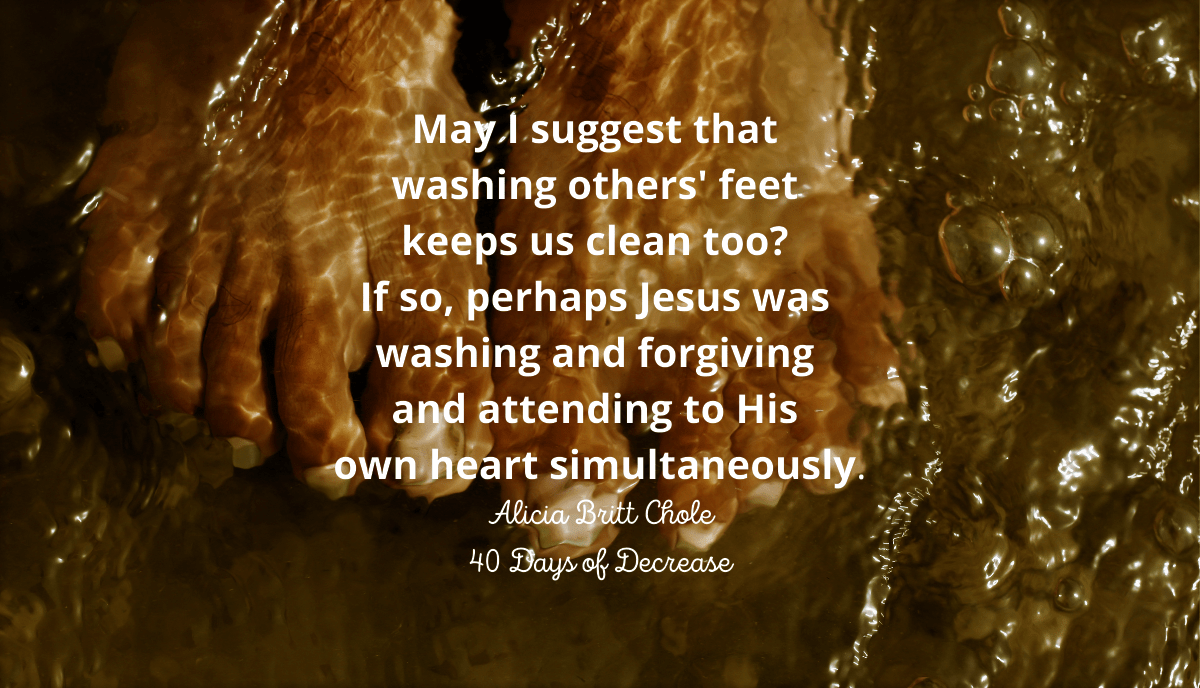
Jesus washed the feet of a betrayer, a denier, and ten deserters….Think of someone who has betrayed you, denied your love, or run away in your time of need. What would it take, what would it mean, for you to wash their feet?

Alicia Britt Chole

Chole’s words made me think back to moments where I’ve made an intentional choice to serve someone who had wounded or disappointed me.

Inevitably, loving action led to loving feelings.

One of the things that has become abundantly evident to me in the years since Dominic ran ahead to Heaven is this: carrying unforgiveness and bitterness is simply too hard a task.

If Jesus could (and did!) forgive His betrayer, His disciples for abandoning Him and even those who ultimately crucified Him, then I can (and should!) forgive those who have disappointed, abandoned or somehow been “less than” I needed them to be.

So for today, let’s fast “Armchair Jesus”-the Jesus who is all God and not very human. Jesus felt it all.

He experienced it all.

And He is more than capable and willing to strengthen me to stand up under any temptation, assault of the evil one or tendency of my flesh.

**As promised, I am sharing thoughts on 40 DAYS OF DECREASE (a Lenten journal/devotional). If you choose to get and use the book yourself, I’ll be a day behind in sharing so as not to influence anyone else’s experience.**

Today Is The Second Best Time to Make Amends (or Plant a Tree).

Life is really rather unforgiving, isn’t it?

I can only live forward and there are no do-overs.

No amount of regret can roll back the clock and give me another chance to do it right, do it better or just do it at all.

Read the rest here: The Best Time To Plant A Tree