Christmas 2025: So…How ARE You Doing?

Sometimes it’s hard to gauge effectively and objectively how I’m really doing.

Living inside my own head often obscures tell-tale signs that maybe I’m not coping as well as I think I am.

So I depend on feedback from friends and family as an early warning safety system.

But many of us are physically isolated from others who might otherwise help us discern when we need help. A heart can fall fast into a deep pit of despair without realizing it.

A friend recently shared this infographic and I love it!

It’s an objective (though not exhaustive!) checklist anyone can use to determine if they are slipping into unhealthy or potentially harmful behaviors, attitudes and thought patterns.

I wanted to share it with my fellow broken-hearted sojourners as a tool.

Please be honest with yourself even if you can’t be honest with others.

And if you find that you are closer to the red than the green, let me (or SOMEONE) know!

You may be isolated but you are NOT alone!

Reach out.

You are irreplaceable

You are irreplaceable – Freed to Fly

Grief Work 2025: Self-Care Is Necessary

My first instinct as a mother and a shepherd is always, “How can I help?”

I routinely set aside my own needs for the needs of others.  Not because I’m so selfless but because that’s how I’m made-I’ve always had the heart of a caretaker.

That’s not a bad thing, most of the time.

But if taking care of others means NOT taking care of myself, then in the end, I’m of no use to anyone.  When I allow every bit of energy-emotional, physical, psychological and spiritual-to drain away until there’s nothing left, I am unable to meet my most basic needs, much less the needs of others.

I’ve written before that grief puts a hole in my bucket It guarantees that no matter how much is poured in, I’m never truly full.

I’ve also written about setting boundaries and trying to preserve margin as I walk this Valley.  I have to create space between me and the people around me if I’m going to make it through.

But there are some other steps I can take to help ensure my heart is strong enough for the journey.  It’s not always about what I don’t do.

Sometimes it’s about what I choose TO do.

Here are some ideas for self-care in grief (or really ANY hard place in life):

  • Be patient with yourself.  There is no time frame for grief.  Each heart is unique.  Extend grace to yourself, just as you would to a friend.  Try not to take on extra responsibilities.  It’s better to allow for some flexibility in obligations during this time (even around holidays!).
  • Listen to your body and your heart: If you need to cry, then cry. If you need to sleep, then do so. If you need to talk to someone, seek out someone who will listen. If you need to reminisce, then take the time. It is important for the grieving process that you go with the flow.
  • Lower expectations for yourself and communicate this new reality to others. You are not able to operate as you did before loss.  Your capacity for interacting with others, managing tasks and being available for the needs of others has been dramatically altered.  Own up to it, and let others know that it will be some time before you can shoulder the responsibilties you once did.
  • Let others know what you need from them.  No one is a mind reader.  While we who are bereaved think our needs are obvious, it’s simply not the case.  Communicate to family and friends how they can support you.
  • Accept the help of others. Understand that grief is hard work. It requires a great deal of energy and can be exhausting. Even though we place a high value on self-sufficiency, it is important to ask for, and accept, help from those close to you. Others careand genuinely want to be of assistance, but usually do not know what to specifically offer. In particular, it is vital to know who will listen and be supportive. Sharing your story out loud is one key to healing. And, remember that professional guidance is also available
  • If you need counseling, get it!  There is NO shame in asking for help. Get all the support you need. There are many bereavement support groups as well as counselors or spiritual advisors who specialize in bereavement counseling. Don’t hesitate to contact a medical and or mental health specialist if you have feelings of hopelessness or suicidal thoughts.
  • Accept your feelings. Feelings are neither right nor wrong, they just are. Sadness, loneliness, fear, confusion, anger—these are among the many feelings you may experience, and are completely normal. Emotions are often raw early in the grief process, but it is important to express them. Attempting to stifle feelings usually leads to an emotional outburst at an inconvenient time.
  • Face your feelings. The painful emotions associated with grief are a natural and normal response to loss. You can try and suppress them or hide from them all you want but in the end this will only prolong the grieving process. Acknowledging your pain and taking responsibility for your feelings will help you avoid the complications often associated with unresolved grief such as depression, anxiety, substance abuse, and health problems.
  • Express your feelings. The most effective way to do this is through some tangible or creative expression of your emotions such as journalling, writing a letter expressing your apologies, forgiveness and the significant emotional statements you wish you had said, or art projects celebrating the person’s life or what you lost.
  • Keep a journal.  Writing down your thoughts and feelings can help you to validate and work through your grief.
  • Feel whatever you feel. It’s okay to be angry, to yell at God, to cry or not to cry. It’s also okay to laugh, to find moments of joy, or to let go when you’re ready. Your grief is your own and no one can tell you when you should be “over it” or when to “move on.”
  • Pay attention to physical needs. It’s easy to ignore your health when all you want to do is give up and give in.  However, it is even more important NOW to take care of yourself.  Eat balanced meals (set an alarm if you have to), try to get adequate rest (get medication if you need to) and make sure to get in some physical activity every day (set a timer if necessary).
  • Get physical exercise.  If you exercised prior to your loss, try to maintain the same routine. If you did not exercise prior to your loss visit your doctor before embarking on a physical exercise routine. Physical exercise can improve the way you feel.
  • Eat right and get enough sleep.  Maintaining a healthy diet and getting proper sleep is essential for functioning as well as you can. If you are having difficulty with either, visit your doctor.
  • Be aware of short-term relievers – these can be food, alcohol/drugs, anger, exercise, TV, movies, books, isolation, sex, shopping, workaholism, etc. Most of these things are not harmful in moderation but when used to cover-up, hide or suppress our grief they get in the way of the work grief requires.
  • Take the time to do the things you need to do for yourself.  When you feel up to it, engage in activities to which you feel drawn. It could be visiting a place you haven’t been to in a while, walks in nature, reading, etc.
  • Pamper yourself. Treat yourself well. Do things for yourself that are helpful like walks, being with people who are nurturing to you, and inexpensive activities

Grief is a lifelong process-a marathon, not a sprint.  

Maintaining space to do the work grief requires and engaging in activities and health habits that help me do that work is the only way to endure.  

physical mental well being

Grief Work 2025: How Stress Impacts Grief

It would be so helpful if there was an app to track stress like there is to track spending.

Wouldn’t it be marvelous to get an alert that said, “Low Balance”, for mental, physical and psychological reserves like the one you can get for your bank account right before you are heading to overdraft territory?

But there isn’t.

And few of us are very good at gauging just how much is left in our mental wellness accounts which means we often keep giving when the well is more than dry.

I’d be lying if I said I spend the same amount of time crying, lamenting and bent over in agonizing pain that I did in the early days of mourning Dominic. I’ve found a way to keep him close, to trust his soul to Jesus and to (largely) live in the present instead of always longing for the past.

There are days, though…

Some days are easy to anticipate-birthdays, holidays, the awful anniversary of his leaving-and some sneak up on me. I can often trace my overwhelming sadness to a specific trigger or memory dug up in a drawer or found in a pile of photos.

Occasionally, I have a horrible weepy day for no discernable reason.

That’s when I walk my heart back through recent events and always come to the same conclusion-I’ve let myself run dry:

  • I’ve overcommitted.
  • I’ve not planned rest.
  • I’ve had hard pain days.
  • There’s been family drama.
  • Someone I love is sick.
  • I’m sick.
  • A deadline looms large.
  • There’s some major unpredictability going on.
  • I’ve counseled too many people without enough time to regain my own emotional stores.
  • I’m not sleeping well.
  • I’m doing too much and not listening to my body.

What I’ve come to understand is that stress is a HUGE impact on my grief and how I experience it.

I won’t patronize folks reading this with a simplistic (but wholly unhelpful!) suggestion to “reduce or avoid stress”.

For heaven’s sake! If we could do that with a snap of our fingers we would hardly need someone to tell us to take advantage of that solution.

Truth is, stress is often largely outside our control.

But there ARE some things I can make choices about. So I do. I look ahead at the calendar and note upcoming milestone days. I plug in doctor’s appointments, birthdays and holidays. I review every invitation to celebrations or lunch in light of what is already inked in.

I’ve learned to be honest with folks about my limitations and send a card or gift through the mail if I can’t be there in person. I sometimes suggest an alternative date and time if the one a friend offers just doesn’t work for me. I stand firm in my opinion that “no” is a complete sentence and as long as I’m kind and gracious it is not incumbent upon me to offer an explanation for why I’m turning down an invitation.

And if I have an unexpectedly hard day-from grief or activity or because of my RA-I drop back the next day to allow time to recuperate and rest (if at all possible).

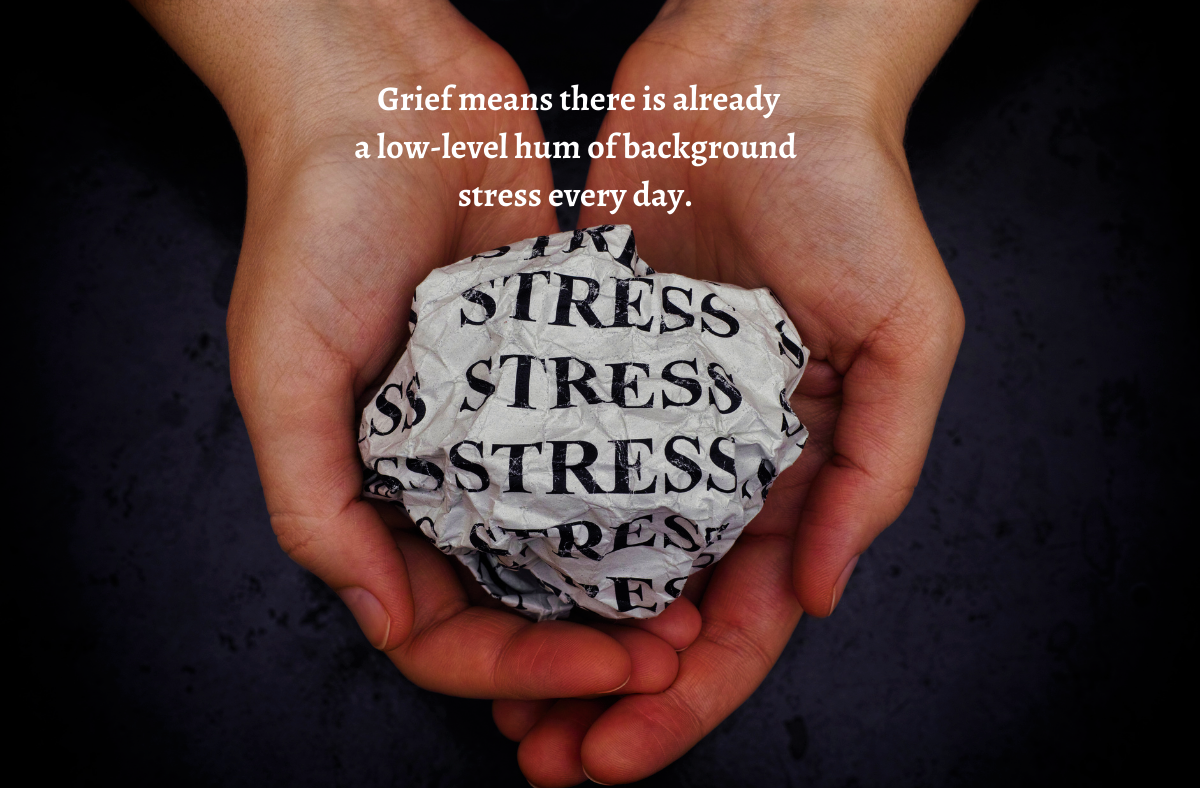
The reality is that child loss means there is ALWAYS a certain low-level hum of stress in my life.

Adding to that already higher-than-average stress means it’s easy for me to be tipped into unhealthy territory.

Crying is only the tip of the iceberg.

Health problems, heart problems, relationship issues and other long-term consequences often result.

It’s not only OK for me to set boundaries to protect my health and my heart,

It’s absolutely, positively the right thing to do.

Grief Work 2025: I Have to FEEL All The Things In Order to Heal

It’s so tempting to try to run or numb the pain of child loss!

Who willingly submits to 24/7 excruciating pain?

But the truth is, unless I face my feelings, give my heart and mind time to experience them and work toward processing them, I cannot even begin to heal.

One of the most difficult and time consuming aspects of grief work is setting aside space and giving myself grace to do just this. In the first couple of years I would venture to say that the majority of my waking hours-intentionally or unintentionally-were spent on this very thing.

Even eleven years later, I still spend some portion of every day (although now it may be fleeting) feeling, dealing and trying to work on healing part of my broken heart.

 ❤ Melanie

If I touch a hot stove my hand jerks away almost before my mind registers the searing pain.  It’s reflex.  Our bodies were designed to react to and protect us from things that cause pain.

Run away.  Don’t go back.  Set up barricades and warning signs so that others can be protected.

Most of the time, this reaction serves us well.

But sometimes those reflexes keep us from healing.

Anyone who’s had major surgery knows that when the nurses come in the next morning saying, “We’re going to get you out of bed today!”, the last thing you want to do is swing your legs over and stand up.  It HURTS!

We want to avoid what hurts, not embrace it.

So it’s no surprise that when we suffer deep emotional wounds, our first response is to try to run away or bury them or ignore them.  The last thing we want to do is face them.

But if I am to heal, I have to face them.  I have to take hold of each place where the dagger of grief and sorrow and regret and anger has pierced my heart and examine it closely.  I have to decide what to do with it, how to integrate it into my life after loss.

Grief is work!  That is one of the reasons grievers need solitude as well as companionship on this journey.  And that is why grief can’t be hurried along.  It takes a great deal of time to do the work grief requires.

If instead of facing our pain, we try to run away or distract ourselves or numb ourselves with alcohol, food or drugs, we only prolong the process.  Grief will not be ignored forever.

healing doesnt mean damage never existed

We must FEEL what we need to feel.

Then we must DEAL with those feelings-it might mean seeking a professional counselor or a trusted friend.  Online or in-person grief support groups are a wonderful resource. Journaling can help too.  But we have got to acknowledge and work through these feelings.

And then we can begin to HEAL  Hearts that have embraced and made some sense of grief can begin to beat again.  They can begin to love again and feel joy again.  They can learn to carry both sorrow and happiness-to remember and honor the missing child while also honoring and loving family and friends still here.

It’s not a “once and done” exercise.

I have repeated these steps over and over in the soon to be [nine] years since Dominic ran ahead to heaven.  New feelings show up at the door of my heart and I have to choose to feel them, to search for what they mean and why they are here and then allow them to be woven into the fabric of who I am NOW-this side of child loss.

It takes courage and stamina and determination, but it is the only way forward.  

owning-our-story-and-loving-ourselves-through-the-process

Bereaved Parents Month 2025: Why Can’t I Keep My House Clean???

Eleven years later and I’m still on the struggle bus with this one.

I used to be able to keep clutter manageable, clothes put away and counters and carpets clean.

Now I sometimes come downstairs and wonder what tornado has blown through the family room only to realize it’s an accumulation of several days’ chores left undone.

Sigh.❤

I freely admit I was never a housecleaning fanatic.

With a busy family, a small farm and mountains of paper, pencils and books scattered around I was content if the most obvious dirt was swept up and the sink free of dishes.

But, I DID have a routine.  I DID clean my bathrooms and wash clothes and make beds and vacuum the rugs on a regular basis.

Not anymore.

Even all this time after Dominic ran ahead to heaven, I have not reestablished any kind of rhythm.

Read the rest here: Why Can’t I Keep My House Clean? Grief and Everyday Responsiblities

Grief in Real Life: Give Sorrow Words

A few summers ago, I participated in an online discussion group with others who read ATLAS OF THE HEART* by Brene Brown.

It was a helpful exercise to map, name and explore emotions so that I can create more meaningful connections to myself and others.

I think I’ve been doing some version of this my whole life. Language matters. Being able to give any emotion-especially the deep pain and sorrow of child loss-matters.

Language is our portal to meaning-making, connection, healing, learning, and self-awareness….

Language shows us that naming an experience doesn’t give the experience more power, it gives us the power of understanding and meaning.

Brene Brown, ATLAS OF THE HEART, xxi

The morning Dominic ran ahead to Heaven, after I made the awful phone calls I reached for my journal.  

I knew if I didn’t start spilling the grief onto paper my heart would explode with sorrow.  

Since I learned to hold a pencil I’ve been writing. 

It’s how I sort my thoughts, figure out my feelings and express my heart. 

i-write-because-i-dont-know

A few months after and I found several online support groups. 

There I learned a whole other  Language of Grief and Loss.  The more I read what others shared, the better I understood my own experience and understood how to communicate that truth to others.

You might not keep a journal or write poetry or craft lengthy essays about your pain and that’s just fine.  There’s no magic in written words.

Find a safe space or person and speak it aloud.  

Sorrow unspoken swells. 

It can’t be contained.  

It will absolutely consume you.  

Give-sorrow-words shakespeare

*Warning: ATLAS OF THE HEART contains language that may offend some folks. I just don’t want anyone to be surprised. ❤

What’s Changed, What’s the Same Eleven Years Down the Road?

What’s changed and what is still the same eleven years down the road of child loss?

I’ve thought about this a lot in the past few months as I prepared for, greeted and marked another year of unwelcome milestones since Dominic ran ahead to Heaven.

Some things are exactly the same:

  • Whenever I focus solely on his absence, my heart still cries, “Can he REALLY be gone?” I am STILL A Mess Some Days….
  • The pain is precisely as painful as the moment I got the news.
  • It’s just as horrific today to dwell on the manner of his leaving.
  • I miss him, I miss him, I miss him. I live every day with his Tangible Absence.
  • I am thankful for his life, for the opportunity to be his mama and for the part of me shaped by who he was.
  • The absolute weight of grief has not changed. The burden remains a heavy one.
  • Daily choices are the difference between giving up and going on. I have to make Wise Choices in Grief.
  • My faith in Christ and my confidence that His promises are sure is the strength on which I rely. I have been Knocked Down But Not Destroyed.
  • I passionately look forward to the culmination of all history when every sad thing will come untrue.

Some things are very different:

  • Dominic’s absence is no longer all I see.
  • Sorrow and pain are no longer all I feel.
  • I’ve learned to live in spite of the hole in my heart-his unique place isn’t threatened by allowing myself to love others and pouring my life into the people I have left.
  • Joy and sorrow are not mutually exclusive. They live together in my heart and I can smile and laugh again while still pining for a time when things were different and easier.
  • I am Stronger because I’ve carried this burden for years. I’ve learned to shift it from side to side.
  • The darkness has receded so that I see light once more. I’m not as prone to fall as fast down the dark hole of despair.
  • My heart longs for reunion but has also learned to treasure the time I have left here on earth.

I’ve never hidden the struggle and pain of this journey.

But I don’t want those who are fresh in grief to think that how they are feeling TODAY is the way they will feel FOREVER.

By doing the work grief requires, making wise choices and holding onto hope a heart does begin to heal.

I am not as fragile today as I was on the first day.

And I am so, so thankful for that. 

It would be so helpful if there was an app to track stress like there is to track spending.

Wouldn’t it be marvelous to get an alert that said, “Low Balance”, for mental, physical and psychological reserves like the one you can get for your bank account right before you are heading to overdraft territory?

But there isn’t.

And few of us are very good at gauging just how much is left in our mental wellness accounts which means we often keep giving when the well is more than dry.

I’d be lying if I said I spend the same amount of time crying, lamenting and bent over in agonizing pain that I did in the early days of mourning Dominic. I’ve found a way to keep him close, to trust his soul to Jesus and to (largely) live in the present instead of always longing for the past.

There are days, though…

Some days are easy to anticipate-birthdays, holidays, the awful anniversary of his leaving-and some sneak up on me. I can often trace my overwhelming sadness to a specific trigger or memory dug up in a drawer or found in a pile of photos.

Occasionally, I have a horrible weepy day for no discernable reason.

That’s when I walk my heart back through recent events and always come to the same conclusion-I’ve let myself run dry:

  • I’ve overcommitted.
  • I’ve not planned rest.
  • I’ve had hard pain days.
  • There’s been family drama.
  • Someone I love is sick.
  • I’m sick.
  • A deadline looms large.
  • There’s some major unpredictability going on.
  • I’ve counseled too many people without enough time to regain my own emotional stores.
  • I’m not sleeping well.
  • I’m doing too much and not listening to my body.

What I’ve come to understand is that stress is a HUGE impact on my grief and how I experience it.

I won’t patronize folks reading this with a simplistic (but wholly unhelpful!) suggestion to “reduce or avoid stress”.

For heaven’s sake! If we could do that with a snap of our fingers we would hardly need someone to tell us to take advantage of that solution.

Truth is, stress is often largely outside our control.

But there ARE some things I can make choices about. So I do. I look ahead at the calendar and note upcoming milestone days. I plug in doctor’s appointments, birthdays and holidays. I review every invitation to celebrations or lunch in light of what is already inked in.

I’ve learned to be honest with folks about my limitations and send a card or gift through the mail if I can’t be there in person. I sometimes suggest an alternative date and time if the one a friend offers just doesn’t work for me. I stand firm in my opinion that “no” is a complete sentence and as long as I’m kind and gracious it is not incumbent upon me to offer an explanation for why I’m turning down an invitation.

And if I have an unexpectedly hard day-from grief or activity or because of my RA-I drop back the next day to allow time to recuperate and rest (if at all possible).

The reality is that child loss means there is ALWAYS a certain low-level hum of stress in my life.

Adding to that already higher-than-average stress means it’s easy for me to be tipped into unhealthy territory.

Crying is only the tip of the iceberg.

Health problems, heart problems, relationship issues and other long-term consequences often result.

It’s not only OK for me to set boundaries to protect my health and my heart,

It’s absolutely, positively the right thing to do.

Grief In Real Life: You Don’t Have to Pretend

There is SO much pressure on grievers to pretend they are “OK” once the socially acceptable amount of time has passed since their loss.

And that is more than unfortunate because not only does it place an undue burden on broken hearts, it inhibits the very necessary work grief requires.

Sharing honestly and openly with safe people, giving voice to our feelings, letting the tears and words flow freely is the only way forward on this treacherous journey.

It’s OK to not be OK.

If you are grievingyou are not responsible for making others feel better about YOUR pain.

You have suffered a great wound and you carry a heavy load.

heal and acknowledge

You are allowed to express sorrow and longing.  It’s what people do.

It’s what we have to do if we are going to make it through this dark valley.

Find a safe person and let. it. out.

Bottling it up inside only drags me deeper under the waves.  Hiding my tears doesn’t save me from sorrow, it only makes me ashamed and anxious.

ann voskamp love will always cost you grief

And there is nothing shameful in grieving my missing child.

Great grief is the price I pay for great love.

I’m not advocating pitching a fit in public.

It’s good to be sensitive to other people, and I want to extend the same courtesy and kindness to others I would like to have extended to me.

BUTwhen sorrow rolls over me like a tidal wave, I do not have to hide to preserve the comfort of others.

And I won’t.

mourning

Surviving the Unthinkable: Grief and Self-Care

My first instinct as a mother and a shepherd is always, “How can I help?”

I routinely set aside my own needs for the needs of others.  Not because I’m so selfless but because that’s how I’m made-I’ve always had the heart of a caretaker.

That’s not a bad thing, most of the time.

But if taking care of others means NOT taking care of myself, then in the end, I’m of no use to anyone.  When I allow every bit of energy-emotional, physical, psychological and spiritual-to drain away until there’s nothing left, I am unable to meet my most basic needs, much less the needs of others.

Read the rest here: Grief and Self-Care: Surviving the Unthinkable