I Can Choose to Step Back and Not React

It is possible not to react to every single thing someone says or does.  It is possible to scroll past social media posts that get under your skin and not look back.  It is possible to ignore a snarky comment or an unhelpful piece of advice from someone who ACTS like they know what you’re going through but really has. no. idea.  

Now if you are new on this journey, you will read these first few lines and think, “Is this woman crazy????” 

I felt EXACTLY the same way in the first months and even through the first couple years in this Valley.

But, I will tell you this:  the sooner you can embrace the habit of practicing the pause, the sooner you will begin to feel like you have some control in your world again.

And isn’t that one of the things we crave after the tsunami of child loss sweeps over our lives-order, control, a sense of purpose and direction?

It’s hard. 

Really, really hard not to react against every arrow shot into my wounded heart.  Even when I know it was an accident and the offense is collateral damage, it still hurts.

But I’ve found that if I just take a single, deep breath I can put a bit of distance between the oomph of the impact and my reaction.  And there is actually power in choosing to ignore offense.

Because then I am in control, not the person lobbing the arrows. 

just-breathe

So what do I do in the split-second it takes to draw in that preparatory breath?  I consider the source.  I think (quickly) about my ongoing relationship with this person, what’s happening in THEIR life and why they might have said or done what they said or did.

Is it ignorance?  Is it sloppy choice of words?  Is it due to stress in his life?  Is she just worn out and not thinking?

And I decide:  is reacting to THIS particular exchange worth damaging the relationship?

Is it worth the negative emotional energy that I will have to expend?

Is it something I can overlook and move past?

Most of the time the answer is, “yes”.  I CAN let it go.  It’s not that big of a deal.  It is not a fair representation of our relationship and it is certainly not worth ruining a friendship.

I’m not just doing THEM  a favor.  I’m doing ME a favor.

choose to respond

I’m not “letting them off the hook”.  I may actually revisit the issue later on, when emotions aren’t running high. 

But I have learned that I only have so much emotional energy to expend in this Valley.  So much of it is already absorbed in carrying the missing and sorrow and reining in my own outrageous feelings that I just don’t need to waste the rest on trivial things.

So I don’t (most of the time). 

Practicing the pause helps me do that. 

It gives me control. 

There is far too little of that this side of child loss.

So I will take what I can get. 

boundaries control react

Holidays 2024: Emotional Overload and T.M.I.

There are so many ways child loss impacts relationships!

Some of the people you think will stand beside you for the long haul either never show up or disappear right after the funeral.

Some people you never expected to hang around not only come running but choose to stay.

And every. single. relationship. gets more complicated.  

When your heart is shattered, there are lots of sharp edges that end up cutting you and everyone around you.  It is pretty much inevitable that one or more relationships will need mending at some point.

Read the rest here: Emotional Overload and T.M.I.

So, What Exactly IS Forgiveness?

Recently someone asked me for my definition of forgiveness.

It caught me off guard.

She had been sharing details of a very painful situation with someone who is clearly intent on making her life difficult “just because”.

I had to think about it.

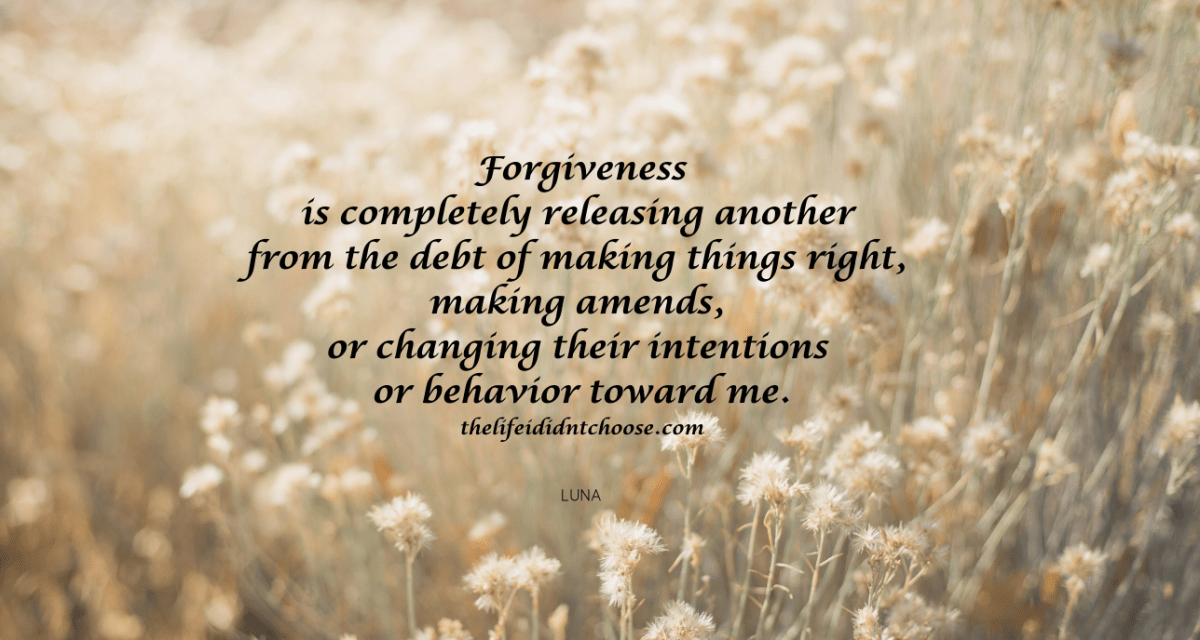
After a few seconds I told her that at its most basic level, I thought forgiveness was completely releasing another from the debt of making things right, making amends or changing in their intentions or behavior toward me.

And then I realized it was precisely what I thought even though I’d never framed it exactly like that before.

I’ve sat with my words for a several days now and I have a few more thoughts.

My definition may lack precision in terms of theology but it is absolutely congruent with lived experience.

It bridges the gap I (and many others) feel between what feels like real forgiveness (releasing the debt) and also still not trusting a particular individual enough to allow them in my life.


I can’t imagine a single soul walking in this world for very long without having at least someone wound them deeply. And it’s no good just trying to ignore the pain or paper it over or distract yourself from it. I eventually find it gnaws a hole in my heart.

When that happens, it’s necessary (for my own mental, emotional and spiritual health) to face it and deal with it.

That’s when the choice to forgive can release the energy that will otherwise be expressed in bitterness or anger or sarcasm or avoidance or unfulfilling and often harmful choices.

If I forgive-release another from the debt of making things right or making amends or changing in their intentions or behavior toward me-then I am no longer held hostage to what they do or don’t do, say or don’t say.

It is real and freeing.

Doing that, I can more accurately evaluate whether the individual is a safe one whom I can allow back into my life:

  • Is their behavior consistent?
  • Are their intentions good and loving or hurtful and mean?
  • Can I trust them?

You do not have to allow them back in if they are not worthy of that privilege.

So, so many bereaved parents have been wounded in so, so many ways.

Sometimes by those they love. Sometimes by strangers who contributed to the death of their child. Sometimes by others who have made it difficult or impossible to do the work grief requires.


Those that inflict the wounds may be repentant or they may not.


That’s outside our control.

But we all have the opportunity to make the choice to release the debt and free ourselves of the ongoing burden of caring whether they are sorry or not.

And that is work well done.


Grief Work Video Notes and Outline

Here is a post that accompanies the video presentation on GRIEF WORK I shared yesterday.

If you missed that post, you can find it here: Grief Work: A Video.

If you haven’t watched the video and plan to, this outline can help you make the most of your time.

If you’ve already watched it and were overwhelmed with the amount of information shared, you can use the outline to organize your own thoughts as you reflect on the content.

❤ Melanie

Child loss is not simply an event that happens at a moment in time. 

It is an ongoing, devastating experience that shatters our hearts, our relationships and our worldview.  It impacts the remotest corners of life in ways we certainly don’t understand nor anticipate in the first hours, days and weeks.  Processing child loss demands time, energy just when we have the least of those resources to expend on anything. 

That’s why I call it “work”. 

How do you pick up the threads of an old life? How do you go on, when in your heart you begin to understand… there is no going back? There are some things that time cannot mend. Some hurts that go too deep, that have taken hold.

Frodo, Return of the King by J.R.R. Tolkien

I use “grief work” to mean all the ways I (and others) must actively seek to identify, face, process, and ultimately incorporate the feelings, trauma and changes loss force upon us.  ways. 

It is exhausting. 

It DOES get better though.  I promise. 

It gets manageable faster when broken hearts don’t try to run away, numb or distract themselves from the challenge.  Grief will not be ignored or stuffed forever. It leaks out somewhere. 

When we refuse to do the work grief requires, we delay healing. 

Grief Work can be understood best when we consider it within the context of relationship: 

  • Relationship with ourselves;
  • Relationship with others (including our missing child);
  • and Relationship with God. 

And I believe the work is best done when we set aside time, designate space and give ourselves and others grace in the process.

RELATIONSHIP WITH SELF

Nonbereaved parents (maybe us in the BEFORE) sometimes joke that their only job is to keep their kid alive.  Even if we’ve never said so aloud, many of us had days when we counted it joy that we came to bedtime and had successfully navigated potentially harmful obstacles with our children. 

It’s a horrifying shock to our core identity as a parent when one day that’s no longer true.  We begin to doubt all kinds of things about who we thought we were.  It takes great effort, courage, energy and lots and lots of time to examine and ultimately integrate these changes. 

I find it useful to think about the process in several stages that often occur simultaneously and repeatedly:

  • Identify the Feelings
  • Acknowledge the Losses
  • Admit the Trauma
  • Face and Integrate the Changes

RELATIONSHIP WITH OTHERS

So much of life revolves around our relationships with other people-family, friends, coworkers, people we go to church with and even the cashier in the grocery store.  A day can be made better or made awful because of stray words, intentional or unintentional conflict, smiles, frowns and kind gestures or funny stories. 

There are so many ways child loss affects how we walk in the world and it absolutely impacts our relationships to those we love as well as those we simply bump into.

Perhaps most dramatically, it challenges and changes how we relate to our child in Heaven. 

What kind of work is required to move forward in this new reality as a spouse, parent, child, employee and member of the community?

  • Family-Including Our Missing Child(ren)
  • Friends
  • Community
  • The Greater World

RELATIONSHIP WITH GOD

It is common for Jesus following bereaved parents to identify with Christ’s words on the cross, “My God, my God, why hast Thou forsaken Me!”.  Or David’s cry, “How long, O LORD?  Will you forget me forever?  How long will you hide your face from me?”.

Some describe their feelings (especially early into this journey) as anger.  Others say they felt deserted.  I say I was disappointed. 

We are not necessarily doubting that God will do the best for us; we are wondering how painful the best will turn out to be.

~C.S. Lewis, A GRIEF OBSERVED

Learning to hold the truth that this life is painful and the truth that God is sovereign and loving in the same heart is probably the most difficult work I’ve done in this journey. 

It required me to do four things:

  • Admit the Pain
  • Acknowledge Doubt and Ask Questions
  • Access the Truth
  • Appropriate God’s Strength

CONCLUSION

Much of this process is organic and different tasks, challenges and seasons present themselves as a natural outgrowth of time and experience. 

It’s definitely not something you can rush. 

I’ve always said that time does NOT heal all wounds.  But there is no substitute for TIME. 

That’s why you must set aside time to do this work. 

It may be stolen moments for those of you with busy households and demanding jobs.  It may be quiet mornings or silent evenings for those who have more margin in daily life.  It might be a weekly getaway if you live with lots of people and have a difficult time turning down the noise of electronics or incessant “to do” lists in your head.  But you MUST find time to sit with yourself, to listen to your heart and to hear from God. 


You will have to carve out or find safe spaces and find safe people. 

Sometimes it means seeking professional help from a counselor or therapist.

Sometimes it’s a friend or two who choose to walk compassionately alongside and who withhold comment and judgement about things they don’t really understand.  They are a valuable sounding board for the stories we need to tell over and over and over as we strive mightily to make sense again of a world turned upside down. 

Online and in person bereaved parent support groups are wonderful!  That is where I learned the language of loss.  It’s where my experience was validated and I was assured that everything I was feeling was absolutely, positively NORMAL

Seek them out. 


Finally, this journey requires SO. MUCH. GRACE! For yourself and for others. 

I call grace the grease for the wheels of relationship.  You are definitely going to disappoint and frustrate yourself and folks you come in contact with.  They, in turn, are going to step on your toes and on your feelings. 

This is uncharted territory for all but the previously initiated and it’s rough going, my friend. 

Try to always assume the best and practice compassion. 

If you can’t muster it, then choose retreat until you are stronger and more equipped to have that difficult conversation or encounter.  But don’t stop communicating.  At least say, “Hey, I am not in a place to talk about this right now.  I’ll let you know when I’m able.” 

No one knows what’s in your heart and mind but you and Jesus.  Give the folks around you a break. 

I am more whole, more at peace and more capable of participating in the life I have while acknowledging and integrating the life I didn’t choose than I was even two years ago.  

My faith is intact. 

My family is learning, loving and living together. 

I don’t fall so deeply into the well of despair as I once did and when I do I can scramble back out again. 

I am not unique or special.  God loves you too.  He will, if you allow Him, bring hope and healing to your heart as well. 

When we dream with God, our dreams-even in burial-are not lost; they are planted. God never forgets the ‘kernel of wheat [that] falls to the ground and dies’ (John 12:24).

What grows from that painful planting is God’s business. But sowing in faith is ours and, like the early disciples, our faithfulness is never sown in vain.

~Alicia Britt Chole, 40 DAYS OF DECREASE


Grief Journey: Unexpected Things Can Make Grieving Harder

No one wakes up one day and just “is”. We become, over time, as our innate nature interacts with the world around us. First our parents and siblings influence us and then school, friends, life experience either gently molds us or pounds us into shape.

Often we get so used to our own way of doing and being we never give it much thought. It’s just “how we are”. We work around our faults and try to use our strengths to our advantage.

Most of us are pretty good at it.

Then something earth shattering comes along and suddenly the cracks are exposed and we haven’t the energy to cover them over.

Read the rest here: What Can Make Grieving Harder? Things You Might Not Expect.

Lenten Reflections 2024: Fasting Comparison and Choosing Relationship

Today’s devotional is focused on Jesus in the Garden and the disciples He asked to keep watch and pray.

Three times the Lord went further into the garden, fell down sorrowing and returned to find His disciples asleep.

I identify both with Jesus begging His companions to keep watch and with the disciples for closing their heavy lids as sorrow overtook them. I want someone to be awake and alert, praying for me in my despair but can find it hard to do that for others as the weight of their sadness makes sleep a welcome escape.

Read the rest here: Lenten Reflections: Fasting Comparison and Choosing Relationship

Why Is It SO Darn Hard to Ask for Help?

I would much rather be the one bringing the casserole than the one receiving it.  

Not because I’m ungrateful but because I’m uncomfortable.

It is humbling to have to depend on other people.  It’s hard to admit I can’t manage on my own.  It’s downright humiliating to need help with daily tasks that used to come easy.

But truth is, I cannot make it alone.

Read the rest here: Grace Like Rain: Why It’s So Darn Hard to Ask For Help

There Is NO Shame in Being Human

If you, like me, have had a less-than-stellar recent record dealing with those you love, those you meet and those you pass on the street or in your car, accept this truth:

You are absolutely, positively NOT perfect.

And that’s OK.

Read the rest here: No Shame In Being Human

It’s SO Important To Speak Truth

I’m here to tell you:  don’t drown your important relationships in unsaid words, unshared feelings, unacknowledged wounds.  

All that does is guarantee distance grows between your hearts.  

If you let the distance become too vast, or the pile of unsaid truth get too high, you might just find you can’t reach that far or that high to reconnect.

It takes a bit of brave to say what’s important and uncomfortable. 

Read the rest here: Speaking Truth

The Best is Yet to Come!

Funerals.

Sigh…

I just came home from my uncle’s funeral. He met Jesus face-to-face the end of June but we didn’t have his service until July 29th for lots of reasons.

Then I opened my computer after a long day of travel and unloading a car full of memories to the news a precious friend-in-loss and indefatigable encourager of grievers had laid down for a nap and woke in the arms of her Shepherd King.

Joy Hart Young was famous for saying, “The BEST is yet to come!” and I believe she is experiencing it at this very moment. She’s in the Presence of the One who saved her, sustained her and loves her. She is reunited with her son, Matt, and tears will never again be her food.

No more night. No more death. No more sadness or sickness or disappointment or sin.

Hallelujah! Amen.

My uncle was old and full of years. Joy wasn’t exactly a spring chicken (she’d approve of my saying that) but she wasn’t the age one might expect to leave this world. Her son and my son were so, so young when their earthly lives ended and their heavenly ones began.

Death comes to us all. No one gets out alive.

Death is a line in the sand that cannot be crossed. What hasn’t been said or done can never be said or done. That’s one of the reasons it’s so very hard.

My uncle made some choices that were burdensome for his family to live with after he left. They will continue to mold his legacy in the hearts and minds of those who loved him.

Joy chose to take the pain of child loss and allow it to shape her into a vessel of hope, grace and encouragement for other parents suffering the same devastating sorrow.

So I’m reminded again that our time here is short. How short (or long) only the Lord knows.

What I do in that time matters.

I won’t get a second chance to live my life. I can’t recoup lost moments or lost years.

There are some practical things I can do like create an end-of-life file or notebook to make it easier on those left behind.

But there are more important things I NEED to do if I’m going to leave a legacy of love.

I have to keep short accounts, make amends, ask for and grant forgiveness.

I need to hug necks, speak aloud the beauty I see in others, shake off shame and emotional baggage.

One day (please Lord let it be!) I’ll lie down and not wake up.

I hope the only sorrow I leave behind is the sorrow of missing my presence, not the sorrow of unsaid words or unhealed wounds.

I’m human.

I’ll miss someone or someplace I need to address.

But (Hallelujah! Amen.) in Heaven it will all be made whole.

The best is yet to come!

Joy Hart Young