Mainly because what usually determines THAT is something that happens (or doesn’t happen) at some point after my morning quiet time.
But whether it’s a good day, a bad day or somewhere in between, it is absolutely, completely, utterly NORMAL for my emotions to change as I make my way down the path called “Child Loss”.
As long as I am doing the work grief requires I will continue to have some better days.
But grief still comes in waves in response to triggers or in response to nothing at all and it may be a bad day.
How well did I sleep, rest, eat or exercise? My body affects my emotions in ways I don’t fully understand but absolutely experience.
Stress can bring tears to the surface. Even GOOD stress can do it. Looking forward to things, planning a party, large meal, trip or event is stressful, even if it isn’t sad. All stress weakens my defenses and makes it harder to employ the techniques I’ve mastered for diverting my thoughts or controlling my tears.
Sunshine or rain? I have learned to count the number of recent cloudy days if I wake one morning feeling bluer than normal. I often realize that a week or more has passed since I’ve seen the sun.
Too much interaction or too little interaction with other humans makes a BIG difference. My introvert self loves long afternoons alone, sitting in silence with a book or crochet, quiet walks in the woods and chore-filled days without music blaring. But healthy solitude can turn to withdrawal if I let it and sometimes I realize my sudden sense of overwhelming grief is, in part, due to lack of human company.
The list is endless.
Thankfully, at nearly twelve years, the better days outnumber the worse ones for me.
But no matter what kind of day it may be, I no longer worry if it’s normal.
When I opened the door to that deputy and received the news, my world suddenly spiraled out of control.
Over the next days, weeks months I would have to do things I never imagined I might do and certainly things I did notWANT to do. So, so much I couldn’t change. So many ways I lost the right to choose.
And I hated it!
Wasn’t long and that sense of helplessness permeated every corner. Even when it didn’t belong there. I began to feel as if I couldn’t control anything.
So in many ways I stopped trying.
But then one day I woke from the fog of despair. I remembered that there WERE some areas of life where I could still make choices.
And it was empowering!
So here’s a list that I pray gives hope to other hurting hearts.
THINGS I CAN CONTROL
My attitude (how I react to what others say or do)
My thoughts (with great difficulty sometimes)
My perspective (when I’m careful to fill my mind, heart and eyes with truth)
If I’m honest (about ALL things-including my feelings)
Who my friends are (from my end-can’t stop people from walking away)
What books I read (I am choosy and only read things that feed my soul)
What media I consume (stay away from toxic people, topics and television)
What type of food I eat (healthy, appropriate amounts)
How often I exercise (a walk, gentle yoga, online video routines)
How many risks I take (not just physical ones, but also emotional and relational risks)
How kind I am to others (being wounded does not give me the right to wound)
How I interpret situations (do I assume the best or the worst?)
How kind I am to myself (extending the same grace to ME that I extend to others)
How often and to whom I say, “I love you”
How often and to whom I say, “Thank you”
How I express my feelings (I can learn healthy ways to speak my truth)
Whether or not I ask for help (no one gets “points” for playing the martyr)
How many times I smile in a day (smiling, by itself, lifts mood-even a “fake” smile)
The amount of effort I choose to put forth
How I spend my money
How much time I spend worrying (or praying or complaining)
How often I spend moments blaming myself or others for past actions
Whether or not I judge other people
Whether or not I try again when I suffer a setback or disappointment (success is getting up one more time than I fall down)
How much I appreciate the people and things in my life
Exercising control over the parts of my life where I CAN exercise control helps me deal more effectively with the many parts over which I have no control
It does not undo the sorrow and pain of child loss, but it does work to balance the emotional scales.
It seems to be the nature of humans to listen with an ear to respond rather than an ear to hear.
I’ve done it myself.
Jumped right in with all kinds of suggestions designed to “fix” someone else’s problem.
Or worse, heaped my own experience with something more or less (often less) similar onto an already overburdened heart.
I hate that tendency in myself and I’m working hard to try to change it.
Those who feel compelled to just say SOMETHING often bombard grievers with platitudes, comparisons to their own grief or just empty, frivolous words that require we either stand there dumbfounded or find a gracious way to exit the conversation.
It’s especially painful for a broken heart when a well-meaning someone decides THIS is the moment for a theology lesson.
“God has something planned for you in this” or “God will use this for good”. (Romans 8:28-29)
“We don’t grieve as those without hope!” ( I Thessalonians 4:13)
“All our days are numbered.” (Psalm 139:16)
I get it-death is a heavy subject and the death of a child isn’t something anyone wants to talk about, contemplate or be forced to wrestle with. So it’s often easier to simply say something-anything-do your duty and walk away.
But it is hardly helpful.
Deep grief as a result of unbearable loss is not a teaching moment.
It’s an opportunity to listen well, think carefully about if or when you need to say anything and simply offer compassionate companionship to a broken heart.
Grieving felt hardly like the time for being taught, at least initially. Early grief was my time for pulling out of my past those truths that I had already learned — out of my ‘basement — so that I could begin to assemble them together into something even more meaningful to me than before. It was the time for understanding that even though I had always believed in heaven, it now looked to my perceptions to be more real than this world. It was the time when, even though I already believed in God’s control of the world, I now felt dependent upon him being sovereign over it for all my hopes. It was the time for realizing that even though I already believed that Christ conquered death, I now longed to see death die.
Every time I come home from a retreat, a conference or a bereaved parent support group meeting I am reminded again that the range of “normal” in grief-especially child loss-is so very wide.
Still crying after a decade? Absolutely normal.
Trouble getting dinner on the table or remembering your child’s school schedule? Yep. That’s normal.
Struggling with crowds, back-peddling on commitments, feeling trapped by phone conversations, shopping when you are least likely to run into someone you know? Perfectly normal.
Our losses range from very recent to decades old and we all acknowledge that our behavior, our feelings, our ability to handle change, nearly every aspect of our lives is impacted by the death of our child.
So if you are wondering if your expression of grief is normal, it is.
Our lives were shattered.
Our hearts were broken.
Picking up the pieces, whatever that looks like, is absolutely, positively normal.
While I certainly had no real idea in the first hours or even weeks what losing a child entailed, I understood plainly that it meant I would not have Dominic to see, hold or talk to.
I wouldn’t be able to hug his neck or telephone him.
He wouldn’t be sitting at my table any more.
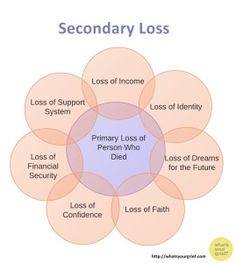
But the death of a child or other loved one has a ripple effect. It impacts parts of life you might not expect. As time went on, I was introduced to a whole list of losses commonly called “secondary losses”.
Here are just a few:
Loss of a large chunk of “self”. Dominic possessed part of my heart and part of my life. It was violently ripped away when he died. There is part of me that was uniquely reflected from him-like a specialty mirror. I can never access that part of me again.
Loss of identity. Before Dominic died I was one kind of mother. I was a mother of four living children who were making their way in the world as successful adults. I was a mother looking forward with happy anticipation to the next years. Now I am still a mother of four children but one whose heart has been changed by tragedy and sorrow. Tomorrow is still bright, but there’s a shadow just behind it.
Loss of self-confidence. I used to enter a room without a thought to how I’d be received or perceived. That’s definitely not the case now. I’m self-conscious-constantly wondering if I’m saying or doing the right thing. I never know if a grief trigger will (at best) pull my attention away from conversation or (at worst) send me scurrying for the bathroom.
Loss of sense of security. I think every parent has moments of fear over his or her child. When they first go off someplace without us, when they get a driver’s license, travel abroad, go to college. But all the awful things I imagined didn’t hold a candle to the reality of waking one morning to a knock on my door and the news that Dominic had been killed. The bottom fell out of my (relatively) safe world. Bad things, random things can and do happen. Once it happened to ME, it changed how I processed everything. The passing years have softened some of the anxiety but I will never be able to assume safety again.
Loss of faith. I did not “lose” my faith. I never once doubted that God was still working, was still loving and was still in control. But I most certainly had to drag out every single thing I thought I knew about how I thought He worked, loved and superintended the world and examine it in light of my experience of burying my son. It took a long time to work through all the pat answers I had been offered and myself doled out to others for years that didn’t fit with my new reality. I am learning that doubt is not denial and that I have to live with unanswered questions.
Loss of family structure. I’ve written before that a family is more than the arithmetic total of the number of members. There were six of us. But we were so much more than six when we were all together! Our talents, personalities and energy were amplified in community. When Dominic’s large presence was suddenly whisked away, every relationship got skewed. We’ve fought our way back to a semblance of “whole” but still miss him terribly. We can function, but we will never be the same.
Loss of my past. Memories are funny things. They are plastic and subject to change. And my recall of an event is limited to my own perspective. For a memory to be rich and full, I need input from others who were there as well. One vessel of family memories is no longer available to add his unique contribution. Every time I pull out a photo or dig down deep in my heart to draw up a treasured moment, I realize I’ve lost something I can not recover. The joke, the glance, the odd detail are all gone.
Loss of the future I anticipated. I’m a planner by nature. Not a detailed, OCD, got-everything-in-order kind of planner, but a “big picture” kind of planner. When Dominic left us in 2014, things were going (pretty much) according to plan. Each child was well on his or her way to the career path they had chosen. I was easing into an empty nest and exploring options for life after homeschooling. My husband was entering his last few years of a lengthy career. It’s hard to explain to anyone who hasn’t experienced it, but when your world is shaken by child loss, everything gets scrambled. You can’t just pick up where you left off and keep going with the pieces that remain.
There’s a prolonged period of confusion and everyone is impacted differently and in ways you could never imagine. All of us have changed dramatically in the years since Dominic left us. He is not the only thing missing from the rest of our lives. Holidays are altered. Birthdays are different. We have to plan special events around uncomfortable milestone dates that roll around every year whether we want them to or not. It’s a constant readjustment to life as it IS instead of life as I thought it WOULD be.
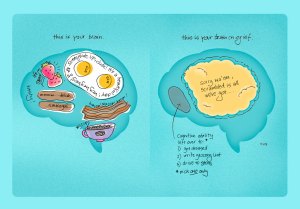
Loss of ability to focus and function. Oh, how this surprised me! I was in some kind of zone for the first month after Dominic left. My other children were home, we had to make it through planning his funeral, two graduations and cleaning out his apartment. I also had to handle paperwork for my husband to take short-term disability due to grief. I cried a lot, wrote down dozens of notes but managed to do what I had to do. Then I crashed. I couldn’t remember a thing. I couldn’t read more than a couple sentences at a time. I hated the telephone. I could barely stand to hear the television. I had to make a list of the most basic things like brushing my teeth, feeding my animals, turning off all the lights before bed. It was awful! And it didn’t really get better for well over a year.
I still suffer from a very short attention span, low tolerance for noise and an inability to accommodate last minute changes. I don’t schedule anything back to back. I live in a rural area and sometimes shop in the nearby town. I will start the day with a long list and shorten it repeatedly as I go along because driving in traffic, crowds and random sounds ramp up my anxiety and make me want to go home with or without what I came for. I have changed the way I do so many things. My pre-loss memory has never returned.
Loss of patience. I am at once impatient and long-suffering. I have zero patience for petty grievances, whining and complaining. Yet I have compassion for other people living hard and unhappy stories. I berate myself for not being “better” and, at the same time, extend grace to others who aren’t “better” either. I want to shake people who bowl over weak, hurting, desperate souls. I don’t have time for moaning about rain when you were planning a picnic but will listen for hours to a mama tell me about her missing child.
Loss of health. I had a number of chronic health conditions before Dominic ran ahead. Within the first year of his departure, I was hospitalized twice. My experience is not unique. Some parents suffer immediate health effects (heart attack, blood sugar spikes, anxiety/depression) and some see a slow decline over time. In part because child loss, like any stressor, will negatively impact health and also because sometimes bereaved parents stop doing the things that help them stay healthy. At almost five years, I’ve learned how to manage the stress better although some of my health issues continue to get worse. It’s hard to tease apart what is age, what is disease and what is grief.
When your child leaves this life before you do, it changes everything.
Not only things you might expect, but many you’d never imagine.
It’s a constant balancing act, readjusting every day to new challenges.
But of all the factors that promote healing, there is NO SUBSTITUTE for time–not in the physical world of surgery and broken bones and deep wounds and not in the inner world of emotional pain and brokenness and sorrow.
Our bodies are made to be amazingly resilient.
Most people don’t really think of surgery as an assault on the body, but it is.
The surgeon knifes through layers of flesh and tissue that are designed to keep intruders out, mucks about inside, does what he or she came to do, and closes up–hopefully without introducing bacteria into the wound. Some medication may be prescribed to promote healing, control pain and reduce the risk of infection.
Then the patient goes home to recover.
But it is really TIME and the body’s own healing powers that do the lion’s share of the work.
Our hearts and minds can be resilient too.
Frequently, someone who suffers an assault on their emotions may not bear outward signs and symbols to mark what they’ve been through. And well-meaning friends and family can forget that healing has only begun and is far from complete.
Sometimes broken people feel pressured to put on a brave face and to stuff their feelings.
For the body, ignoring doctor’s orders to rest after surgery can mean another hospital stay due to complications that might have been avoided if the patient had been given sufficient time to recover.
Emotionally wounded people can end up with complications from pressure to rejoin regular activities and engage society in ways for which they are not yet ready.
It takes TIME to heal from burying a child or any other traumatic loss.
There is no way to rush the healing. It takes HOURS AND HOURS to think about, respond to and process the feelings that overwhelm anyone who is grieving or trying to cope with emotional upheaval of any kind.
So be patient with yourself.
Understand that there will be good days and bad days.
There will be forward movement and steps backward.
Sometimes it will be easy to do something or go somewhere and the next time it might be really hard.
And don’t be afraid to let others know you are still healing.
Deep emotional wounds require great care and an extended period of time to heal if the healing is to be sound and free from unnecessary complications.
You are not selfish to draw boundaries around what you can and can’t do, what you will and won’t allow and where and when you engage with others-you are being wise.
For those walking with the wounded: extend grace and be patient.
Thank God you are not bearing this burden and be mindful of placing demands or pressure on the wounded to heal according to a predetermined timetable.
Then support them in their effort to give themselves the TIME they need to heal.
I don’t know about you, but I think of every day as a blank canvas and it’s my responsibility to paint something useful or beautiful or helpful on it.
I’m a list maker so each night before I drift off, I usually jot down 3 or 300 things I would like to do the next day.
I get up, get started and then (more often than I’d like to confess!) hit a wall.
Sometimes it’s the wall of circumstance. Things happen I didn’t expect and suddenly the hours I was going to spend cleaning the garage are spent cleaning a mess.
Sometimes it’s the wall of community. Someone calls. Or a multitude of someones call. I hate to admit it but I’m really not a fan of the telephone. Like Alexander Graham Bell, I consider it more of an inconvenience and interruption than a means of delightful connectivity. Minutes slip by and I can’t recover them.
I love my friends and family.
But I’d rather chat while we are doing something together in person than over the phone.
Sometimes it’s the wall of pain. Rheumatoid Arthritis, like all autoimmune diseases, is unpredictable. Usually I can tell in the early morning hours if my joints are going to cooperate on a given day. But sometimes they surprise me and I find that all that yard work will have to wait.
Sometimes it’s the wall of grief or sadness or longing or any of a multitude of feelings. I have gotten pretty skilled at steering clear of grief triggers when I know I have lots of things to do. I don’t listen to the songs friends post on their timelines or read too many comments on the sites for bereaved parents. But I can’t anticipate random sights, sounds or memories. I’ve been working on a room, cleaning drawers, moving stuff tucked in corners and come across a Lego man or a pellet from the air soft guns they weren’t supposed to shoot inside the house (but of course did anyway) when the boys were young. That does me in and I have to walk away.
Sometimes it’s the wall of “What difference does it make anyway?!!” This one I usually see approaching in the distance when there have been too many days and too little progress. Or a string of gray, rainy mornings. Or multiple failed attempts at fixing something. And then I throw up my hands and decide my paltry attempts at controlling my corner of the world hardly matter, so why keep doing them.
So I give in and let myself just have a day.
It doesn’t have to be a good one or a productive one or even a cheerful one. The glass can just be a glass. I don’t have to pretend it’s half-full or declare it half-empty.
And after a rest I usually remember that what I used to find impossible is now possible; what used to be hard, is often a little easier.
I am stronger and better able to carry this load.
Sorrow is no longer all I feel nor my son’s absence all I see.
And although THIS day may be lost. It’s only ONE day.
It’s perfectly OK for me to sit down with a cup of coffee, a book or a movie and let myself off the hook.
Our family is navigating deep grief a second time.
In January, my granddaughter, Holly, was gathered into the arms of Jesus after only two weeks on earth-almost to the minute.
Once again my children are plunged beneath the flood of hurt, pain, questions and sadness of child loss.
This time my oldest son and his wife are the center of the circle. Their sons are the immediate next ring. My two other earthbound children, my husband and I are slightly more removed.
But distance from the center does not necessarily indicate the degree to which the same loss might reignite old feelings, trauma, anxiety and unwanted physical, mental and spiritual responses to grief.
A grief circle is comprised of those most closely impacted by a loss.
The world likes to draw it tight because even if it doesn’t represent the reality of those involved. Expanding the circle expands the need for compassion and compassion might well demand action.
Drawing it smaller also gives the curious permission to ask personal questions from those close to the loss (and who may have information they desire) without feeling guilty about asking the question.
May I give a piece of (unsolicited) advice?
Please. Don’t.
Please don’t ask my children how I’m doing.
Please don’t ask my son and daughter, the uncle and aunt of Holly, how their brother is doing or how I am doing.
Please don’t ask my son how his wife is doing. He is also a parent of a child he can no longer hold.
Please don’t assume that being slightly removed from the center of loss means being removed from the pain and damage such a loss entails.
You are welcome to ask me anything. Both my experience and age mean I’m better equipped to answer or not answer as I am able.
I have found that Holly’s brief life and death have impacted me in ways I don’t understand and am still trying to process.She is my grandchild. I don’t love her less because her life on earth was brief.
Since I’ve walked this broken road, I am oh, so aware of what lies ahead for both my son and daughter-in-law as parents, their sons as surviving siblings and my own children as doubly grieved siblings.
I remember thinking when we gathered in the AirBnB the night after the long, long day Holly took her last breath how heavy, powerless and hopeless I felt.
No words could undo what had happened.
No hug could press the pieces of broken hearts back together.
No amount of wishing, wishing, wishing would turn back a clock that had relentlessly brought us forward to this very moment.
My family is knit together in ways and with bonds no one would choose.
We keep our phones with us “just in case”. We share travel itineraries, traveling companions’ contact information, and we answer phone calls from one another no matter where we are or with whom.
The grief circle is larger than most folks would like to admit and it remains intact over time and across distance.
There is no “fix” for grief.
No “getting over” or “past” loss.
There is moving forward and I am so, so proud of my family for choosing that hard path.
But here we are again.
And it is going to take more time than anyone outside our circle would like to admit.
I remember as a young mother of four working hard to keep my kids safe.
Next to fed and dry (two still in diapers!) that was each day’s goal: No one got hurt.
It never occurred to me THEN to add: No one got killed.
Because the most outlandish thing I could imagine was one of them falling or touching a hot stove and us having to rush to the emergency room.
Then I became a mother of teens and one by one they acquired a driver’s license and motored away from our home.
That’s when I began to beg God to spare their lives.
One particularly frightening test was when all four went to Louisiana-my eldest driving and the rest in the van with her. I made them call me every hour and tell me they were OK. It was the first time I realized that I could lose every one of them in a single instant should they crash-all my eggs in one basket.
I was glad when that day was over. Although the irony is they were no “safer” at the end of those 24 hours than they were at the beginning.
Because what I know now, but didn’t know then is this: There is no such thing as“safe”.
Not the way we like to think of it-not the way we add labels to devices, seat belts to cars, helmets to everything from bicycles to skateboards. Of course we should absolutely take precautions!Many lives are saved by them every single day.
But. BUT…
Life is more random than we want to admit.And there is no defense against random.
There is no way to screen for every underlying physical abnormality, no way to drive so well you can stop the drunk or inattentive driver from plowing through a stop sign, no way to anticipate every foolish choice a young person might make that ends in disaster instead of a funny story.
My first response when Dominic died driving his motorcycle was that I wanted my surviving sons to sell theirs. They did so out of respect for me. Neither of them wanted their mama to have to endure a second knock on the door and the same message delivered twice.
I receive it as a sacrifice offered in love from them.
Because it was.
Since Dominic left us almost [twelve] years ago, I have had to deal with my desperate need to keep my living children safe.
And it is a real struggle.
Each child is involved in a career that includes inherent risk. None of them are foolhardy, but they are exposed-perhaps more than many-to potential bad actors and dangerous circumstances.
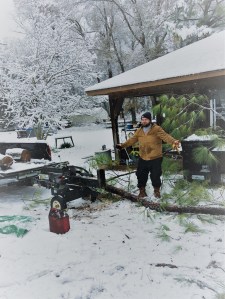
This branch fell just minutes after my son was standing in that spot splitting logs.
How I long for those days when I could tuck everyone in, turn out the lights and sleep soundly because all my chicks were safe inside my own little coop! How I wish the only danger I thought about or knew about was a bump on the head from hitting a coffee table!
How my heart aches for one more moment of blissful ignorance!
But I can’t live in some imagined water color past. I have to live in the world as it is.
So I remind my heart that safe is an illusion-no matter where we are. Life is not living if it’s only about preserving breath and not about making a difference.






















 thelifeididntchoose