Grief in Real Life: Give Sorrow Words

A few summers ago, I participated in an online discussion group with others who read ATLAS OF THE HEART* by Brene Brown.

It was a helpful exercise to map, name and explore emotions so that I can create more meaningful connections to myself and others.

I think I’ve been doing some version of this my whole life. Language matters. Being able to give any emotion-especially the deep pain and sorrow of child loss-matters.

Language is our portal to meaning-making, connection, healing, learning, and self-awareness….

Language shows us that naming an experience doesn’t give the experience more power, it gives us the power of understanding and meaning.

Brene Brown, ATLAS OF THE HEART, xxi

The morning Dominic ran ahead to Heaven, after I made the awful phone calls I reached for my journal.  

I knew if I didn’t start spilling the grief onto paper my heart would explode with sorrow.  

Since I learned to hold a pencil I’ve been writing. 

It’s how I sort my thoughts, figure out my feelings and express my heart. 

i-write-because-i-dont-know

A few months after and I found several online support groups. 

There I learned a whole other  Language of Grief and Loss.  The more I read what others shared, the better I understood my own experience and understood how to communicate that truth to others.

You might not keep a journal or write poetry or craft lengthy essays about your pain and that’s just fine.  There’s no magic in written words.

Find a safe space or person and speak it aloud.  

Sorrow unspoken swells. 

It can’t be contained.  

It will absolutely consume you.  

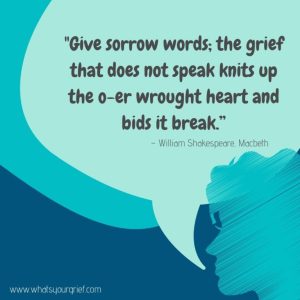
Give-sorrow-words shakespeare

*Warning: ATLAS OF THE HEART contains language that may offend some folks. I just don’t want anyone to be surprised. ❤

Grief In Real Life: It’s OK to Talk About Death

We wall off our world with words.

The ones we speak and the ones we swallow down so they don’t escape our lips.

But, as Mr. Rogers says, “Anything human is mentionable.”

Even death.

We don’t like to talk about death. It’s unpleasant and frightening and often divisive. We all know it’s coming-no one (except Enoch and Elijah) have left this world any other way. Yet the polite thing to do is pretend it doesn’t exist or at the very least, isn’t likely to happen any time soon.

But that serves no good purpose.

It stops us from having meaningful conversations with those we love as they approach the end of their days. It keeps us from making amends while there is still time, saying the things that need to be said, wrapping up loose ends and frayed relationships.

It stops us from listening to the bereaved. If we get too close and pay too much attention to the aftermath of loss then we have to think about what it really means to live on without someone we love.

And it has shaped a society in which those who grieve too loudly or too long are shushed and shamed.

Refusing to talk about death doesn’t make it disappear.

It only makes it harder to deal with.

The rest of the Mr. Rogers quote is this:

…and anything mentionable is more manageable. When we can talk about our feelings, they become less overwhelming, less upsetting, and less scary. The people we trust with that important talk can help us know that we are not alone.

Fred Rogers

Learning the language of loss and lament is part of the healing process in grief.

We’ve never been very good in Western society talking about or dealing with death. So many hearts are hurting and have nowhere to go, no one to talk to, no safe refuge for their pain.

If someone trusts you with his or her feelings, receive it as a gift.

Make space for them to be honest about what they are experiencing.

Remind them that “Anything human is mentionable”.

And listen. 

I don't believe in best friends {discuss amongst yourself ...

Grief In Real Life: Hiding Behind Small Courtesies

It’s what you do, it’s what you say.

Please”and “thank you” are how we live in community with others.

Even when our world is crumbling and our hearts are breaking, we don’t toss these courtesies away.

You begin to realize that everyone has a tragedy, and that if he doesn’t, he will. You recognize how much is hidden beneath the small courtesies and civilities of everyday existence. Deep sorrow and traces of great loss run through everyone’s lives, and yet they let others step into the elevator first, wave them ahead in a line of traffic, smile and greet their children and inquire about their lives, and never let on for a second that they, too, have lain awake at night in longing and regret, that they, too, have cried until it seemed impossible that one person could hold so many tears, that they, too, keep a picture of someone locked in their heart and bring it out in quiet, solitary moments to caress and remember.

Roseanne Cash, Composed: A Memoir by Roseanne Cash

I remember walking down the grocery store aisle wondering if the face I smiled into was faking it like I was. I wondered if they were hiding behind pleasantries because they form a good shield.

I imagine, on some level, most were. Because nearly everyone has a secret wound.

And, like Cash said, if they haven’t yet, they will be.

Grief In Real Life: Heartache and Hope

I am so very thankful for the hope I have in Christ.

I am dependent every moment on the strength of Jesus and the Word of God to point my heart to the eternal truth that my son is safe in heaven and that I will be reunited with him one day.

I honestly don’t know how a person who does not share my hope in the finished work of Christ can bear the burden of child loss.

But hope, strong as it is, and effective as it is, does not erase the pain.

It gives me the endurance to bear the pain.

It allows me to see past the pain to something better.

But I still feel the pain.

Hope is not anesthesia.

Hope does not dull my senses nor does it render my heart hard to the longing and missing and hurting of life without the son I love.

substance

I believe in Christ.

I believe that “God so loved the world He sent His only begotten Son that whosoever believeth in Him should not perish but have everlasting life”. (John 3:16)

And often, when inviting someone to believe in Jesus I will explain that God loves them SO much, He gave up His Son, just to save them.

Only the hardest heart would think such sacrifice was small or insignificant.

If it was painful for the Father to allow wicked men to kill His Son, then it is painful to me for death to take mine.

It is unhealthy to ignore pain.

heal and acknowledge

But when it comes to emotional pain, we sometimes shut people out or shut them down.

I submit that we diminish the power of the cross when we deny or minimize the presence of pain.

Believing that God is in control and Jesus lives does not undo grief’s storm-it is a lifeline that keeps my desperate and hurting heart from sinking under the waves.

hope holds a breaking heart together

One day my hope will be made sight.  One day the faith I hold onto will be realized in full.

jesus wept

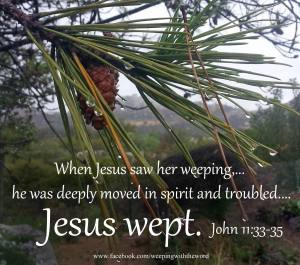
Jesus wept at the tomb of Lazarus, even though He knew that death would not win and Lazarus would walk out of the grave.

For now, I place my broken heart in the hands of the One Who made it because I know He knows my pain.

And I know that He longs as much as I do for the day when all will be redeemed and restored.

rev 21_4

Grief In Real Life: Why I Say, “My Son Died.”

Died.  

It is a harsh word.

I understand completely that some parents don’t want to use it to describe their child and I respect that.

I have chosen to use it often (not always-sometimes I say “left” or “ran ahead to heaven”) because what happened IS harsh. I don’t want to soften it because there was nothing soft about it for me or my family.

It is heartbreaking, lonely, heavy, hard and utterly devastating. 

grief bubble

As a believer in the promises of Scripture, I use it because I want to paint a stark contrast between hopelessness without Christ and the hope I have because of the blood of Jesus applied to my heart and the heart of my son.

Without that assurance, the hopelessness would continue for eternity.

romans 10_9

But because of Jesus, while this reality is harsh, hard and heartbreaking, I have an eternity of rest, renewal and redemption to look forward to.

not ashamed

I think each of us finds our own path through this Valley and should say or use whatever word is best for our own heart.

This is simply one choice among many.  

I’m so sorry that we need ANY words to describe our child’s physical absence in this earthly journey. 

no evil can conquer grace forever

What’s Changed, What’s the Same Eleven Years Down the Road?

What’s changed and what is still the same eleven years down the road of child loss?

I’ve thought about this a lot in the past few months as I prepared for, greeted and marked another year of unwelcome milestones since Dominic ran ahead to Heaven.

Some things are exactly the same:

  • Whenever I focus solely on his absence, my heart still cries, “Can he REALLY be gone?” I am STILL A Mess Some Days….
  • The pain is precisely as painful as the moment I got the news.
  • It’s just as horrific today to dwell on the manner of his leaving.
  • I miss him, I miss him, I miss him. I live every day with his Tangible Absence.
  • I am thankful for his life, for the opportunity to be his mama and for the part of me shaped by who he was.
  • The absolute weight of grief has not changed. The burden remains a heavy one.
  • Daily choices are the difference between giving up and going on. I have to make Wise Choices in Grief.
  • My faith in Christ and my confidence that His promises are sure is the strength on which I rely. I have been Knocked Down But Not Destroyed.
  • I passionately look forward to the culmination of all history when every sad thing will come untrue.

Some things are very different:

  • Dominic’s absence is no longer all I see.
  • Sorrow and pain are no longer all I feel.
  • I’ve learned to live in spite of the hole in my heart-his unique place isn’t threatened by allowing myself to love others and pouring my life into the people I have left.
  • Joy and sorrow are not mutually exclusive. They live together in my heart and I can smile and laugh again while still pining for a time when things were different and easier.
  • I am Stronger because I’ve carried this burden for years. I’ve learned to shift it from side to side.
  • The darkness has receded so that I see light once more. I’m not as prone to fall as fast down the dark hole of despair.
  • My heart longs for reunion but has also learned to treasure the time I have left here on earth.

I’ve never hidden the struggle and pain of this journey.

But I don’t want those who are fresh in grief to think that how they are feeling TODAY is the way they will feel FOREVER.

By doing the work grief requires, making wise choices and holding onto hope a heart does begin to heal.

I am not as fragile today as I was on the first day.

And I am so, so thankful for that. 

Father’s Day 2025: Father’s Day for Bereaved Fathers

I can’t pretend to understand exactly what it feels like to be a father who buries a child. I’ve only been able to watch from the outside as my husband absorbed the impact of that great wound.

But I can tell you this:  for dads, like moms, each holiday is another mile marker on the road of grief.

It is another poignant reminder that things are not as they were-they are not as they should be.  

father hurts too

Many men keep the hurt bottled up inside, don’t talk about it, don’t seek out fellow bereaved fathers, and don’t cry as much as their wives.

It is easy to forget and overlook the ongoing pain of child loss for fathers-especially when outward signs are few.  

But I promise you-that dad in the pew on Sunday-he’s hurting.

That man shaking hands and joking-he remembers.

He hasn’t forgotten that one of the special people that called him “Daddy” is no longer around to do it.

Tell him you remember too.

Speak his child’s name and share a special memory.

Acknowledge the pain.  Let him express his grief.  

And honor him as a father to ALL his children-those that walk the earth with him and those that don’t.  

good father unsung

Grief In Real Life: It Lasts a Lifetime

I’ve been reminded afresh in the past few days that loss changes everything.

We often wish it didn’t-that it would last only a season and then things would return to normal. But they don’t.

When one life is yanked violently from the fabric of a family the hole simply can’t be mended. You have to learn to live with the fragility and compromised strength that remains.

It’s hard and it keeps on being hard.

❤ Melanie

When a child dies, everything shifts.

Every relationship is altered.  

Every pattern changed.

loss happens in a moment but lasts a lifetime

It would be so helpful if there was an app to track stress like there is to track spending.

Wouldn’t it be marvelous to get an alert that said, “Low Balance”, for mental, physical and psychological reserves like the one you can get for your bank account right before you are heading to overdraft territory?

But there isn’t.

And few of us are very good at gauging just how much is left in our mental wellness accounts which means we often keep giving when the well is more than dry.

I’d be lying if I said I spend the same amount of time crying, lamenting and bent over in agonizing pain that I did in the early days of mourning Dominic. I’ve found a way to keep him close, to trust his soul to Jesus and to (largely) live in the present instead of always longing for the past.

There are days, though…

Some days are easy to anticipate-birthdays, holidays, the awful anniversary of his leaving-and some sneak up on me. I can often trace my overwhelming sadness to a specific trigger or memory dug up in a drawer or found in a pile of photos.

Occasionally, I have a horrible weepy day for no discernable reason.

That’s when I walk my heart back through recent events and always come to the same conclusion-I’ve let myself run dry:

  • I’ve overcommitted.
  • I’ve not planned rest.
  • I’ve had hard pain days.
  • There’s been family drama.
  • Someone I love is sick.
  • I’m sick.
  • A deadline looms large.
  • There’s some major unpredictability going on.
  • I’ve counseled too many people without enough time to regain my own emotional stores.
  • I’m not sleeping well.
  • I’m doing too much and not listening to my body.

What I’ve come to understand is that stress is a HUGE impact on my grief and how I experience it.

I won’t patronize folks reading this with a simplistic (but wholly unhelpful!) suggestion to “reduce or avoid stress”.

For heaven’s sake! If we could do that with a snap of our fingers we would hardly need someone to tell us to take advantage of that solution.

Truth is, stress is often largely outside our control.

But there ARE some things I can make choices about. So I do. I look ahead at the calendar and note upcoming milestone days. I plug in doctor’s appointments, birthdays and holidays. I review every invitation to celebrations or lunch in light of what is already inked in.

I’ve learned to be honest with folks about my limitations and send a card or gift through the mail if I can’t be there in person. I sometimes suggest an alternative date and time if the one a friend offers just doesn’t work for me. I stand firm in my opinion that “no” is a complete sentence and as long as I’m kind and gracious it is not incumbent upon me to offer an explanation for why I’m turning down an invitation.

And if I have an unexpectedly hard day-from grief or activity or because of my RA-I drop back the next day to allow time to recuperate and rest (if at all possible).

The reality is that child loss means there is ALWAYS a certain low-level hum of stress in my life.

Adding to that already higher-than-average stress means it’s easy for me to be tipped into unhealthy territory.

Crying is only the tip of the iceberg.

Health problems, heart problems, relationship issues and other long-term consequences often result.

It’s not only OK for me to set boundaries to protect my health and my heart,

It’s absolutely, positively the right thing to do.

Grief In Real Life: You Don’t Have to Pretend

There is SO much pressure on grievers to pretend they are “OK” once the socially acceptable amount of time has passed since their loss.

And that is more than unfortunate because not only does it place an undue burden on broken hearts, it inhibits the very necessary work grief requires.

Sharing honestly and openly with safe people, giving voice to our feelings, letting the tears and words flow freely is the only way forward on this treacherous journey.

It’s OK to not be OK.

If you are grievingyou are not responsible for making others feel better about YOUR pain.

You have suffered a great wound and you carry a heavy load.

heal and acknowledge

You are allowed to express sorrow and longing.  It’s what people do.

It’s what we have to do if we are going to make it through this dark valley.

Find a safe person and let. it. out.

Bottling it up inside only drags me deeper under the waves.  Hiding my tears doesn’t save me from sorrow, it only makes me ashamed and anxious.

ann voskamp love will always cost you grief

And there is nothing shameful in grieving my missing child.

Great grief is the price I pay for great love.

I’m not advocating pitching a fit in public.

It’s good to be sensitive to other people, and I want to extend the same courtesy and kindness to others I would like to have extended to me.

BUTwhen sorrow rolls over me like a tidal wave, I do not have to hide to preserve the comfort of others.

And I won’t.

mourning