Lenten Reflections: Fasting Apathy-Making Space for Holy Anger

Today’s Fast: APATHY

In a society drowning in bad ‘news’, apathy can seem an attractive alternative to absorbing the insane amount of planetary pain the Internet brings to our attention every waking moment. However, the antonyms of apathy are not absorption, activism or even emotionalism; they are sympathy, sensitivity and concern.

Alicia Britt Chole

Holy gets angry.

When the things that break God’s heart break mine, it’s natural and right that my spirit cries for justice.

Jesus drove the money changers from the temple because they had turned the space God intended as invitation for prayer and seeking into a space of convenience. “Holiness”-meeting the requirements of the Law and its sacrifices-was being used as an excuse to exclude the very ones the Lord was wooing.

Hey-I get it.

I’m overwhelmed every single day by the enormity of pain, suffering and injustice that greets me when I open my computer.

But like I’ve said over and over and over-I may not be able to do great things but I can do small things with great love. I may never do anything that makes headlines but I can do something every day that makes headway into the life and heart of those around me.

Apathy is an excuse. It’s not one God rewards.

Where is God leading your heart to take action?

Who is God placing in your path that needs help or encouragement?

What part of your immediate sphere of influence can be changed if you choose to get involved?

**As promised, I am sharing thoughts on 40 DAYS OF DECREASE (a Lenten journal/devotional). If you choose to get and use the book yourself, I’ll be a day behind in sharing so as not to influence anyone else’s experience.**

Grief Is A Forest of Sorrow

One of the things I realized early on this journey was that I did not possess the vocabulary for the deep pain, unbearable sorrow and relentless longing I was experiencing.

So I sought out quotes, fellow travelers and groups of others who shared this awful path.

It helped.

It didn’t take away the pain but it gave me words to express it. It gave me courage to believe I could survive it.

I will never forget those who chose to come back with a torch in the dark and light the way.

There are so many ways to describe grief.

So many ways individual hearts walk this path.

For many of us there’s a sense of being locked in time, stuck in space, unable to leave the moment one received the news or the few days before and after.

It’s maddening that the earth still turns, the sun still rises and people go on with life when in so many ways our world is frozen in place.

Read the rest here: Forest of Sorrow

Lenten Reflections: Fasting Isolation, Choosing Community

It’s particularly unfortunate that the term chosen for physically distancing ourselves during the recent pandemic was “social distancing”. Because we are not created to remain socially distant/isolated from other human beings.

The toll shows. Elderly folks stuck behind doors, unable to talk freely and often with others withered away from isolation as often as the virus. It’s become obvious that children have suffered as well.

ALL of us need connection.

It doesn’t necessarily have to happen in a crowd. It doesn’t even have to be in person anymore (although that’s preferable).

As long as we can see one another, read body language, hear tone and bounce conversation back and forth, life-giving connection can happen.

Today, then, fast isolation. Meet a friend for coffee, call a cousin, visit a neighbor, or connect with a colleague. Purpose to link and be linked, to need and be needed, to see and be seen. Refuse to discount your influence, especially in small acts, and intentionally nurture your God-given web of relationships.

Alicia Britt Chole

Those of us who belong to Christ are connected ultimately by His grace, His blood and His Spirit.

We only have to reach out and embrace that connection to be refreshed and renewed. (Even if reaching out is virtual!)

**As promised, I am sharing thoughts on 40 DAYS OF DECREASE (a Lenten journal/devotional). If you choose to get and use the book yourself, I’ll be a day behind in sharing so as not to influence anyone else’s experience.**

Lenten Reflections: Welcoming Those Whom Jesus Loves

If I read the Gospels and really put myself in the story, I would have to admit that I may well have wanted to “protect” Jesus from some of those that sought His help and His blessing.

It’s easy to fall into the trap of deciding who might be worthy of God’s time and attention.

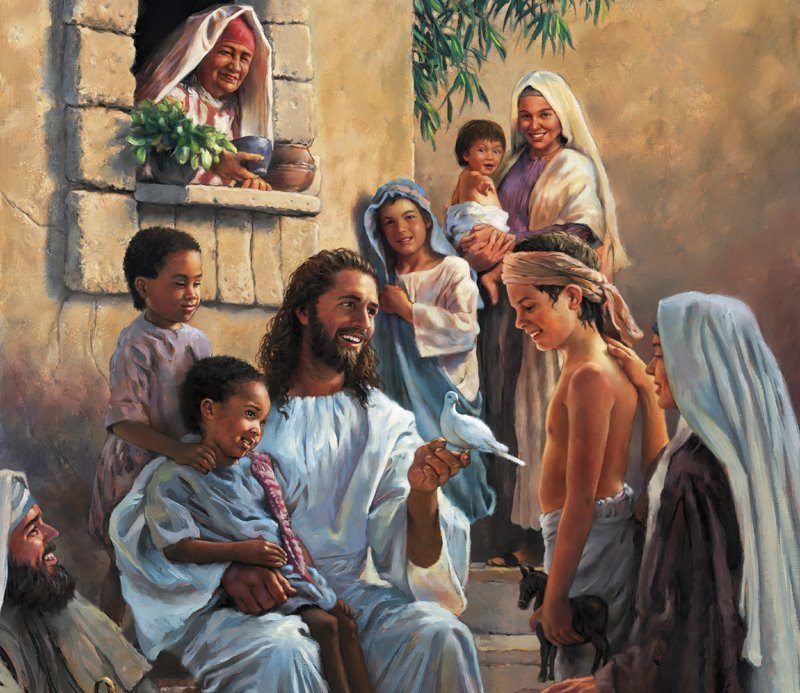
The disciples decided Jesus was too busy and too important for children to be brought near. Our gentle Shepherd not only welcomed the little ones but told his followers that they must all become as children.

How often do I undervalue someone else’s Christ encounter because it isn’t expressed in eloquent or even coherent words?

How often do I minimize the power of grace and mercy to change a heart or a life because the changes I expect or want to see aren’t the ones I can observe and fit neatly into categories?

Religious profiling is a thing, y’all.

We tend to interpret others’ experiences in light of our own and the traditions with which we are familiar and comfortable. When someone comes to us with a tale of an authentic spiritual encounter that falls outside those boundaries, it’s easy to dismiss it.

Imagine Moses walking back home after meeting God in the burning bush and trying to explain THAT to those he lived with!

It’s not my place to authenticate or validate how the Lord chooses to work in another person’s life and heart.

As long as what they share is consistent with Scripture I should welcome them as Jesus does.

Whom do we spiritually underestimate? The elderly? The young? The poor? The wealthy? The beautiful? The disabled? What group or class of people would we have turned away from Jesus?….Today ask God to shine His light upon any form of religious profiling in which you are dismissing those Jesus would welcome.

Alicia Britt Chole

This video and song are particularly dear to my heart. William Wilberforce fought for the abolition of slavery in Britain for most of his adult life.

He was considered lots of things-crazy among them-but stayed the course in spite of illness, discouragement and seeming failure because he was convinced God had called him to the task.

Many well-meaning Christians questioned whether or not he had really heard from the Lord.

Hindsight makes it clear they were wrong.

**As promised, I am sharing thoughts on 40 DAYS OF DECREASE (a Lenten journal/devotional). If you choose to get and use the book yourself, I’ll be a day behind in sharing so as not to influence anyone else’s experience.**

Lenten Reflections: Letting Go of the Need to “Fix It”, Making Space To Watch God Work

As a people-pleasing firstborn pseudo-control-freak I’m all about fixing it.

I’m pretty sure I chose Psychology as one of my college majors because I figured it would better equip me to fix relationships around me.

But life intervened with first smaller unfixable crises and then the ultimate no-way-on-earth-to-fix-it death of Dominic. So I’m not nearly as inclined toward even trying now as I was a few years ago.

Still, I can find myself falling into the old habit of offering up advice instead of offering an ear. I might quickly delve unasked into my own experience and silence a heart that simply needs to be heard. I may well toss out trite “reasons” that “explain” why awful visited my friend while God seemed silent.

Part of the compulsion results from the author’s observation:

The church in general panics when miracles miscarry. We scurry clumsily about to prop up God’s sagging reputation. There must have been a problem, we offer. God must have something even better around the corner, we propose. Must He? Here, then is my Lenten plea for the day: let the mourning mourn. Grant those who grieve the dignity to ask questions. Bestow upon the bewildered permission to not edit their honesty.

Alicia Britt Chole

Recall miracles that ended in heartbreak…when, if ever, have you felt the need to “prop up God’s sagging reputation”?

How might you choose a different approach that grants grace and space to those who mourn?

**As promised, I am sharing thoughts on 40 DAYS OF DECREASE (a Lenten journal/devotional). If you choose to get and use the book yourself, I’ll be a day behind in sharing so as not to influence anyone else’s experience.**

Mardi Gras and Ash Wednesday-What a Contrast!

I think I will post this link as long as I maintain the blog because I will always be a voice for those whose lives look more like Ash Wednesday than Mardi Gras.

I will continue to speak out for space in our congregations and fellowships that acknowledge life is often hard, often unfair and often more like a broken hallelujah than a high note.

I am not a member of the Church of the Perpetually Cheerful. 

I am a member of the Broken Body of Christ, limping through this world, holding on to hope with both hands.

Read the rest here: Mardi Gras and Ash Wednesday: A Study in Contrasts

How We Can Make Church a Safe Haven For The Brokenhearted

f you have lived a blessed life where the greatest challenge to your faith has been disappointment and not destruction then I am so, so happy for you. Really.

Some of us have dragged our broken hearts through the church doors out of habit with little hope we might find the genuine comfort we need to survive inside.

Because experience taught us that while it is perfectly acceptable to raise a hand and ask for prayer one or two weeks in a row, it better not become a predictable pattern. Patience with unsolvable and messy ongoing situations runs thin as leaders turn the discussion toward “victory in Jesus”.

But that isn’t what Christ came for-not that we don’t have ultimate and even some temporal victory through Him.

He came for the broken and breathless. He came in the flesh because our flesh is weak and life is hard and bad things happen.

We’ve got to do a better job welcoming and ministering to hurting hearts.

We have to.

❤  Melanie

I am a shepherd.  My goats and sheep depend on me for food, for guidance and for their security.

And every day I am reminded that a shepherd’s heart is revealed by the way he or she cares for the weakest and most vulnerable of the flock.

But most of us are far removed from the daily reminder of pastoral life that was commonly accessible to the authors and readers of the Bible thousands of years ago.  So it’s no surprise that we tend to forget the connection between a shepherd’s life and a pastor’s calling.

Read the rest here: Loving Well: How the Church Can Serve Grieving Parents and Other Hurting People

Grief is a Family Affair: Tips for Interacting With Bereaved Families

I think the mama is often the first person others think about when they hear a child has run ahead to Heaven.

But child loss affects dads too.

And it’s often sibling loss as well.

Grief is truly a family affair-each member is changed by the experience and they ALL need support.

I firmly believe that our friends and extended family want to reach out, want to help, want to walk alongside as we grieve the death of our child

 I am also convinced that many of them don’t because they don’t know how.  

It may seem unfair that in addition to experiencing our loss, we also have to educate others on how to help us as we experience it, but that’s just how it is.

The alternative is to feel frustrated and abandoned or worse.  

Read the rest here: Child Loss: Helpful Tips for Interacting With Bereaved Families

A Grieving Heart

In the last post I shared the difference between mourning and grief. While the outward ceremonies have long passed, the inward struggle to embrace and understand the pain and sorrow of losing my son continues.

If you love someone who has lost a child, perhaps these thoughts might help you understand a bit of their pain and how completely it changes the way bereaved parents encounter the world.

Please be patient. Please don’t try to “fix” us. Please be present and compassionate. And if you don’t know what to say, feel free to say nothing-a hug, a smile, an understanding look-they mean so very much.

 ❤ Melanie

A bereaved parent’s grief doesn’t fit an easy-to-understand narrative. And it flies in the face of the American “pull yourself up by your bootstraps” mentality.

You can’t beat it–it’s not a football game-there is no winning team.

You can’t lose it–it’s not the extra 10 pounds you’ve been carrying since last Christmas.

You can’t get over it–it’s not a teenage love affair that will pale in comparison when the real thing comes along.

You can only survive it.  You can heal from it, but it will take a lifetime and require very special care.

Read the rest here: Loving Well: Understanding the Grieving Heart

How to Transition from “Good-bye” to Grief

A funeral or memorial service seems like a final chapter.  We close the coffin, close the doors and everyone goes home.

But for bereaved parents and their surviving children, it’s not an end, it is a beginning.

Much like a wedding or birth serves as the threshold to a new way of life, a new commitment, a new understanding of who you are, burying a child does the same.

Read the rest here: Loving Well: Transitioning From “Good-bye” to Grief