I always like to share this post after a holiday because I never want any hurting heart to think the pain they feel “the day after” is not a normal part of the grief journey.
It is absolutely, positively NORMAL to feel more anxious, more sad, more lonely, more despair once the plates are cleared away and everyone else has returned to their respective homes.
Grief is funny that way-sometimes the very busyness and noisy conversation we dread so much BEFORE a big day turns out to be a good distraction from the quiet desperation and longing that would otherwise demand attention.
And then…in the quiet, in the stillness it all comes crashing down.
It’s a paradox really-that grieving hearts can be more anxious and more sorrowful BEFORE and AFTER a milestone day, birthday or holiday than on the day itself.
That’s not true for everyone, but it’s a frequent comment in our closed bereaved parent groups.
If you woke this morning feeling more broken than blessed, I see you.
If you could care less about the bounty on the table and can only feel the barrenness in your heart, I know how you feel.
Today doesn’t have to be any special way, my friend. Give yourself grace. Give yourself permission to feel what you feel and do what you do and not do what you can’t do.
❤ Melanie
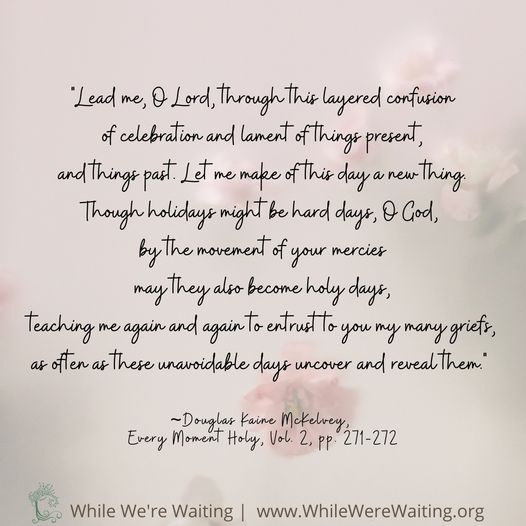
THANKSGIVING PRAYER FOR HURTING HEARTS
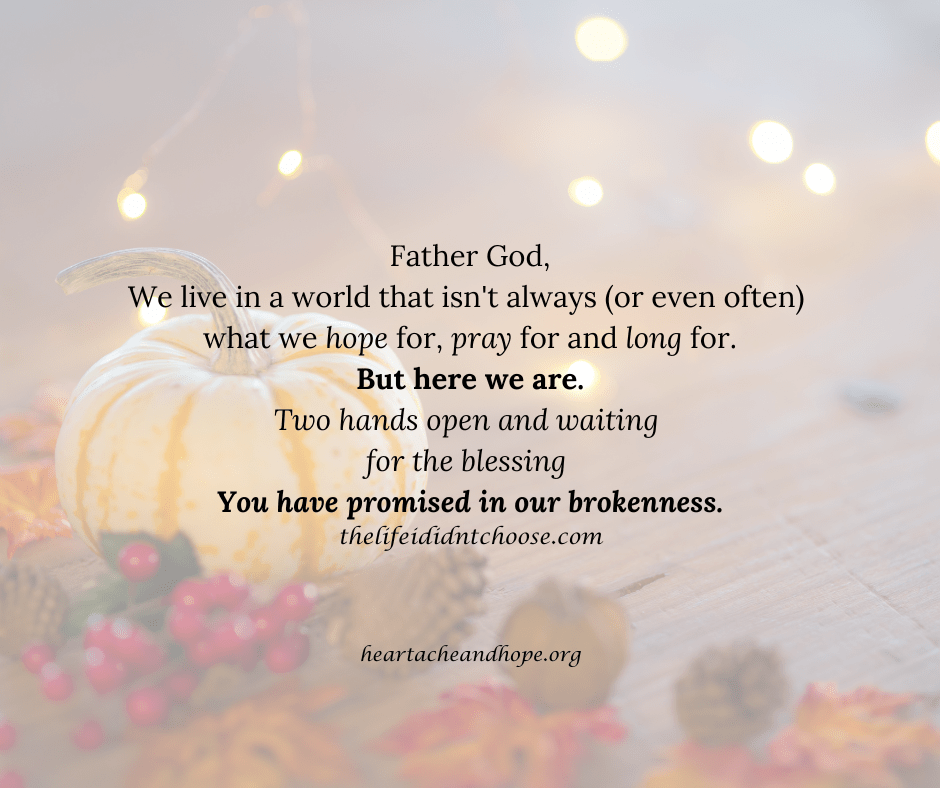
Father God,
We live in a world that isn’t always (or even often) what we hope for, pray for and long for.
But here we are.
Two hands open and waiting for the blessing You have promised in our brokenness.
I am oh, so thankful for the many ways You have blessed me, continue to bless me and uphold me with Your righteous right arm. I know, know, know that if You were not walking with me in this Valley, I would have given up and given in long ago.
I am not ungrateful. I am blessed.
But I am also broken.
My heart longs desperately for what it cannot have. I am forced to walk forward but I want to turn back time. I’m grateful for every face around my table but always thinking about the one that will never sit there again.
I miss those I love who have run ahead to joyous celebration in Heaven. I long for just a taste of divine joy as I wait my turn to join them.
Thanksgiving big and loud just isn’t in my playlist anymore. Quiet gratitude that makes space for sorrowful reflection is more my style.
Make me truly thankful for the promise that no matter how often circumstances change or how dreadful those changes may be, You are the same-yesterday, today and forever!
Your steadfast love holds us fast. I rest in that truth.
Help me hold onto hope. Help me hold onto every good and perfect gift You still give me as I wait. Grease the wheels of every relationship with grace.
Greet me this morning with new mercies and fresh strength.
Give me the strength to endure, the grace to participate, the breath to speak love and the confidence that you see every tear I shed when no one is looking.
When I celebrated my fiftieth, I had so many dreams and plans! I couldn’t have imagined that the next ten years would be filled with the heartache of child loss, along with all the hope and joy of an expanding family.
But here I am.
Definitely older and, I would like to think, a little wiser.
Wiser to the truth that no one escapes pain in this life. Wiser to the fact that joy and sorrow can coexist. Wise enough to know by experience that sometimes the very best thing you can do is shut your mouth and open your arms to a hurting heart. Wise enough to realize that birthdays for bereaved parents are often complicated.
I wrote this post several years ago but share it annually because unless you’ve sent a child ahead to Heaven, you might not realize how very tricky birthdays can be for the parents left behind.
❤ Melanie
Tomorrow is my birthday.
And while I am truly grateful for another trip around the sun, since Dominic left us it’s not a simple celebration of life lived and the hope of years to come.
The last birthday I had with an unbroken family circle was a lovely surprise party for my fiftieth held in Dom’s apartment.
Rocking babies I never dreamed that one day my life would look like this.
I never imagined that one of those tiny bodies I held close to my mama heart would not outlive me.
Now I sit in the same rocking chair in the dark, thinking about how so many things I wouldn’t have written into my story are now part of it.
And if I’m honest, it can easily overwhelm my heart. It can carry me to a place of despair and desperation where there’s no room for thanksgiving-not the holiday OR the feeling.
Here we are-the eleventh year of holidays without Dominic-and I’m no better at it than I was at first.
We are days away from plunging headfirst into the rough and tumble holiday season.
Thanksgiving is coming fast and I don’t know about you, but it seems that once I eat the turkey and dressing, the clock moves faster and the days crowd one another in a race to Christmas and the end of the year.
So I want to take a minute to think about how important it is to make and maintain space for grief during this busy season.
But it can feel oh, so lonely amidst the lights and the laughter when the one name you want most to be spoken aloud just isn’t.
So what are some practical ways to include our missing child in holiday celebrations?
I, and three other bereaved moms, together with Our Hearts are Home, shared thoughts and ideas on how to remember -in a tangible, physical way-our child during the holidays.
Two common themes tie them all together: (1)represent your child in a meaningful way that is authentic to who they are; and (2) help lead others into the knowledge that it is not only OK to talk about your child but downright joyful to hear it (even if it makes you cry).
Not every idea will suit every family but there is probably one (or more!) that you might find suit yours.
So here they are.
THANKSGIVING
Light a candle (real or battery powered) and put it in a prominent place or as part of a centerpiece. You can attach a lovely tag or put a picture next to it or somehow otherwise indicate that it is in honor of your child.
Memory candles of all sorts are available to order and ideas for making them are easily found online. They often have names and (if you want them) dates etched directly onto the candle or on a container designed to hold a candle.
Photographs are always wonderful. Some families set a place for their missing child or have a separate chair set aside to note their absence. Pictures can be placed on the table, on a side table next to a child’s favorite dish or in some other spot. It’s a Jewish tradition to include photos of all close family members gone before during Sukkot (a biblical holiday many feel is the precursor to our Thanksgiving) as a way to remember and honor ongoing ties and love
Cook your child’s favorite dish and put a note next to it that says so. Perhaps bring copies of the recipe or, if something that lends itself to this, prepare take home boxes with a serving or two for family members to relish and remember later. Mention to others sharing the meal that this is your child’s favorite and why. It’s a great way to encourage natural conversation.
Share why you are thankful for your missing child. This can be done in the context of offering thanks for other family members who have joined you and for those who are no longer present if you feel awkward or expect pushback from family members.
Provide a ceramic plate with your child’s name in the center and acrylic paint markers. Have family and friends write one word that they think of when they think of your child. Directions for curing the paint and making it permanent can be found online.
Donate a holiday meal in their honor through a local food bank or charity.
Watch a favorite movie or show and share memories of why it’s a favorite.
Create a memory table by asking guests to bring something that reminds them of your child. During your time together, ask the guest to share why they chose that item.
Create a Thanksgiving memory journal. Ask others to write a memory in it. You can add to it each year.
Do an act of kindness in their honor.
Share stories. One of the things I’ve learned is that if I don’t bring Dominic up and “give permission” to others, they often won’t either. Share about your child in Heaven just as you would one that is here on earth. Every family has a story about that “one Thanksgiving, so and so did…” .
Provide a family photo album of Thanksgivings past. These will naturally spark conversation about memories, about the lives and love of those no longer present and give bereaved parents a great opening to speak about their child.
Leave an empty chair or place setting.
Participate in a Thanksgiving walk or run in their honor. There are lots of 5Ks around this time of year and almost anyone can participate. Get a group, dress up honoring your child and (turkey) trot on!
You might just want to visit their grave or a special place that is meaningful to you.
Send thank you notes to those who were special to them or played a part in their lives. The first Thanksgiving after Dominic left for Heaven, I wrote notes to everyone I could think of who had shown up or helped our family in some way during those early days.
CHRISTMAS
Hang ornaments that represent your child. Some parents do a separate tree for their missing child (and some keep it up all year).
Hang your child’s stocking along with the others. You can write letters to your child and encourage other family members to add their own. You can ask family members to fill the stocking with gift cards that can be donated in your child’s name to a charity that represents his or her heart.
Volunteer to serve at one of the many organizations that need extra help this time of year.
Listen to favorite songs. It’s easy to make an entire dedicated playlist of songs that remind you of your child or are your child’s favorites.
Buy a gift they’d like and give it away. Many parents purchase gifts for a child who would be the same age as their child this year. You can get names from your local DHR or from churches or other organizations.
One family who draws names for Christmas asked family members to purchase a present that began with their daughter in Heaven’s first initial.
Adopt a family and provide Christmas for them in your child’s honor.
Make a memory chain for the tree. One mom said her daughter had family and friends write a memory on the strips and then put them together in a chain. It could be lengthened each year.
Purchase a poinsettia at church remembering your child.
Give an item that belonged to them to someone who would treasure it. This one can be hard because it’s difficult to release those physical objects our child last touched. But if/when you are ready, it can be a truly beautiful and special act of remembrance.
Make cookies for caregivers or others who helped during a prolonged illness or hospital stay. Make cookies for first responders in your own community.
Memory table runners are easy to purchase or make. Have guests write a favorite memory using permanent markers.
Make a story book of their life and display it where others can see it and enjoy it.
Make or purchase an ornament with their handwriting imprinted to give to family. Because Dominic left for Heaven when my other children were also leaving home, I have made or bought ornaments every year that represent our family and include names. Dominic’s is always included.
(Of course, you could do most of the things listed for Thanksgiving as well.)
I’ve written a lot about surviving the holidays after child loss and will be sharing many of those posts in the coming weeks.
But there are a few thoughts I want to leave you with that I pray provide some hope for any heart dreading the next seven weeks.
Soon after Dominic ran ahead to Heaven I realized all the trappings I associated with Thanksgiving and Christmas were not essential to the primary ideas embodied in both holidays.
Thanksgiving is about setting aside time to express gratitude to God for what He has done, is doing and will continue to do.
I can still manage that.
Christmas is a celebration of the Light coming into a dark world.
This broken heart can definitely get behind that any day.
So, in the end, if your heart cannot bear the thought of one more holly jolly song, one more hap-hap-happy get together, one more frenzied rush to the store for a forgotten present or pantry item—just choose to sit this one out.
I hid this post in my draft folder for months before I published it the first time.
It seemed too raw, too full of all the pain inside my mama heart to put out in the wide world for everyone to see.
And then it was time (like now) to change the flowers on the place where my son’s body rests and I couldn’t stand it anymore.
I wanted to scream at the top of my lungs, “THIS IS NOT ALL THERE IS OF MY BOY!”I wanted to stop people on the street and make them listen to his story, to give away a piece of him for others to carry in their hearts.
It’s been over two decades since the Towers fell.Hard to believe-no matter how great the tragedy, life goes on.
Like many, I was watching things as they happened that day.
My husband, an architect and engineer, saw the wobble in the first tower and knew, he knew, it was going to collapse. Horrified I began to understand that whoever was still in that building was running out of time.
And I cried, oh, how I cried.It was awful.
Since then I’ve lived my own tragedy.
My son was unexpectedly and instantly taken from us in an accident.
So when I’m reminded of 9/11 my heart takes me right to those left behind.
And while politicians and pundits can debate the reasons for the attack, can argue about what could have been done, should have been done and why and when-they can never answer the real question in the heart of every family who buried a loved one because of the events of that day.
Why MY husband, wife, daughter, son?How do I make sense of this senseless tragedy?
The answer is, “You can’t.”
You cannot know why one person chose to go this way and lived and another went a different direction and died. It’s impossible to understand the series of events that made someone late for work that day but lead another to show up early.
Last minute travel plan changes saved some from being aboard the fateful planes and put others in a seat.
I can’t know exactly why my son lost control of his motorcycle that night. I will live the rest of my life without an answer to that question.
It’s an ongoing challenge to face the discomfort of things NOT making sense. It goes against human nature to acknowledge that the world is far less predictable than we like to believe.
It takes courage to greet each new day with knowledge that ANYTHING might happen-not only beautiful and wonderful things, but ugly and awful things as well.
If I let my heart dwell on the questions of “why?” and “control”, I am paralyzed, unable to take another step.
There’s no clear path through a world filled with the rubble of broken lives and broken people.
So I turn my heart toward Christ and His promise to never leave or forsake me.
And I am emboldened to take the next step because I know He is already there, even in the dark.
There are things to do, places to go, people to see, animals to feed.
I get up, get going and get on with it.
But there are some days that are what I call “Hard Stops” on this journey. They are the days that force my heart to take special notice of the fact that Dominic isn’t here.
Sometimes they are milestone dayslike birthdays or holidays or the anniversary of that awful knock on the door.
Sometimes they are events where he should be there-like seeing his brother one more time before he deploys half-way around the world.
These days make my heart measure the time since I last hugged his neck, heard his voice, saw his strong, square hands reach across the table for the salt shaker-and I am overcome with how long it has been!
Then my heart shifts to the months and likely years I will have to live with this aching empty place where he should be but isn’t and I fear I just can’t do it!
Many days I’m able to distract myself from the sorrow and to live with the missing.
But these “hard stop” days force me to face it head on. and it is overwhelming.
Every. Time.
So what do I do?
When my heart is overwhelmed, I take it to the Rock that is higher than I.
I run to the Refuge of my Faithful Father.
I turn my eyes to my Savior Who will redeem and restore.
I put my hand firmly in the hand of my Shepherd Who will not leave me in this Valley of the Shadow of Death.
And I pray for myself-and every heart having a hard time holding onto hope today-that we will feel the Father’s loving arms around us and that He will give us strength to stand.
You plan to mark this day as a special milestone for the rest of your life.
You absolutely, positively NEVER think you will have to mark another one: the day he or she leaves this life and leaves you behind.
But some parents have to mark both. The dash in the middle is shorter than we anticipated, and our child’s life ends before ours.
So how do you do it? How in the world do you observe the polar opposite of a birthday?
Here are some ideas (shared with permission) that parents shared recently in an online discussion sparked by one mom’s very honest admission that she just didn’t have it in her to create another video montage from the same old photos to mark yet another year without the earthly companionship of her precious son:
Don’t do anything. That is an option. We do not have to draw a red circle around THAT day on the calendar, gather folks as if it’s a celebration. As one mama said, “Yes, the day they left us does not need to be ‘remembered’.” For some parents, going to work like it’s a regular day, engaging in whatever normal activities are required, ticking the hours off on the clock until night falls and the earth turns to the next day may be the very best choice. Another mama wrote this: “I have friends who celebrate a ‘heaven day’ for their son. I can’t. I just can’t. If it were up to me, I would probably go camp somewhere all alone, and not move a muscle for the entire day.”
Do something big (or small). Some parents choose this day to hold an annual “Celebration of Life”. It might take the form of a balloon release, or lantern release at home, at a park or other outdoor venue or at the cemetery. It might be lunch or dinner out at your child’s favorite restaurant or at home with your child’s favorite menu. Invite friends and family to join you and ask that they bring a photograph or memory and share. One mom said that such an event kind of happened organically and spontaneously when contacted by her son’s widow: “We went to one of [his] favorite restaurants. Told funny stories about him, talked about how missed he is, then went o his grave and put fresh flowers.”
Serve others. Did your child have a special interest in a particular charity or community organization? Maybe you can spend this day volunteering or raising awareness/money for that group. Often having something to do helps a heart from sinking into despair. If the group allows, maybe put up a sign saying, “Volunteering today in honor of __________” and attach appropriate photos of your child. Some parents whose child died from cancer or suicide or violence participate in walks or fundraisers that highlight those causes.
Encourage Random Acts of Kindness (RAK). I plan to do this one in April. It will be seven years (!) and I can barely stand it. But so many of the comments from Dominic’s friends after he left for Heaven went something like this one, “He was always doing something for someone else. Fixing their car or showing up when they needed an encouraging word.” He was known for his many acts of generosity and kindness and I feel like he lives on in the hearts of others because of that. I had cards printed ( I intentionally let his “dates” off) which I will distribute well in advance of April 12th for friends and family to leave behind when they do a RAK in memory of Dom. Vistaprint and other online publishing companies offer reasonable prices and will guide you through the process step-by-step.
Escape. Lots of us find being at home (alone or in the company of others) too hard to bear. Many received word of their child’s death at home and as the day creeps closer, the memories crowd every corner of mental and physical space and are inescapable. So sometimes parents plan a trip around this time. Go somewhere your child would have loved to go or go somewhere he or she enjoyed visiting. Take photos and post them in honor of your child if you want to.
Focus on family. You may not want to be alone, but the thought of being with anyone outside your closest grief circle is overwhelming. That’s OK. Spend time with the people who, like you, are most affected by your child’s absence. You don’t have to do anything special. You can make room for them to speak or not speak about their grief as they choose. Sometimes just having another warm body in the room is enough to ward of the chill of despondency.
Flip the script. For those of us who believe that this life is not all there is, the day can be one of celebration. Our children have escaped life full of sorrow and trouble and are safe forever in the arms of Jesus, where we will also be one day. Waiting is hard, but waiting is not forever.
Simply allow yourself to feel the full force of missing and grief.“As far as his death day, for me, that is a day when I allow myself to fully feel and express the pain of my loss. It is a way to (temporarily) empty myself of all this pain, so I can breathe again to face another day. I will sit in his sweatshirt, listen to reflective music, cry a lot, talk to him, pray to God, and just allow myself to feel all the pain and emotion that everyday responsibilities cause me to stuff away.” If you can manage it, taking the day off work and giving yourself grace and space to grieve in ways that are denied so often may be the very best way to experience the day.
Here’s a list of ways some parents honor their child on this day:
Giving away stuffed toys with a card or note explaining why.
Taking goodies to first responders and/or nurses who were served their family during an accident or illness.
Handing out Bibles or books in memory of their child.
Making memory baskets for parent whose child will be born straight into heaven.
Adding to a scholarship fund or other charitable fund in honor of their child.
Placing balloons, flowers or other special decorations on their child’s final resting place.
Lighting candles, releasing butterflies, balloons or lanterns.
Placing a memorial advertisement in a local paper.
Do or don’t do whatever helps you make it through those twenty-four hours that represent another year of sorrow, another year of missing.
There is NO wrong way to mark or not mark this day.
It’s up to you and your heart.
And absolutely does not require anyone else’s permission or approval.





















 thelifeididntchoose