Grief Work 2025: Loss is Relentless

My family has opened our eyes to thousands of mornings knowing the one thing we would change if we could is outside our control.

When the world faced the pandemic these past years, it was a new and disturbing feeling for millions (billions?). We are still reaping the consequences of decisions taken during that time.

Eventually, though, most people’s lives have returned to a semblance of normal that makes allowances for the changes.

But some of us emerged on the other side of that season carrying the new and unrelenting burden of loss.

And nothing will ever be normal again.

re·lent·less

adjective

oppressively constant; incessant.

Synonyms:  persistent, continuing, nonstop, never-ending, unabating, interminable, incessant, unceasing, endless, unremitting, unrelenting, unrelieved.

please be aware i am trying

Grief Work 2025: Healthy Boundaries in Grief

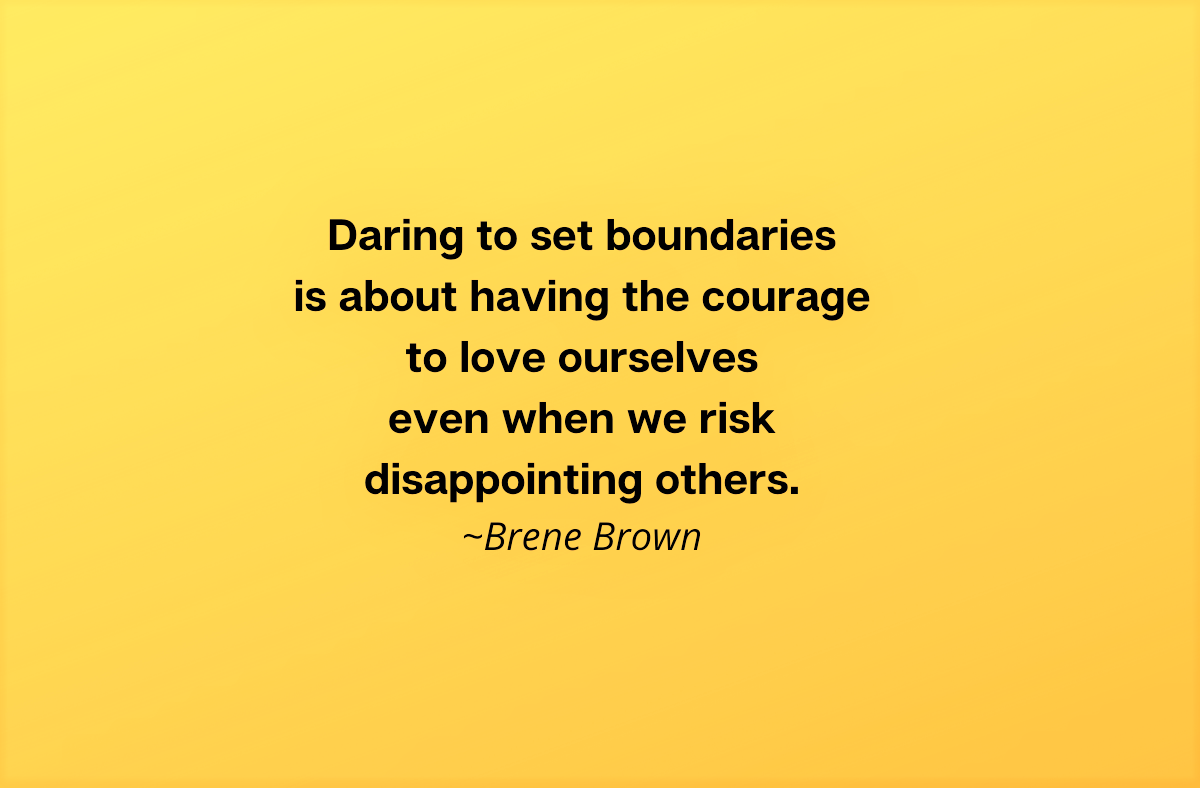
As a people-pleasing first born who hates conflict, giving in has always been  easy for me. It’s only later that I wish I hadn’t.  

So for most of my life, setting personal boundaries has been challenging.

But in the aftermath of child loss, healthy boundaries are no longer optionalthey are necessary for survival.  

So what are healthy boundaries?

  • Saying “no” without guilt
  • Asking for what you want or need
  • Taking care of yourself
  • Saying “yes” because you want to, not out of obligation or to please others
  • Behaving according to your own values and beliefs
  • Feeling safe to express difficult emotions and to have disagreements
  • Feeling supported to pursue your  own goals
  • Being treated as an equal
  • Taking responsibilty for your own emotions
  • Not feeling responsible for someone else’s emotions
  • Being in tune with your own feelings
  • Knowing who you are, what you believe, what you like

~sharonmartincounseling.com

What does this look like in real life?

  • Not being “guilted” into engaging in social/family/church activities before I am ready
  • Letting family and friends know when I need encouragement, companionship, solitude, help or space
  • Keeping or making doctor’s appointments and staying on top of my physical well-being by sleeping/eating/taking medication/exercising as best I can
  • Participating in what is helpful and life-giving to me when I want to and not because I feel like I have to.  
  • Giving myself space and time to figure out how losing a child impacts my beliefs, my sense of self, my understanding of the world-being honest about questions and about struggles.  If I have to take a break from church for awhile, that’s OK.
  • Expecting support from friends and family to do the work grief requires.  If some in my circle can’t do this, then I’ll put those relationships on hold until I feel stronger. I am not required to live up to other people’s standards.
  • Embracing and acknowledging my own emotions.  Not expecting someone else to “make me better”.  No one can take away the sorrow and pain of child loss.  It is excruciating.  There is no way through but THROUGH.  Face the feelings.  Get help from a counselor if necessary.  Join a support group.  Find safe friends.  But I will not be able to distract myself or ignore the heartache forever.
  • Understand that though I share the loss with others-a spouse, my surviving children, my child’s grandparents, etc-I am not responsible for how they are dealing with loss. I may offer help, may arrange counseling (especially for children), should strive toward an environment where feelings can be expressed-but I can’t work through their loss experience for them.  
  • Pay attention to my own feelings and what triggers grief attacks.  When I can, plan around the triggers.  When I can’t, accept the feelings and go with them.  If I need to leave a venue, leave.

What it doesn’t look like:  

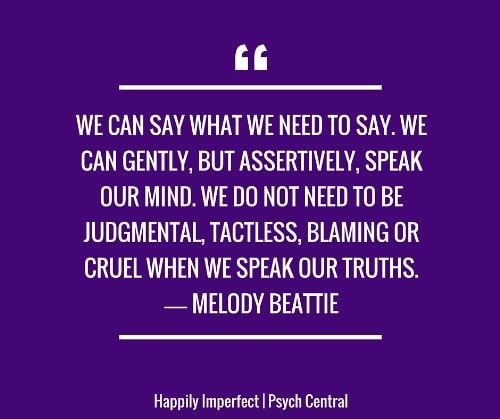
Healthy personal boundaries are not an excuse for bad behavior.  They are not to be used as blunt instruments to bully others into submission or to advance my own agenda against theirs.

My boundaries don’t give me the right to be hateful, hurtful or unkind.  They are not permission to pitch fits, make public displays or belittle others.  

say-what-we-need-to-say-gently

And they are absolutely NOT a reason to plaster hate speech across social media.  If I have a personal relationship issue then it needs to be handled personally and privately not publicly. Vague Facebook statuses that suggest I’ve been offended by half my friend list are off limits.

Establishing healthy personal boundaries is work.  

Already exhausted from grief, the last thing I want is more work.

But if I don’t defend the space and time I need to do the work grief requires I cannot make progress toward healing.

If I don’t limit my interaction with those who are unhelpful or downright hurtful, I will be dragged down further in the mire of sorrow and sadness.

If I don’t purposely pursue physical, emotional and psychological healthgrief will kill me.

Grief Work 2025: Will it Ever Get Better?

I know that when I first stumbled onto a bereaved parent group, it was one of the things I was looking for: evidence that the overwhelming pain of child loss would not last forever.  

Some days I was encouraged as those who had traveled farther down this path posted comments affirming that they could feel something other than sorrow.

Some days I was devastated to read comments from parents who buried a child decades ago asserting that “it never gets better”.

Who is right?  

What’s the difference?

Do I have any control over whether or not this burden gets lighter?

It was eleven years in April since Dominic ran ahead to Heaven and I’ve learned a few things since then.

letting-go

Time, by itself, heals nothing.  But time, plus the work grief requires, brings a measure of healing.  

If I cling with both hands to my loss, I can’t take hold of the good things life still has in store for me.  

Longing for the past all the time only brings sorrow.  I cannot turn back time.  Days, weeks, years will keep coming whether or not I choose to participate in them.  I will rob my heart of potential joy by focusing exclusively on the sorrow I can’t undo.

Daily choices add up.  When I lean into the small things required each day, I build confidence that I can do the bigger things that might still frighten me.  Making phone calls eventually helps me show up to a meeting or to church.  I strengthen my “can do” muscle every time I use it.

Doubt doesn’t disappear. Facing my doubt forces me to explore the edges of my faith.  It does no good for me to stuff questions in a drawer and hope they go away.  They won’t.  I have to drag them into the light and examine them.  Doubt is not denial.  If God is God (and I believe that He is!) then my puny queries don’t diminish His glory.  He knows I’m made of dust and He invites me to bring my heart to Him-questions and all.

My mental diet matters more than I might think.  I have to be very careful what I feed my mind.  If I focus on sadness, tragic stories, hateful speech and media that feeds my fears and despair then those feelings grow stronger.  If instead I focus on hopeful stories, good conversation with faithful friends and inspiring quotes, verses and articles I feed the part of my heart that helps me hold onto hope.

I need a space where I can be completely honest about what this journey is like.  Bereaved parents’ groups have been that space for me and have been an important component of my healing.  But even there I must be cautious about how much time I spend reading other parents’ stories if I notice that I’m absorbing too much pain and not enough encouragement.

me too sharing the path

Grief is hard.  

It’s work. 

And that work is made up of dozens of daily choices that are also often difficult.  

I don’t expect to be healed and whole this side of eternity.  But I do know that if I consistently do the work grief requires I will be stronger, more whole and better able to lean into the life I have left than if I don’t.

I want to live. 

I want to honor my son by living a life that’s more than just limping along, barely making it, struggling for each step.  

So I do the work grief asks of me.  

Even when it’s hard.  

give yourself space to do the work grief requires

Grief Work 2025: Forgiving Others

There are lots of opportunities for offense surrounding the death of a child.

Once your heart is broken open wide with great sorrow, there’s no defense against the bumps and bruises that are a natural product of human relationship and interaction.

  • Friends and family that didn’t show up.
  • Friends and family that showed up but said or did the wrong thing.
  • Friends and family that abandoned me as soon as the casket closed.
  • People that make me feel guilty for grieving or question my sanity or my “progress”.

But I’m learning to let go of offense.

Not only because it is too heavy to carry in addition to my grief, but because the Lord has commanded it.

❤ Melanie

I grew up reciting what’s commonly called, “The Lord’s Prayer” without much thought to the individual phrases or their meaning. It wasn’t until adulthood that I read it in context and continued on to the rest of the chapter.

What I found there was chilling.  

These are some of the hard words of Christ that most lay persons and many theologians prefer to gloss over.

“For if you forgive other people their failures, your Heavenly Father will also forgive you. But if you will not forgive other people, neither will your Heavenly Father forgive you your failures.”

~Jesus (Matthew 6:14-15 PHILLIPS)

WOW!  The plain reading of this text tells me that if I refuse to forgive othersI place myself outside the forgiveness of my Father.

It makes sense though-if my sins were borne by Christ on the cross, then so were yours.  

If His grace covers me, it covers you.  

If I want to be seen through the eyes of mercy, then I must be willing to look through those same eyes at my fellow man.

At first this feels like bondage instead of freedom.  

But the truth is, forgiveness is liberating.  

It sets me free to operate in the fullness of who I am in Christ.  It forces me to trust Him with my pain, with my sorrows, with my offenses and with balancing the scales of justice.

forgiveness-quote-charles-stanley

Forgiveness opens the path to relationship and community.  It testifies to the mercy and grace of God.  

It shines like a beacon of light in a dark world.  

It is the power of Christ in me.

To forgive another person from the heart is an act of liberation. We set that person free from the negative bonds that exist between us. We say, “I no longer hold your offense against you” But there is more. We also free ourselves from the burden of being the “offended one.” As long as we do not forgive those who have wounded us, we carry them with us or, worse, pull them as a heavy load. The great temptation is to cling in anger to our enemies and then define ourselves as being offended and wounded by them. Forgiveness, therefore, liberates not only the other but also ourselves. It is the way to the freedom of the children of God.

~Henri Nouwen

forgiveness_is_the_fragrance_that_the_violet_sheds_on_the_heel_that_has_crushed_it-385646

Grief Work 2025: Faith and God’s Strength

A little review as we get to the last post in our series: Trying to stuff or hide my pain from myself, God and others is fruitless and unhelpful.

I’ve got to breathe out the sorrow, doubts, angst and disappointment to make room for the life-giving breath of Truth and the Holy Spirit.

And then I need to do one more thing. I must appropriate the strength and courage of my Savior-the Author and Finisher of my faith.

It is possible to endure. It is possible to finish well. It is possible to hold onto hope and follow the Light and Love of Jesus through this Valley.

 ❤ Melanie

My friend and fellow bereaved mom, Margaret Franklin, Ryan’s mom, shared a beautiful Dutch word with me “Sterkte” (pronounced STAIRK-tah).

It literally translates “strength” or “power” but culturally means much more.  It means bravery, strength, fortitude and endurance in the face of fear and insumountable odds through the empowering strength of God in me.

Not MY strength, but HIS.

It’s the strength Isaiah meant when he wrote:

But they that wait upon the Lord shall renew their strength; they shall mount up with wings as eagles; they shall run, and not be weary; and they shall walk, and not faint.

Isaiah 40:31 KJV

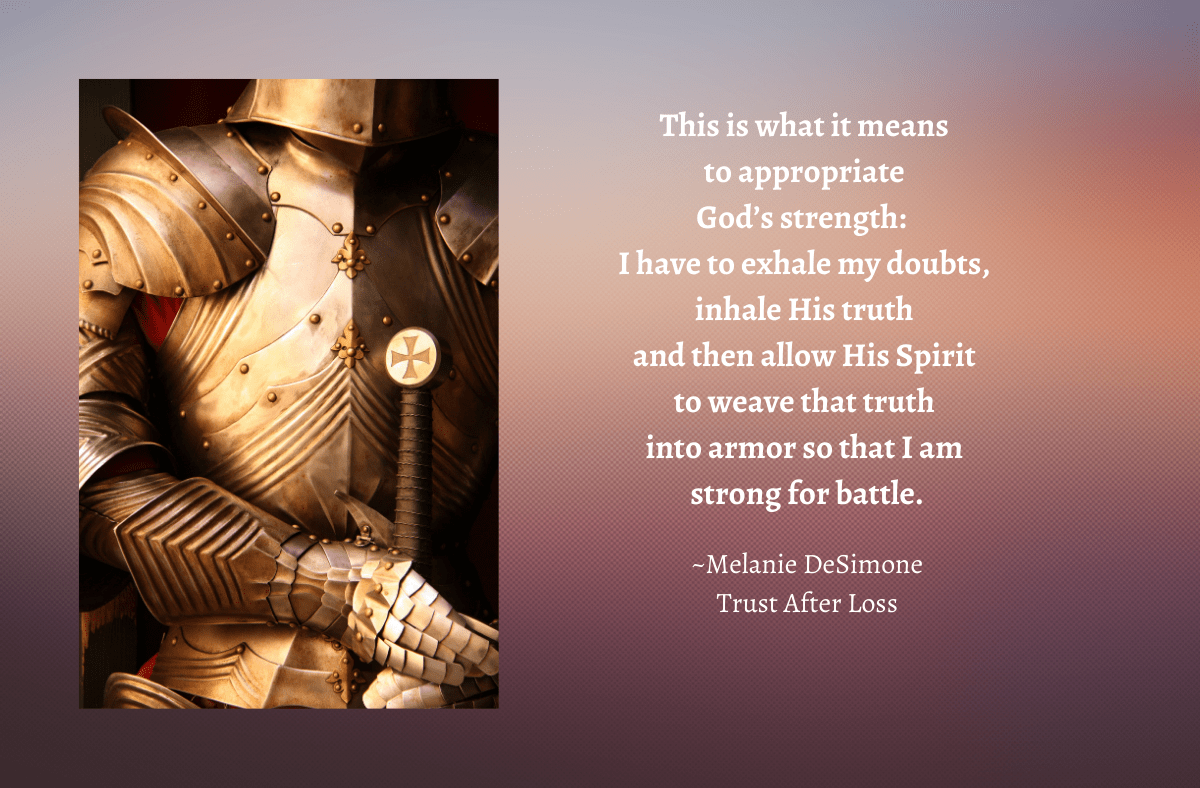
This is what it means to appropriate God’s strength:

I have to exhale my doubts, inhale His truth and then allow His Spirit to weave that truth into armor so that I am strong for battle.

armor-of-god

There were twelve spies that scouted out the Promised Land.

All twelve had experienced the parting of the Red Sea, all twelve had seen the pillar of fire by night and cloud by day,  all twelve saw God conquer the Egyptians.  But ten of them never allowed that experience to go further than head knowledge.

Only Caleb and Joshua embraced that truth and allowed God to use it to change their hearts.  Those two were willing to fight the giants because they knew it would be God fighting for them and through them and they did not have to depend on their own strength for victory.

That’s what “sterkte” is-it’s inviting God’s power to dwell inside me so that I am strong for battle in HIS strength.   It’s letting His Spirit speak courage to my heart so I have the endurance to live this life NONE of us chose.

In my own strength I am doomed.  In His strength I am guaranteed enduring to the end.

When I was searching for a verse to help explain sterkte-because it is such a lovely and succinct expression of how hearts can and do endure this awful pain, the dark nights of doubt and yet remain strong in this journey-I found it in Habakkuk.

It’s a tiny book tucked into the back of the Old Testament and begins with the prophet asking God questions:

“Do You know what Your priests and leaders are doing?  Are You going to DO something?”

And God says, “Yep.  Going to use the Babylonians to wipe them out.”

Habakkuk answers, THAT’S Your plan???”

God responds, “Yes-but see, I’m going to be sending a Messiah to make all this right.  I’m doing something you can’t understand.  I’m working my plan for history and eternity.”

Habakkuk ends his book with these verses:

16 I heard and my [whole inner self] trembled; my lips quivered at the sound. Rottenness enters into my bones and under me [down to my feet]; I tremble. I will wait quietly for the day of trouble and distress when there shall come up against [my] people him who is about to invade and oppress them.

17 Though the fig tree does not blossom and there is no fruit on the vines, [though] the product of the olive fails and the fields yield no food, though the flock is cut off from the fold and there are no cattle in the stalls,

18 Yet I will rejoice in the Lord; I will exult in the [victorious] God of my salvation!

19 The Lord God is my Strength, my personal bravery, and my invincible army; He makes my feet like hinds’ feet and will make me to walk [not to stand still in terror, but to walk] and make [spiritual] progress upon my high places [of trouble, suffering, or responsibility]!

Habakkuk 3:16-19

Nothing changed!

Bad stuff was coming!

But Habakkuk appropriated God’s strength for himself and knew that would be enough to see him through. 

He was broken but trusting.

god uses broken things

There is no shame in being broken.

Here’s the deal:  God loves the broken.  Christ came for the broken.  It’s the broken and breathless who long for the Spirit to blow llife across their wounded hearts.

It’s the hopeless and fearful that run faster to the safety of their Shepherd.

It’s the worried and weary who are thankful for a Burden-bearer.

Hallelu-Yah!

This is NOT a once and done kind of thing- I m here to testify that it is most certainly NOT.  I am assaulted repeatedly by pain and doubt.  I circle back around and revisit places I thought had healed over and over and over.  A sound, a sight or a memory can bring me back to Day One in a heartbeat.

So what does faith really look like?

Is it always a never-ending, wild “Hallalujah!”?

I don’t think so.

I think faith is essentially this:  turning my face toward the God I love even when (especially when!) I’ve stopped expecting an answer and maybe even when my heart has despaired of help.

I would argue that faith is precisely that step forward into the dark unknown, onto the broken road, lifting the unbearable heaviness as an offering and trusting that

God sees,

that He hears

and that He will not abandon me.

Each time I doubt I am quicker to acknowledge the pain and admit my doubt– I take my questions to God.  My mind is more likely to access TRUTH and my heart is more inclined to appropriate God’s strengthmy personal bravery, my invincible army.

hebrews-11_1.jpg

I used to think that Hebrews 11:1 was essentially a personal verse-my faith confirmed to ME that God was working.  But now I see it in a different light.  I think it is a corporate verse leading my heart to emulate lives that exemplified enduring faith-that “great cloud of witnesses” cheering us on from Heaven.

I did not choose this life but it is the one I’ve been given.  My prayer in this Valley for myself and all of us who are broken is this:

“God to mold me and make me into the masterpiece You designed me to be as a testimony to the fact that You are who You say You are.”

I long for my faith to be evidence to a doubting world that there is MORE than the eye can see.  I want my endurance to be an invitation for others to join me in pursuing what lasts for eternity and not just for this short mortal life.

Full redemption will have to wait for Heaven, but God is working even now to bring some redemption from my pain. 

He [Christ] said not, ‘Thou shalt not be tempested, thou shalt not be trevailed, thou shalt not be dis-eased,’ but He said, ‘Thou shalt not be overcome.’

Julian of Norwich

courage and perseverance

Grief Work 2025: Faith and Truth

Have you ever walked away from a conversation and thought, “My goodness! I talked WAY too much”?

I have.

I can become so wrapped up in sharing my own experience, spilling my own feelings, trying to communicate my own point of view that I don’t leave space for the other person to get a word in edgewise.

Sometimes I do the same thing when talking to God-I can’t stop chattering long enough to hear what He wants to speak into my pain.

When I choose to listen, He is faithful to remind me of truth. He is faithful to lead me to the green pastures of His word where I can feast on His promises and be filled with hope.

 ❤ Melanie

“I wake before the morning light.  Every. single. morning.

I get my coffee, sit in my chair and wait for sunrise.

I never worry that today it might not happen.

I’m never concerned that after all these years of faithfulnessthis day may be the one where daylight fails to make an appearance.

There is no fear in this darkness because I know it will not last forever.

Morning is coming.

Morning. Is. Coming.

And that’s the hope I cling to in this longer darkness of the Valley of the Shadow of Death-no matter how many years it may bethe Valley has an end.

The same God Who keeps the earth in orbit around the sun has ordained that death will not have the last word.

Light will triumph.

Darkness will have to flee.”

From Morning Is Coming

sunrise trees

I have loved Scripture as long as I can remember.  When I was in second grade I got the notion to read the whole Bible straight through-in the King James Version.  I made it to Leviticus before I threw in the towel.

By the time my kids were grown I had read and studied Scripture for decades. 

But three years before Dominic ran ahead to Heaven I realized my reading had become rote-I felt like I “knew” all the stories.  So I slowed my study to a crawl-only one chapter a day-and I usually copied the whole chapter plus my notes into a journal.  I had just finished this time through the Bible in January before Dom was killed in April.

And all that truth stored in my mind and heart was what I “read” for months when my eyes were too full of tears to see print on a page.

Many verses stung-some still do-but I was committed to bathe my broken heart in what I knew was true.  I would take it like medicine, even when it tasted awful.  I knew-in the end-it was my only hope for help.

It’s easy when doubt creeps in to let my heart hold onto it-even in the face of Truth that puts the doubt to rest.

But if all I do is question, question, question and never still my soul to receive God’s answers or His comfort, then I will simply run out of oxygen and faith.  I will lay prostrate with the enemy’s foot on my neck.

I will lose all hope and give up and give in.

I let my feelings, questions and doubts OUT, but I also choose to take the Word of God IN.

And when I can’t do anything else, I recite and cling to the names of God:

Jehovah-Roi-the God Who Sees Me.  This is the name Hagar gave God in the desert.  He didn’t change her circumstances but He assured her that she was seen, not overlooked and not abandoned.

Jehovah-Nissithe LORD my Banner.  God is the One I look to in the battle.  He will not always save me from the fight, but He has guaranteed the victory.

Jehovah-Shalom-The LORD my Peace.  Jesus is Sar Shalom-the Prince of Peace Who promises Himself to every heart that will turn in faith to Him.  This peace is inner certainty that He is Lord over all, even when the evidence I can see is telling me that’s not true.

THE NAME OF THE LORD IS A MIGHTY TOWER.  THE RIGHTEOUS RUN TO IT AND ARE SAVED.

I leaned hard on the Word stored in my heart. I was too broken (and some days still am too broken) to open my Bible.

God had prepared David for years as a shepherd to lean hard on Him.  David’s Psalms don’t end with “Where are You, God?” they progress to a recitation of the character of the LORD, to an enumeration of His past faithfulness, to a true understanding that sometimes there’s NO understanding what He is doing.

And David leaned in, hung on and recited truth to his heart even when his head couldn’t figure out how what he was experiencing squared with what he knew to be true.

The whole book of Job is full of questions but it is also contains Job’s declaration he was firmly convinced that “as for me, I know that my Redeemer lives, and He will stand upon the earth at last.”  (Job 19:25)

hallelujah1

“You can’t hold your breath forever.

But when you first learn your child is dead you want to–oh, how you want to.

I don’t know if it was defiance or hope that made me certain that if I could just stop breathing, I could freeze time.

I could undo the truth.

I could stop the creeping terror that seized my heart.

But it was impossible.  My body insisted that my lungs release the poison of carbon dioxide and refresh my oxygen supply.

There is a spiritual counterpart to the physical desire to stop breathing. 

Most bereaved parents will tell you that at some point in their grief journey, whether they would describe themselves as “believers” or not, they have had to examine their notion of God.

They have to ask, “How am I to relate to this Person that controls the Universe–this Being that could have saved my child–but chose not to?”

I am a Christ follower.  I believe in Jesus and I trust His Word.

But I will honestly confess that burying my child has made me reexamine just what that means and just Who He is.

Before my son was killed, I gave mental assent to the idea that “God is in control” but wasn’t forced to reconcile His control with my heart’s desire to guarantee my family’s safety.

But His existence, and His character does not depend on my understanding.  And to be frank, a God I can comprehend wouldn’t be much of a God at all.

I could not will my body not to stop breathing.

And what I am learning in this grief journey is that I can’t hold my spiritual breath forever either.

The poison of doubt and the insistence that I be able to comprehend the fullness of God will suffocate my soul as surely as lack of oxygen will stop my heart.

So, “Hallelujah” is my exhale.

It is my letting go-my drawing in again the life-giving truth that God is God and I am not.

And acknowledging that while I cannot understand His ways, I can choose to trust His Father love.” 

From Hallelujah is an Exhale

There is no easy answer for why children die-no sweet saying that can wash away the pain and the sorrow and the regret of burying your son.

But I know this:  If my healing depends on me, I am lost.

If the God of heaven is not the god of all, then I have no hope.

If Jesus didn’t really come, and die and rise again,  I have nothing to look forward to. 

Ann Lamott recounts this tale in her book, Plan B:  Further Thoughts on Faith:

There is a lovely Hasidic story of a rabbi who alwasy told his people that if they studied the Torah, it would put Scripture on their hearts.  One of them asked, “Why on our hearts, and not in them?”  The rabbi answered, “Only God can put Scripture inside.  But reading sacred text can put it on your heart, and then when your hearts break, the holy words fall inside.”

My heart is already broken-burying my son did that. 

Now I’m waiting

and trusting

that the holy words will fall inside.  

band-aid-and-heart

Grief Work 2025: Faith and Doubt

Some of us have grown up in faith communities where doubt is treated as disbelief.

I’m so sorry.

Doubt is, in my opinion, a precursor to deeper faith, stronger commitment, informed and more solid trust in God and in His goodness and sovereignty.

If devastating loss has brought you to knees or face down on the floor begging God to make sense of it all, you are in good company. So many of His saints have cried out in despair.

If you are frightened you are losing faith, remember this: the simple fact you know where and to Whom to bring your pain means your heart is still turned toward your Savior.

 ❤ Melanie

Grief forces me to walk Relentlessly Forward  even when I long to go back.

I can’t stop the clock or the sun or the days rolling by.

Those of us who are more than a couple months along in this journey (or any journey that involves tragedy and loss) know that it is ABSOLUTELY POSSIBLE to feel worse than in the first few days.

Because as the edges of the fog lift and the reality of an entire lifetime looms before you the questions form and the doubt sinks in.

Where ARE You God?

Why don’t You DO something?

Are You even LISTENING?

So many of us who have been in church for a long time think that Wrestling With God or entertaining doubt  is sin-or, at best- unhealthy and proof of a weak faith.

faith is not an epidural

But Scripture is filed from start to finish with God’s people asking God:

“Why?”

“Where are You?”

“What exactly are is Your plan here?”

Truth is, you can’t hide it.  God KNOWS it anyway.

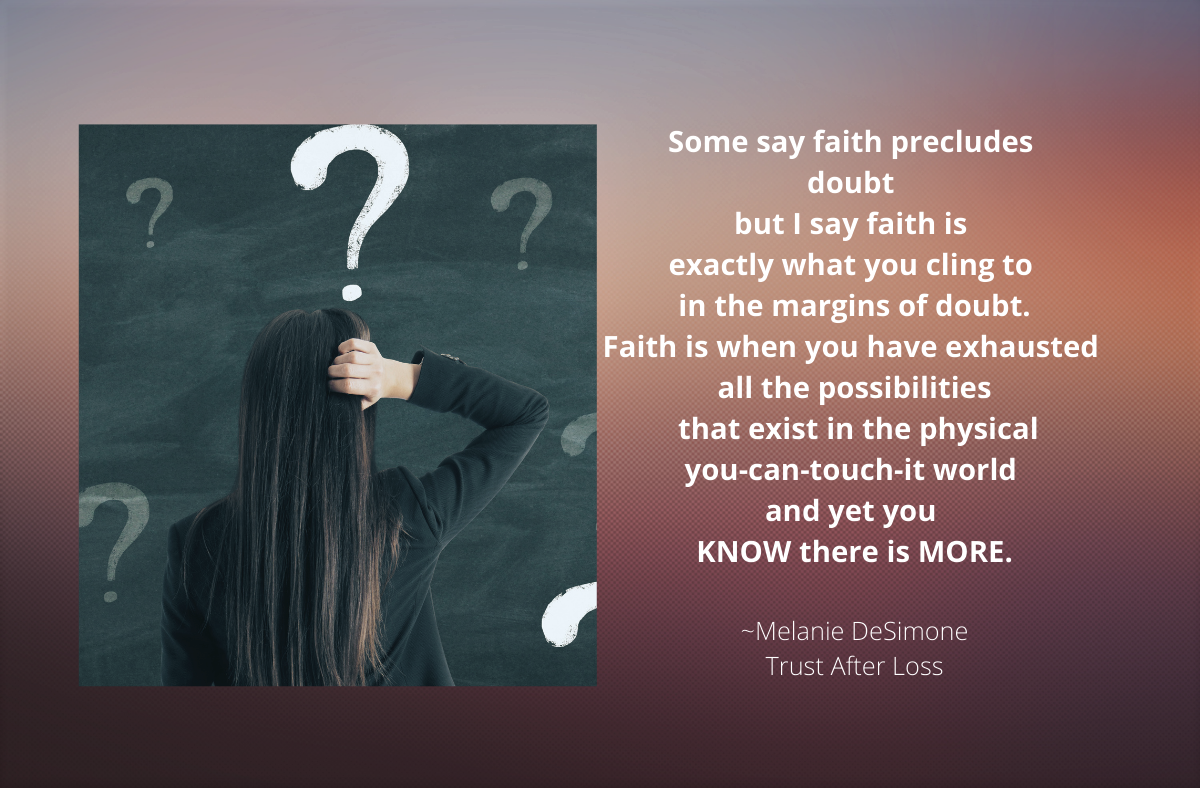
Some say faith precludes doubt but I say faith is exactly what you cling to in the margins of doubt-when you have exhausted all the possibilities that exist in the physical, you-can-touch-it world and yet you KNOW there is MORE.

Even in my most doubtful moments I knew God was there.  Even if I couldn’t see Him, even if I couldn’t hear Him, even if I couldn’t feel Him-I still knew He was there.  Somewhere deep inside me I knew He was still God. 

But I was trying to figure out how to re-engage with this God that wasn’t at all who I expected Him to be and didn’t act in ways I thought He should.  The relationship had changed because I was not the person I used to be before I buried my son.

HE is the same, but I am most definitely NOT.  

God invites us to bring Him our questions and our doubts.  He says, “Come let us reason together.”  Questions are how you mark the borders of what you know and find the edges of what you don’t.

God is not diminished by my desire to understand and make sense of my world-He doesn’t owe me an explanation-but He gives me freedom to ask the questions.

my-faith-is-a-wounded-faith

Wrestling is not UNBELIEF.  Wrestling is the hard work of true faith.

Walk through the Hall of Faith in Hebrews 11-Abraham, Sarah, Moses, Gideon, Samuel, David-every. single. one. had questions for God.

God is not threatened by my wondering.  His throne is in no danger due to my queries.

It is most often other believers who find the questions unsettling.  Doubters can be shifted to the back pew-not because people are mean but because our presence is threatening.  For someone yet to face the test of faith, our test can remind them that theirs may be coming.

I don’t want nor expect to have the last word, I believe that belongs to the Creator of the Universe.  But I think He will hear my pleas.

In my trouble I called to the Lord, I cried out to my God for help.  From his temple he heard my voice.  My call for help reached his ears.

Psalm 18:6 ICB

God is God of the day and God of the night-when I can’t feel Him, He’s still here.

He knows my frame-He made me.

He knows I’m strugging, I can’t hide it.

When I swallow my doubts instead of speaking them all I do is poison my own heart.

Lament is a biblical response to deep pain.

I have to exhale before I can inhale. 

If my heart is full of unreleased anger and bitterness, then it has no room for the Spirit of God to move.

If I want to keep my faith, I’ve got to acknowledge my doubts.  

bereavement-is-the-sharpest-challenge-to-our-trust-in-god-if-faith-can-overcome-this-there-is-no-quote-1

Grief Work 2025: Faith and Pain

For those of us who follow Jesus, perhaps the most difficult and important grief work we must do is deciding how our faith fits into the new and awful reality of child loss.

I’ve encountered so many hurting hearts struggling to square their experience of devastating loss with their faith in a loving and all-powerful God.

I write about my own struggle over and over in this space but this series of posts is an orderly exploration of doubt, pain, faith and the hope I’ve found in Christ Jesus.

I pray it helps another heart hold on.

 ❤ Melanie

Child loss is Unnatural-no way around it.

Out of order death is devastating.

When my perfectly healthy, strong and gifted son was killed instantly in a motorcycle accident on April 12. 2014 my world fell apart.  My heart shattered into a million pieces.  And even after all these years, I’ve yet to even FIND all of those pieces much less put them back together.

So what does a heart do when that happens?  Because, try as I might, I cannot stop time. 

Even THAT awful day only lasted 24 hours.

When the sun rose again, the pain was still there.  And behind that pain and mixed with it was something else-disappointment, disaffectiondistrust.

Where were You, God???

God is sovereign-He rules.

God is good-He loves.

How do those two truths live together in a universe that includes child loss? How can I trust the rest of my life and my eternal future to a God who lets this happen?

It’s a process.  And it takes time.  It involves purposeful choices by me to place my heart where it can hear truth even when it doesn’t want to hear and doubts every word.

The first step toward trusting again is to ADMIT THE PAIN.

You may be thinking, “Are you crazy?”.   

“Of course I know I’m hurting-my child is no longer here!”

But that’s the easy pain to recognize and own up to.  For those of us who have swallowed the western church model of “Sunshine Christianity”*, we will have a much harder time admitting our dismay that as victors in Jesus we feel discouraged, defeated and disgusted.

And should we dare to whisper it aloud we may well be shouted down by voices afraid to hear what they themselves sometimes secretly think but never speak.  So we convince our hearts these are phantom pains like those of a lost limb and try to ignore them.

But they will not be ignored.

The Bible is full of broken people bringing their hearts and their hurts to God.

  • He doesn’t despise my pain.
  • He doesn’t turn away from my tears.
  • He doesn’t hurry me through hearbreak.

Death is awful!  We dare not make it small!

It was the penalty for sin and the price of salvation.  To deny the presence of pain is to diminish the power of the cross.

I must admit my pain:

  • Own it.
  • Feel it.
  • Name it.
  • Speak it.

I’m not the first nor will I be the last to wonder about where God is and what He is doing.  Nicolas Wolterstorff’s adult son was killed in a climbing accident and his little book, Lament for a Son, was one of the best I have read in grief.

It struck a chord with me both because of the similarity of our loss and his honesty in exploring the edges of pain and doubt.

He writes:

Will my eyes adjust to this darkness?  Will I find you in the dark-not in the streaks of light which remain, but in the darkness?  Has anyone ever found you there?  Did they love what they saw?  Did they see love?  And are there songs for singing when the light has gone dim?  Or in the dark, is it best to wait in silence?

Noon has darkened.  As fast as they could say, “He’s dead”, the light dimmed.  And where are you in the darkness?  I learned to spy you in the light.  Here in this darkness, I cannot find you.  If I had never looked for you, or looked but never found, I would not feel this pain of your absence.  Or is it not your absence in which I dwell, but your elusive troubling presence?

Nicholas Wolterstorff, LAMENT FOR A SON

C.S. Lewis wrote A Grief Observed after the loss of his wife, Joy.  And he also is honest and raw-asking aloud the questions that hide in our hearts, admitting the fear that the God we serve may not be the God we thought we knew.  

Giants in faith-both men. 

Yet they, like us, had to bring the shattered pieces of their broken hearts to the foot of the cross and beg God to put them back together. 

Admit the pain. 

God already knows.  

god shouts in pain cs lewis

*Sunshine Christianity is the notion that once one belongs to Jesus the road is smooth (God can make a way), the path clear of obstacles (if you have enough faith), and if I simply claim the promises of Scripture I have victory over every circumstance.  It does not square with either Jesus’ own experience nor that of the 12 apostles.

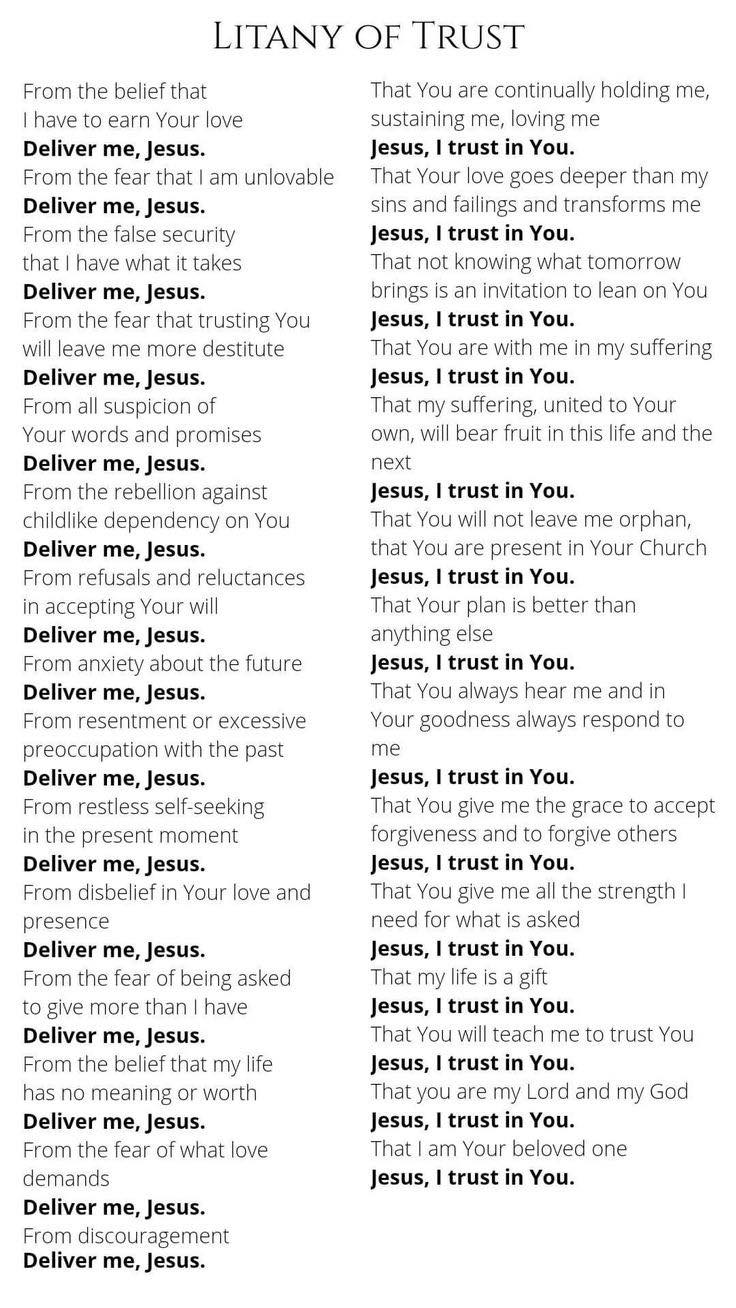
Litany of Trust

Another bereaved parent shared this “Litany of Trust” in one of our closed groups the other day.

It reminded me of the many quotes, verses and choruses I typed or wrote out and taped all over my house in the early days after Dominic ran ahead to Heaven.

My own head and heart were filled with doubt, sorrow and pain and I knew that if I didn’t keep truth in front of my eyes, those lies would take over and squeeze out any hope hiding in the corner.

I STILL have several of these reminders tacked up because there are days…

So I wanted to share this beautiful catalog of all the ways Jesus, our Great Shepherd King, delivers us from futile and unfruitful fear:

Many of us who grew up in non-liturgical churches (myself included), might be dismissive of repetitious prayers. But there is both beauty and power in repeating truth to our hearts and souls.

Paul said, “But how can they call to him for help if they have not believed? And how can they believe if they have not heard the message? And how can they hear if the message is not proclaimed?” (GNT).

He was speaking specifically about the gospel but isn’t the whole Bible full of Good News?

When we proclaim it aloud and anew, we are literally strengthening the inner man (or woman!).

May we take hold of the truth and every tool that helps our hearts cling to Hope❤

Bereaved Parent Month 2025: Hardly the Time for Being Taught

It seems to be the nature of humans to listen with an ear to respond rather than an ear to hear.

I’ve done it myself.

Jumped right in with all kinds of suggestions designed to “fix” someone else’s problem.

Or worse, heaped my own experience with something more or less (often less) similar onto an already overburdened heart.

I hate that tendency in myself and I’m working hard to try to change it.

Those who feel compelled to just say SOMETHING often bombard grievers with platitudes, comparisons to their own grief or just empty, frivolous words that require we either stand there dumbfounded or find a gracious way to exit the conversation.

It’s especially painful for a broken heart when a well-meaning someone decides THIS is the moment for a theology lesson.

“God has something planned for you in this” or “God will use this for good”. (Romans 8:28-29)

“We don’t grieve as those without hope!” ( I Thessalonians 4:13)

“All our days are numbered.” (Psalm 139:16)

I get it-death is a heavy subject and the death of a child isn’t something anyone wants to talk about, contemplate or be forced to wrestle with. So it’s often easier to simply say something-anything-do your duty and walk away.

But it is hardly helpful.

Deep grief as a result of unbearable loss is not a teaching moment.

It’s an opportunity to listen well, think carefully about if or when you need to say anything and simply offer compassionate companionship to a broken heart.

Grieving felt hardly like the time for being taught, at least initially. Early grief was my time for pulling out of my past those truths that I had already learned — out of my ‘basement — so that I could begin to assemble them together into something even more meaningful to me than before. It was the time for understanding that even though I had always believed in heaven, it now looked to my perceptions to be more real than this world. It was the time when, even though I already believed in God’s control of the world, I now felt dependent upon him being sovereign over it for all my hopes. It was the time for realizing that even though I already believed that Christ conquered death, I now longed to see death die.Lianna Davis, Made for a Different Land