It was a harsh sentence: Forty years of wandering in the desert for not putting their faith and trust in the God who had delivered them from bondage.
But wandering wasn’t the half of it.
Death surrounded them. All those adults who gave in to fear were doomed to die before the forty years were finished.
Can you imagine how many graves were dug in the wilderness? How many tears were shed? How many fists raised to the sky or hands to hearts begging, begging, begging for the sojourn of sadness to end?
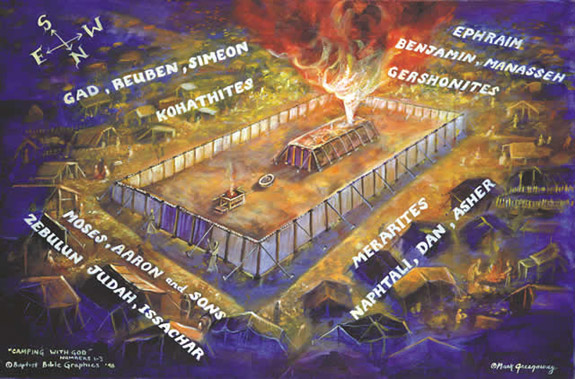
So it was no accident that the Lord commanded Israel to set her camp with the Tent of Meeting at the center. He wanted them always to be aware of His enabling, powerful, holy Presence.
Even in the midst of judgement, death and sorrow. He was there.
And God is here with me in the midst of my mourning too. I am thankful for His Presence.
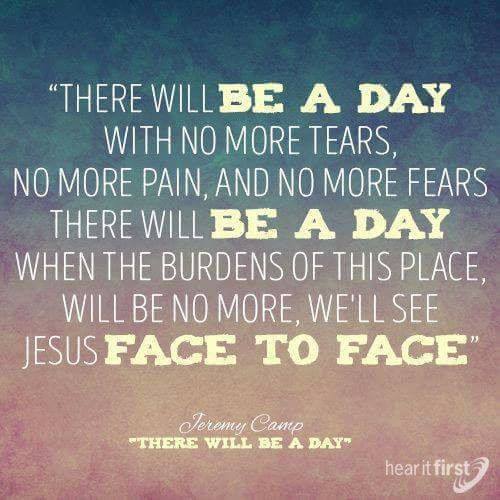
But the most beautiful promise is that there will be a Day when He will wipe away all the tears. He will redeem all the pain. He will undo all the damage death has wrought.
Joy will once again be untainted by sorrow.
And I heard a great voice out of heaven saying, Behold, the tabernacle of God is with men, and he will dwell with them, and they shall be his people, and God himself shall be with them, and be their God. 4 And God shall wipe away all tears from their eyes; and there shall be no more death, neither sorrow, nor crying, neither shall there be any more pain: for the former things are passed away.
Revelation 21:3-4 KJV
I make seasonal wreaths for Dominic’s resting place. I include these verses every time.
Because I believe them with my whole heart.
I love the way The Jesus Storybook by Sally Lloyd-Jones renders them:
And the King says, “Look! God and his children are together again. No more running away. Or hiding. No more crying or being lonely or afraid. No more being sick or dying. Because all those things are gone. Yes, they’re gone forever. Everything sad has come untrue. And see – I have wiped away every tear from every eye!“
Jesus Storybook Bible by Sally Lloyd-Jones
“Everything sad has come untrue.”
Heaven will not simply be rest after a long life’s struggle.
It will be restoration, redemption, recreation and resurrection.
Every thing stolen will be restored. Every thing bartered away by sin will be redeemed. Every thing destroyed by carelessness, hatefulness and cruelty will be recreated in perfection. And every thing dead and buried will be resurrected to life everlasting.
I can’t wait.
QUESTIONS:
What does it mean to you that “God is here”?
What do you think Heaven is like? Is your idea informed by popular media or by Scripture?
Does the idea of “everything sad coming untrue” speak courage to your heart? Why or why not?
If you have felt God’s presence in this Valley, how has He manifested that? If you haven’t felt His presence, would you consider asking Him to make Himself real to you today?
PRAYER:
Lord,
I’ll admit that sometimes future hope is not much to hold onto when sorrow and longing and despair overwhelm my heart. I need to feel Your Presence here and now. I’m not asking for a burning bush, but give me assurance that You have not abandoned me.
Fill my heart with hope and help me hold onto the promise that one day all this pain will be redeemed. Give me an eternal perspective.
I realize not every parent enters child loss with the same reverence for Scripture and trust in the promises of God that I had when Dominic left us.
So it may be hard for your heart to believe the words we’ve been reading and studying this month. It may be near impossible for you to feel that God is a good Father, that He has not abandoned you and that He has a purpose and plan for your life, even here in this awful Valley.
If you’ve read this blog for any length of time, you know that while I still have faith, it’s a tested faith. I have dragged every single thing I believed before Dominic ran ahead to Heaven, held it up and scrutinized it in the cold light of loss.
Some things I don’t clutch so tightly anymore. Many things I wouldn’t spend five minutes defending anymore. But there are absolute, rock-solid, foundational truths that I will declare with my dying breath.
The character of God is flawless. His ways are holy and good. He will not allow the enemy of my soul to have the last word. Death is (ultimately) defeated and victory is sure.
When I was on my face in mourning, when dust was my food and bitter tears were my drink, these are the promises that breathed life back into my broken heart.
Remember [always] the word and promise to Your servant, In which You have made me hope. 50 This is my comfort in my affliction, That Your word has revived me and given me life.
Psalm 119: 49-50 AMP
When people in the Bible asked God to “remember” it wasn’t that they thought He forgot. It was a way of reciting truth to their own hearts and praying God’s words back to Him.
So when I was just on the other side of the awful news but past Dom’s service and all the people and activities surrounding it, I began most days in my journal with something similar.
I would write out a verse confirming God’s promises to me and my family. I would make it personal-put our names in it- and pray it back to Him. The more I did that, the more my spirit was revived. The more my spirit came back to life, the more I was able to listen to and hear from Him.
It’s a slow, slow process.
The blow is sudden, severe and debilitating (no matter how your child left this earth).
Recovery cannot be rushed along.
I feel most days like I’m still receiving hope and life in drips and dribbles.
But the more I focus my mind’s attention and my heart’s affection on God’s sure promises, the more alive I feel.
And one day I’ll be fully alive-as Dominic is right now- dancing, laughing, singing to the tune of millions of rejoicing voices.
Until then, I’ll keep pointing my heart in the right direction.
My own plans are made. While I can, I sail east in the Dawn Treader. When she fails me, I paddle east in my coracle. When she sinks, I shall swim east with my four paws. And when I can swim no longer, if I have not reached Aslan’s country, or shot over the edge of the world into some vast cataract, I shall sink with my nose to the sunrise.
~Reepicheep, C.S. Lewis, Voyage of the Dawn Treader
QUESTIONS:
Do you have hope? Why or why not?
Do you think you can influence whether or not hope lives in your heart? Why or why not?
What do you do each day to feed hope in your heart?
If you are new on this journey of loss, you may be certain you will never feel alive again. You may think you will never feel hope or joy or anything besides sorrow again. I promise that if you will let the words of God sink in, if you will take your heartache to Him and allow Him to touch the broken places, you will begin to revive. How do Reepicheep’s words speak to you today?
If you are farther along the road of loss, record some specific moments when you felt God met you and breathed life into your spirit.
PRAYER:
Lord,
Truth is that all life comes from You. There is nowhere else to turn but to Your face, Your hand, Your heart. Part of me wants to give up and give in. I want to be rid of this pain, this heartache, this sorrow and unrelenting despair. But I know You have a purpose and plan for me even here, even now.
Help me choose to make space for Your word and Your love to penetrate my heart. Help me offer up my broken bits to You and wait patiently for You to weave them back together into something beautiful.
When I have nothing left, touch me. When I give up, encourage me. When I can’t see the light for the darkness, shine on me.
It’s kind of counterintuitive really-that my initial response to Dominic’s death would be affirmation of my faith and my response weeks later would be doubt.
But it makes a lot of sense really.
When the unthinkable happens, if your heart is already turned in a particular direction the path of least resistance is to keep flowing downhill.
A bit later, when shock has worn off and your brain wakes up and you begin to do the “math” suddenly it’s not so easy to believe that God is good, He is sovereign and He has a perfect plan.
I wanted explanations!
Like Job I had a list of questions for the Almighty. And also like Job, I found that when He showed up (not in person but through His word) I could only cover my mouth in shame.
When I was beleaguered and bitter, totally consumed by envy, I was totally ignorant, a dumb ox in your very presence. I’m still in your presence, but you’ve taken my hand. You wisely and tenderly lead me, and then you bless me. 25-28 You’re all I want in heaven! You’re all I want on earth! When my skin sags and my bones get brittle, God is rock-firm and faithful. Look! Those who left you are falling apart! Deserters, they’ll never be heard from again. But I’m in the very presence of God— oh, how refreshing it is! I’ve made Lord God my home. God, I’m telling the world what you do!
Psalm 73:21-28 MSG (paraphrase)
Here’s the good, good, good news: God isn’t surprised at my anger, disappointment or lack of understanding.
He- like every good parent who recognizes a child is reacting out of ignorance-takes my hand, holds me close and waits until the energy of rebellion and frustration spends itself, and says, “There, there, dear one. I’m here.”
I can’t scare God away. He’s the Perfect Father.
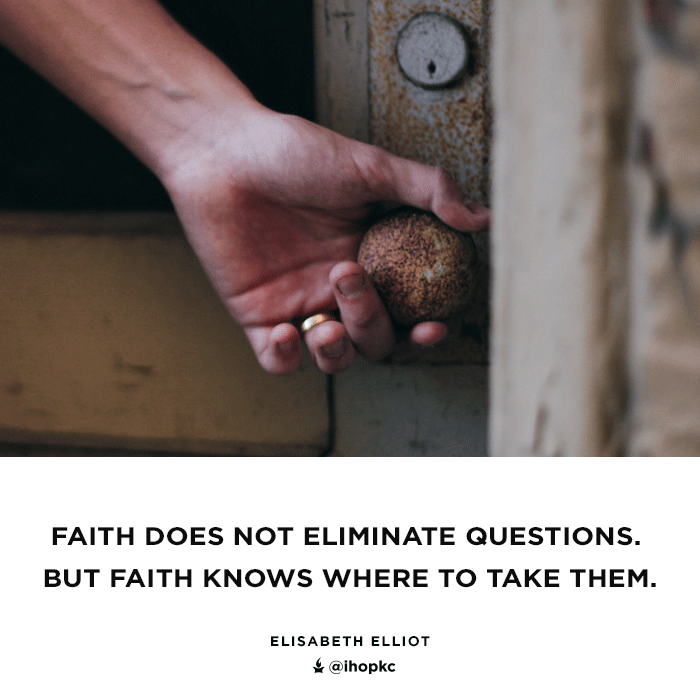
So if you are struggling with questions and struggling whether or not to take them to God (as if He doesn’t know)-go ahead. Hand them over.
He is neither afraid of nor offended by our weakness, our impertinence nor our honest questions. He wants us to let them go. He wants us to speak them aloud, admit to our own hearts we have them and then release them.
Because in the space created in surrender, He can work.
In the gap between our own strength and the awful struggle ahead, He will pour grace, mercy, endurance and hope.
He never leaves us nor forsakes us.
My parents would argue I am young.
My children would laughingly accuse me of being old. (My skin is definitely sagging!)
Some days I feel one way or the other and it has nothing to do with the years I’ve lived and everything to do with the hardships I’ve endured.
But I can say with absolute certainty that I am more sure now than I was before that God is God.
He is good.
He will redeem, restore and resurrect.
QUESTIONS:
Have you ever been bitter? How do you think it might have informed your feelings about God?
Are you bitter now? Have you considered telling God about it?
Do you feel God is near you? Why or why not?
When the psalmist compares himself to a dumb animal he’s referring to the fact that oxen or donkeys go where their masters tell them to (or not!) and either comply or resist with no real understanding of why they may be asked to do this or that. But we are not dumb animals. We can choose to trust our Master because of past experience and the sure promises of Scripture. How does focusing your attention and heart’s affection on the Truth of Scripture help you surrender?
Our flesh will fail. It’s not a question of if but a question of when. Honestly,my flesh has failed many times in these 55 years. I’ve written before that I’m convinced the years of Bible study before Dominic ran ahead to Heaven were years spent preparing my heart to receive that blow. I was not spared, but I was prepared. If you haven’t made a commitment to spend daily time in Bible study and the Presence of God, would you be willing to try to do it now? Have these days of reflection given you any new nuggets to hold onto?
PRAYER:
Lord,
I know You can drag me around like a recalcitrant child or a misbehaved pet. But you don’t. You want me to bring my hurt, my anger, my bitterness, my disobedience and distrust to You.
You don’t run away. You aren’t hard to find. You don’t turn your back on me. You are always a breath away-waiting to hold my hand, wrap my heart in your love and whisper courage to my soul.
Help me run first to You. Always, always to You. You truly are my only hope. My true salvation. My Rock and my Shelter.
Keep my eyes focused on You and not on people around me. Comparison only breeds discontent. I know that one day-one glorious Day-the song I’ll sing will be to my Redeemer and tell of Your faithful goodness to me.
There has been an interesting back and forth in my spirit since Dominic ran ahead to Heaven.
Before I got the knock on the door I didn’t really fear for my children’s safety.
They traveled the world, did things that would make others cringe, ran into situations when others ran away and I can honestly testify that other than the typical, “Be safe!”, comment by mothers everywhere, I did not sit up at night wringing my hands hoping they’d be OK.
Then Dominic was killed less than a mile from his apartment. An ordinary evening doing ordinary things except for his foolish choice to go too fast on his motorcycle.
And everything changed.
Suddenly imagining child loss was not necessary. I was living it in technicolor reality.
There was no earthly remedy for my heartache. No safe space in the physical world for me to carry my pain.
Only God could comfort my mama heart.
God is our shelter and our strength. When troubles seem near, God is nearer, and He’s ready to help. So why run and hide? 2 No fear, no pacing, no biting fingernails. When the earth spins out of control, we are sure and fearless. When mountains crumble and the waters run wild, we are sure and fearless. 3 Even in heavy winds and huge waves, or as mountains shake, we are sure and fearless. [pause][b] 4 A pure stream flows—never to be cut off— bringing joy to the city where God makes His home, the sacred site where the Most High chooses to live. 5 The True God never sleeps and always resides in the city of joy; He makes it unstoppable, unshakable. When it awakes at dawn, the True God has already been at work.
Psalm 46: 1-5 VOICE
I don’t know about “fearless” but I can testify the fear that consumed me in the wake of Dominic’s death for the safety of my earth bound kids was eventually replaced with a calm assurance that nothing had really changed.
They were still in the hands of a God who loved them more than I did.
They were still secure for eternity because they had put their faith and trust in the finished work of Christ.
They were still just as likely (or unlikely) to be the targets of another’s (or their own) sinful or foolish choices.
And our hope was not (never has been) in THIS life. Instead it is in the eternal life God offers all through Jesus.
Ezekiel records a vision of seeing first a trickle, then a stream and finally a river flowing from the throne of God and giving life to creatures, trees and those who eat them.
Truth is, there is no stopping the plans of the Almighty.
And there is no stopping the flow of life from Jesus to His sheep.
I am so thankful for this promise, this truth and my own testimony that God is indeed the Giver of life, a safe Refuge and a sure Foundation.
QUESTIONS:
Would you describe yourself as a fearful person? Why or why not?
We are all afraid sometimes. What do you do when you are afraid? To whom do your share your fears?
How can you make today’s verses personal and allow them to encourage your heart?
I love the water analogies in Scripture. They really speak to my heart because with a farm full of critters I can see how critical water is to life on a daily basis. Has the trial of child loss (or other hard place) made you more or less thirsty for the Living Water Christ offers?
Sleep can be hard to come by when you are overwhelmed with grief, stress or fear. Does it help your heart to think about God as the God who never sleeps? Why or why not?
What do you want from God right now? What would it look like for Him to be your personal place of safety?
Who do you need to release to the care of the Father? Who are you worried about that you need to place in His hands?
PRAYER:
Father God,
You are never caught by surprise. You know the end from the beginning. When things overtake me help me remember that You are there. I need a refuge from this life of grief and pain. I need to rest my feet on the solid Rock of Your presence, Your goodness and Your provision. Open my spiritual eyes to see the way You are working even here, even now.
I want to drink from Living Water. I want to be so filled with Your grace, mercy, love and strength that no matter what life throws at me my testimony is to Your sustaining power.
Joy seems a distant memory. Days when laughter flowed freely and fully from my belly out of my lips are like a dream. Give me joy again. Even tainted with sorrow, give me joy. Thank You that I know you are near and that You have a plan.
If someone asked me to describe Jesus I would say He’s the God who does not turn away.
He’s the God who comes near.
He’s the God who will always, always, always show up and bend down.
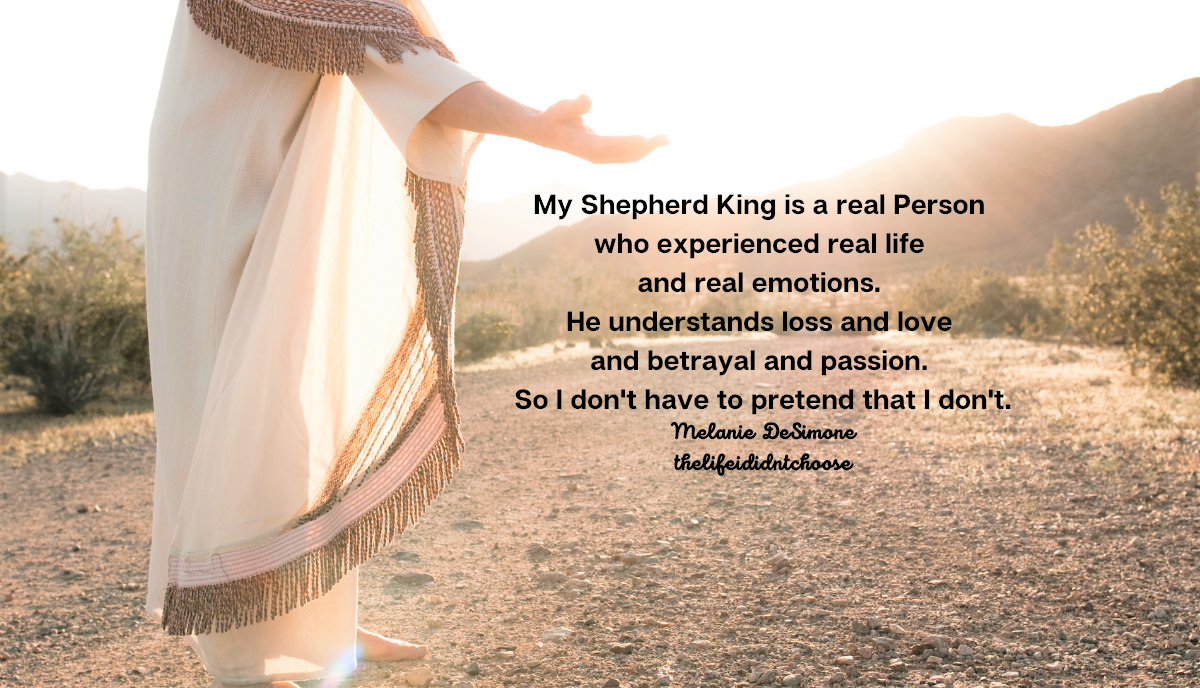
That’s what I hold onto in this life I didn’t choose-that my Shepherd Savior sees me, hears me, loves me and will help me.
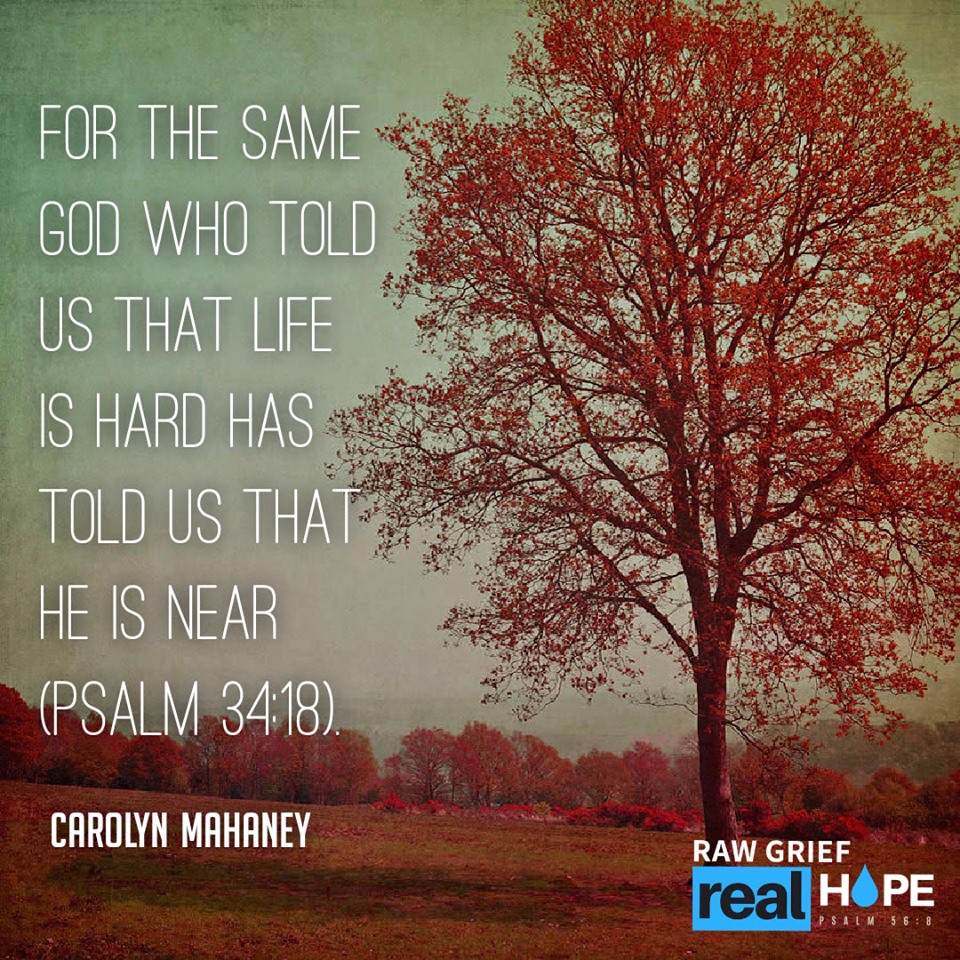
For the Eternal watches over the righteous, and His ears are attuned to their prayers. He is always listening. 16 But He will punish evildoers, and nothing they do will last. They will soon be forgotten. 17 When the upright need help and cry to the Eternal, He hears their cries and rescues them from all of their troubles. 18 When someone is hurting or brokenhearted, the Eternal moves in close and revives him in his pain.
Psalm 34: 15-18 VOICE
Not long after Dominic’s death there was a horrible mass shooting and the perpetrator was in his fifties. I have to admit I literally yelled at God, “REALLY???? This guy lives to his fifties only to kill a bunch of innocent people and You didn’t save Dominic from his accident?!!!”
I was angry and frustrated and sad and broken.
If I’m honest I’ve had a few more moments like that since then.
But I’m brought up short when I read these verses and others like them. The wicked do not have God’s ear. They will not know eternal life with Him in Heaven. They may even be worldly successes but nothing they do will last forever. Riches don’t secure immortality.
Only a penitent heart leaning fully on the grace and mercy of God is eternally safe.
Because I am His child. when I’m hurting, God does not run away or turn a blind eye or a deaf ear-He meets me there.
Jesus is the lover of my soul.
He is the Healer of my heart.
QUESTIONS:
Do you feel heard by God? By others? Why or why not?
How do you deal with the fact that sometimes evil seems to win and evil people prosper?
How would you describe Jesus? Has grief changed how you describe Him?
Is your description consistent with what Scripture tells us about Him?
Theology matters-especially when grieving. What I believe about God and Christ either undermine or strengthen my faith. Write down ten things you believe to be true about God and/or Jesus.
PRAYER:
Father God,
I admit that it’s infuriating and feels unfair that sometimes those who don’t love You still prosper. They seem to have a life free from trouble and heartache. And here I am-hurting, deeply harmed and holding on by a thread.
But You are not unjust. You are not ignoring me. You will work all things together for good for those who love you. Help me trust those truths.
You are the God who came near in the stable and on the cross. You are the God who dwells inside those who receive the gift of salvation through Christ. You are not far away.
Before Dominic ran ahead to Heaven I didn’t cry much.
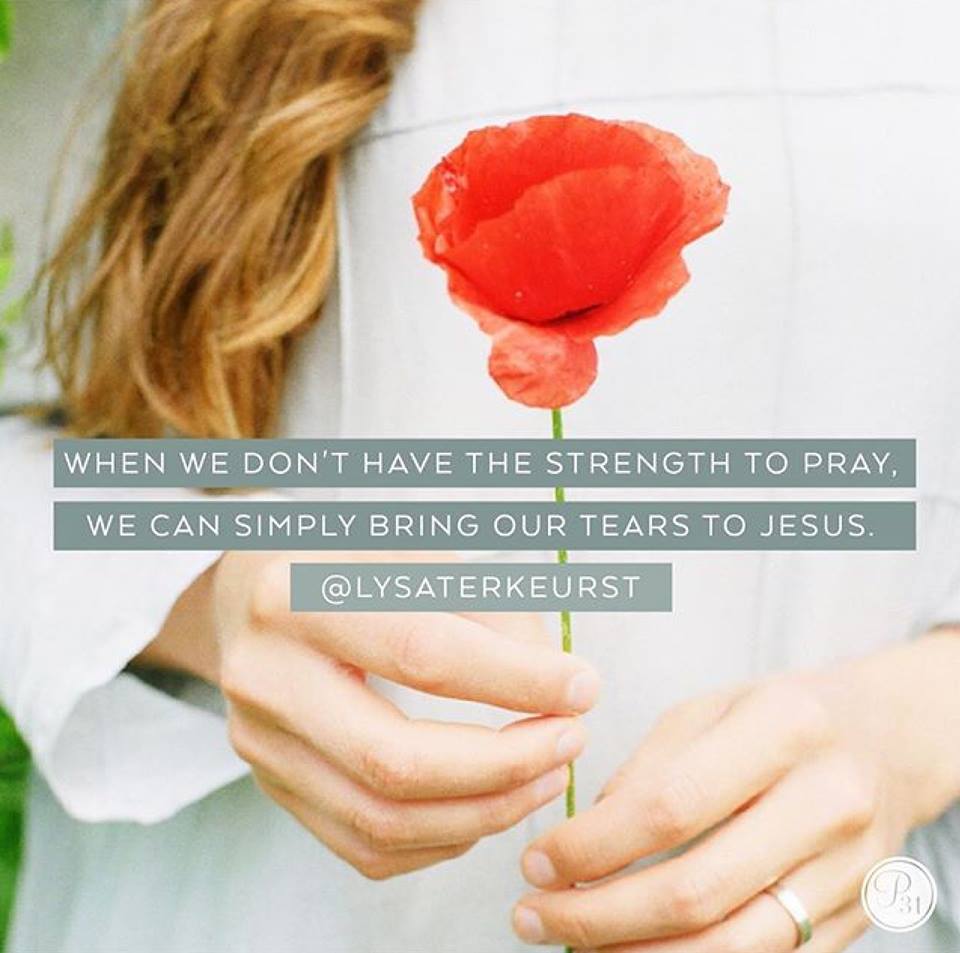
Since April 12, 2014 I’ve cried a river-tears for breakfast, lunch, dinner and into my pillow at night when I tried to fall asleep.
When sorrow overtakes a heart, it’s hard to think about anything else.
There was a very real danger that sadness would drag me down in a pit so deep I would never be able to crawl back out.
And then the enemy of my soul would win.
But God.
The most beautiful words I know.
God reached down and raised me up from the depths of despair. He dragged me out of the pit of sorrow. His light shone so bright that even the darkness of death could not hide it.
Like the Psalmist, I can praise the Lord for saving me from my enemy.
I praise you, Lord, because you have saved me and kept my enemies from gloating over me. 2 I cried to you for help, O Lord my God, and you healed me; 3 you kept me from the grave. I was on my way to the depths below,[b] but you restored my life. 4 Sing praise to the Lord, all his faithful people! Remember what the Holy One has done, and give him thanks! 5 His anger lasts only a moment, his goodness for a lifetime. Tears may flow in the night, but joy comes in the morning.
Psalm 30: 1-5 GNT
It’s thought that David wrote this psalm on the dedication of his house. He had been pursued, fought battles and only now taken the throne promised to him years before. He had literally been saved from death on many occasions. His enemies had plotted and planned and never been successful.
If God is for us, who can stand against us?
I think David was also thankful that God had rescued him from the pit of despair. I can’t read the psalms without a sense of David’s internal battle against what may have been depression but was most certainly deep, deep sorrow and disappointment that life didn’t go as planned.
When David thanked God for reaching down, lifting him up and setting his feet on solid ground he was as thankful for the emotional rescue as for the physical one. He had learned that things might be bad for awhile but they would not be bad forever.
Despite how long the darkness lasts or how awful the blow, it’s only a tiny blip compared to eternity.
It feels interminable. It seems insurmountable. But it isn’t. God’s goodness overcomes any scheme of the enemy and I need to remind my heart of that truth.
One of the reasons I watch the sun rise every morning is because it affirms this truth: night does not last forever. No matter how dark, no matter how cold, no matter how frightful, no matter how sad-night is constrained by the sunrise.
My earthly suffering is constrained by God’s goodness.
Tears are still my food more often than I could have ever imagined they would be.
Dominic is not going to be miraculously raised from his grave (although God could do it if He chose).
But my tears won’t last forever.
Morning is coming.
Sure as sunrise.
QUESTIONS:
I suspect I’m not alone in the changes child loss has wrought. For someone who didn’t cry much before, suddenly crying often was uncomfortable at first. Now I understand tears are often the only response I have left some days. Do tears bring relief or do they distress you further?
Does it help you hold onto hope to know that God will not allow our enemy, the devil, to win? Why or why not?
Some of the words used in Psalms hurt my heart. I may have been spared from the grave but Dominic wasn’t. How do you reconcile physical safety of some people with the fact that our child(ren) wasn’t/weren’t spared? It’s a question I had to face head on before I could allow God to begin a healing work in my heart.
God is not confined by time like we are so often the authors of Scripture are speaking about events current to their own lifetimes and also writing prophetically. When David writes about weeping lasting “for a night” he’s not saying that all sorrow ends in twelve hours. He is saying that all sorrow will end. Does that encourage you? Why or why not?
PRAYER:
Lord,
So often I am dragged down into the pit of despair by my sadness, sorrow and hopelessness. When I wake to tears on my pillow and fall asleep to my own sobs, it seems like there will never be a moment or a day when my heart is not overwhelmed.
I feel like the enemy is winning some days.
Help my heart hold onto the truth that I am only privy to a tiny sliver of knowledge. Give me strength to hold onto hope when my own strength fails. Put praise in my mouth when You pull me out of the pit, foil the schemes of my enemy and set me on the solid ground of truth. Speak courage to my soul.
Let each sunrise remind me again that the night will not last forever. Darkness cannot swallow the light. Death does not win. Life and light and love endure forever.
I have definitely felt besieged in this grief journey.
I imagined myself holed up in a castle turret, hoping against hope that heartache would stop battering the gates below.
For a long while I was afraid.
I was fearful that if the onslaught didn’t stop my heart would give in to despair, I’d let go of hope, I’d lay down and give up.
I don’t believe for one minute that David was never scared.
Instead, I believe that the words he used when his brothers mocked his step forward to take on Goliath were words God burned in his soul:
The Lord who rescued me from the paw of the lion and the paw of the bear will rescue me from the hand of this Philistine.
I Samuel 17:37 NIV
David was courageous IN SPITE of the fear because he knew the God he served. He had prior experience with God’s faithfulness. He was confident that the Lord would not allow him to fail.
So we come to today’s verses. They were penned a good while after Goliath, after being anointed king but before he gained the throne.
He was running for his life, fighting enemies on every side.
David had to remind himself of truth, just like me. He needed to sing aloud so his heart could be brave.
When the armies of the enemy surround me, I will not be afraid. When death calls for me in the midst of war, my soul is confident and unmoved. 4 I am pleading with the Eternal for this one thing, my soul’s desire: To live with Him all of my days— in the shadow of His temple, To behold His beauty and ponder His ways in the company of His people. 5 His house is my shelter and secret retreat. It is there I find peace in the midst of storm and turmoil. Safety sits with me in the hiding place of God. He will set me on a rock, high above the fray. 6 God lifts me high above those with thoughts of death and deceit that call for my life. I will enter His presence, offering sacrifices and praise. In His house, I am overcome with joy As I sing, yes, and play music for the Eternal alone.
Psalm 27:3-6 VOICE
His soul was confident and unmoved in the midst of danger because he threw himself on the mercy of the Lord.
His plea was not, “Keep me safe” it was “Keep me near”.
Jesus told the disciples not to fear the one who could kill the body but fear the One who is able to destroy both body and soul in hell. (Matthew 1:28)
David got it.
He knew that no matter what happened-if he lived or died-his true shelter and his true life was in the Lord.
He was focused on Who walked with him not what might happen to him.
Truth is, we don’t always experience miraculous deliverance from life’s troubles or dangers. People we love die. People we care about are cast down, carried through hard times and come out the other side battered, bruised and barely holding on.
If I can only praise a God who spares me, I have no songs to sing.
But if I can praise the God who loves me, who offers eternal security through the blood of Christ, the God who will weave ALL the threads of my life-the dark, the light, the ugly and the beautiful-into a masterpiece declaring His glory for all eternity, then I have a song as long as I have breath.
And when breath leaves this body and I am free of my earthly tent, I’ll sing a new song for ever and ever and ever.
This was David’s God.
This was the God of Moses, Isaac, Jacob. Peter and Paul.
This is MY God.
And He longs to be yours too.
QUESTIONS:
Who do you turn to when you are afraid?
When have you felt God’s assurance in the midst of a fearful situation?
My family was very involved in worship music ministry for years. Dominic was a talented drummer, among other things. In the first days after his death, music ministered to my soul. But after the funeral I felt the music die within my heart. Have you ever felt like you didn’t have a song to sing anymore? Did God meet you there and help you find your song? Are you willing to ask Him to give you a new song, even on this broken road?
Eternal hope does not keep us from feeling pain in the here and now. But it can help a heart hold on. What words from this Psalm stand out to you? Are you able to praise God even as you feel pain?
Can you ask for God to keep you near even if He doesn’t keep you (or your loved ones) safe?
Praise can be as simple as repeating truth aloud or writing it in your journal. If you can’t sing, consider speaking aloud the names of God, His eternal attributes or verses that describe them. Your heart is listening. Give it courage.
PRAYER:
Father God,
So many times I come to You with a list of petitions-do this, do that, solve this, fix that, keep me and mine safe, secure and happy. I’m seeking Your hand and not Your face. And when things don’t turn out the way I want them to I feel betrayed.
What you want is for me to trust Your heart even when I can’t trace Your hand. You have promised never to leave me nor forsake me. Help me, like David to ask you to keep me near, not just to keep me safe.
Your name is a strong tower, the righteous run to it and are saved-not saved from earthly destruction or trouble but from eternal damnation.
When I lose my song, give me a new one. When I forget that You are with me, make Your Presence undeniably real. When I lose hope, speak courage to my heart. And when I doubt that I can make it one more minute, much less one more day, strengthen me with Your might.
The longer I care for my sheep and goats, the more I understand why God put His leaders through this school of discipleship.
Many days it’s a thankless job-my charges often do foolish things that place them in peril, they work hard to tear down the fences I’ve erected for their safety and they wander away forcing me to chase after them and bring them home.
But I never give up on them.
A shepherd’s heart is revealed in how she (or he) takes care of the weakest animals.
I cannot lay my head down at night without taking mental inventory to make sure they are safe, secure and well cared for through the darkness until morning dawns afresh.
David spent years and years in “shepherd school”.
It prepared him to fight Goliath.
It molded his heart to lead God’s people.
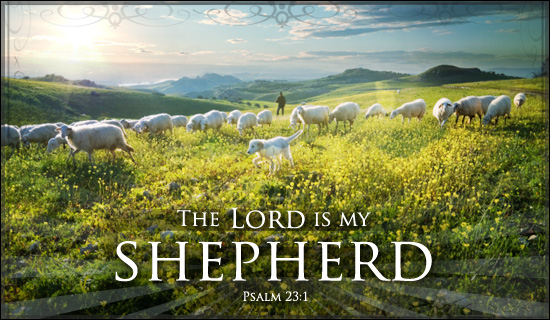
The Eternal is my shepherd, He cares for me always. 2 He provides me rest in rich, green fields beside streams of refreshing water. He soothes my fears; 3 He makes me whole again, steering me off worn, hard paths to roads where truth and righteousness echo His name. 4 Even in the unending shadows of death’s darkness, I am not overcome by fear. Because You are with me in those dark moments, near with Your protection and guidance, I am comforted.
Psalm 23: 1-4 VOICE
I could write for days on what these verses mean to my own heart. I could tease out dozens of lessons from the picture David paints of tender care, abundant mercy, amazing love.
But the one thing I’ll share now is this: I never, ever, ever abandon my flock.
If all I had was a stick and my voice, I’d fight off every enemy.
I am never too busy nor too distracted to tend to their needs. I never forget to feed them, water them, check on them and call them home in the evening.
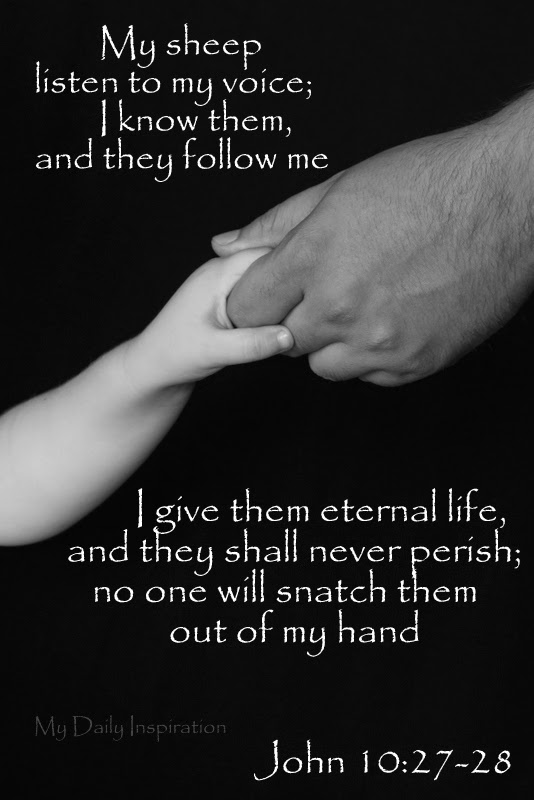
They know my voice.
They follow me because I am trustworthy. They allow me to tend their wounds because I am gentle. They come running to me when they are afraid because they know I am a fierce defender.
If I-a mere, fallible, fragile mortal-am this concerned about my little flock, imagine how our Good Shepherd cares for us!
Don’t rush over these verses because they are familiar.
Go back, read them again.
Know that the Lord God loves you.
He LOVESyou.
He lovesYOU.
QUESTIONS:
Do you remember the first time you encountered this Psalm? Does it hold a special memory?
How has the Lord given you rest in the midst of weariness?
How has God provided necessities for you?
What does it mean to you that Jesus called Himself the Good Shepherd? Read that passage in John 10 and notice how He defines what a good shepherd looks like. How might that encourage your heart when walking in this Valley of the Shadow of Death?
I can’t tell you the number of times I’ve had to find an old, lame or nearly blind goat or sheep that wandered off and got lost. I do what it takes to bring them home. No matter how far you wander, Jesus is coming to get you. Can you relate a time when Jesus reached out in a special way and helped you make it back home?
What do you need from your Shepherd today? Ask Him for it.
PRAYER:
Lord,
You ARE the Good Shepherd. You love me. You care for me. You lead me to places of rest when I am overcome with weariness. You walk beside me and offer refuge when I am afraid.
This grief journey is hard. Sometimes I wonder if You are really here or if You have abandoned me. Help me hear Your voice. Help me run to You for safety.
Teach me to follow You always, even when You lead me in dark places and I’m fearful. Thank You for leaving us with a beautiful picture through David’s words of Your heart.
We’ve all done it-pretended to be looking somewhere else when we pass a needy soul.
Who has time to get involved?
They might be an addict or have a contagious disease or mental illness. They might be too lazy to work, too unpredictable to trust, too likely to be here next week and need something again. It might cost more than the five dollars we’re willing to hand out.
So we walk on by and hope they don’t force the issue by standing in our way.
But God never ignores a hurting heart.
He never redirects His gaze so it doesn’t fall on the one begging for mercy.
He does not ·ignore [despise or disdain] ·those in trouble [L the suffering of the afflicted]. He doesn’t hide his face from them but listens when they ·call out to him [cry to him for help].
Psalm 22:24 EXB
How amazing that the God of the universe, the One who hung the stars in the sky and told the sea, “This far and no farther!” hears me when I cry out to Him for help!
And not only does He hear me, He longs to comfort me with His love.
He does not despise my weakness or look down His nose because I’m unable to solve my own problems or help myself.
Even when others ignore me or try to make my pain small, God is listening. He never sleeps. He’s never too busy. He’s never hoping I go away and stop bothering Him.
He knows my name.
I’m not a faceless, nameless one of thousands or millions chattering away like background noise in a crowd.
He hears MY voice.
God-my God-has a personal, specific relationship with me, His child.
He leans in, bends down and listens attentively to whatever I tell Him. Like any human father, His heart is pierced when mine is broken.
I am so, so thankful that the God I serve loves me.
He specifically, purposefully loves me with unconditional love.
Even when I’m weak.
Even when I’m running away.
Even when I question the things He allows in my life.
He will never look away or stop reaching for me.
QUESTIONS:
What does it mean to you that God hears you?
Do you always FEEL heard? Why or why not?
When have you felt God’s personal care and encouragement?
How might you help your heart hold onto the truth in this verse when it seems God isn’t listening or at least isn’t giving you the relief you seek?
Can you find two or three other verses that emphasize God’s attentiveness to His children?
PRAYER:
Father God,
Sometimes I am willing to give mental assent to the fact that You hear me. And yet my heart argues that my head must be mistaken because the answers I beg for are long in coming.
The silence is deafening.
But I know your ways are not My ways and Your time is not my time. Give me confident assurance that You hear me whenever I cry out to You. Thank you that in Christ I can call You “Daddy” and always rest in the truth You are for me and not against me.
Fill my heart full of Your love. Overwhelm me with Your grace-grace to ask and grace to endure no matter what the answer may be.
I have to admit that when I read the book of Job NOW, it’s no longer an intellectual exercise or detached theological foray into suffering and the sovereignty of God.
I was always appalled at what Job and his wife (remember her?) suffered. I was always a bit confused by God’s question to Satan, “Have you considered My servant, Job?” I was both comforted and confounded that God set boundaries but set them at the bare minimum to spare Job’s life.
Just being honest here.
Pastors and teachers love to talk about the sweeping arc of the story. They love to pull out lessons about how to comfort others in suffering, how to endure suffering ourselves and how, in the end, God restored to Job the things that had been robbed from him.
But my heart walks slowly through those pages. My soul weeps with every new blow struck against a man who, by God’s own account, was a righteous servant of the Most High.
I wonder if David knew the story of Job. It’s believed to have been one of the oldest books in the Old Testament.
If he did, I wonder if he took comfort in the knowledge that God eventually restored Job to a place of blessing, honor and safety.
David certainly knew what it was like to ride high on the wave of God’s favor and then to be dashed to bits on the rocks of adversity. He slew Goliath and then he was anointed king. He was Saul’s musician, ultimately his son-in-law and then his enemy. He knew that God declared his glorious future but he lived for years hiding in caves, eating what he could find and serving random wealthy patrons in hopes of a little peace between Saul’s attempts on his life.
So when he survived yet again, he wrote this Psalm as praise and prophecy.
He rode upon a heavenly creature,[a] flying; He was carried quickly on the wings of the wind. 11 He took darkness as His hiding place— both the dark waters of the seas and the dark clouds of the sky. 12 Out from His brilliance hailstones and burning coals broke through the clouds. 13 The Eternal thundered in the heavens; the Highest spoke; His voice rumbled [in the midst of hail and lightning].[b] 14 He shot forth His arrows and scattered the wicked; He flung forth His lightning and struck them. 15 Then the deepest channels of the seas were visible, and the very foundations of the world were uncovered At Your rebuke, O Eternal One, at the blast of wind from Your nostrils. 16 He reached down His hand from above me; He held me. He lifted me from the raging waters. 17 He rescued me from my strongest enemy, from all those who sought my death, for they were too strong. 18 They came for me in the day of my destruction, but the Eternal was the support of my life. 19 He set me down in a safe place; He saved me to His delight; He took joy in me.
Psalm 18: 10-19 VOICE
Again, David paints a vivid picture of God as Mighty Warrior.
But not just any warrior, raging through battle, unaware of who may be on His left or right. God is the One who protects His anointed. He is the One who reaches down and rescues.
God set David in a safe place. When He declared, “Enough!” no enemy could come further.
David had the sure promises of God to lean on. He knew that God is in control even when things feel out of control.
In the same way, the Lord established a hedge of protection around Job. He set the limits for Satan. He had him on a chain.
Of course there’s no indication from Scripture that Job knew his suffering had any limits. And while he didn’t sin by accusing God of wrongdoing, he certainly voiced his pain, indignation and desire to end his suffering through death.
I feel like I’m living in a space between the personal, rock-solid promises God gave David through Samuel and others and the blind faith of Job where God’s hand and purpose were concealed.
I know that every promise of God in Christ is “yes” and “amen”.
I know that the end has been written and everything that has been stolen, broken or touched by death will be redeemed, restored and resurrected.
But some days I wonder how long I’ll have to wait until I see those promises fulfilled. I wonder how much more I might have to endure, give up or lay down before I reach my heavenly Home.
That’s when I call my heart back to this picture of God as a Warrior who will always rescue me-both here and in the hereafter.
God has put my foot on a solid Rock.
When sorrow threatens to drag me deeper than my heart can bear, He reaches down and pulls me up.
When fear finds me in the dark and whispers lies in my ear, He makes His Presence real and speaks comfort to my soul.
Like Job and David and millions before me, I can trust the One who promises.
I can rest in His unfailing love and absolute sovereignty.
He never lets go.
QUESTIONS:
If you are like me, sometimes we read Scripture like a story book-we already know the ending and often ignore the very real human drama people were living through. Does it help your heart hold onto hope to know that even after God rescued David from the hand of Saul, he (David) was still not in full possession of the promise that he’d be king? Why or why not?
Child loss is absolutely the most devastating blow I’ve suffered in my life and it was a long, long time before I was able to look up in my brokenness and look for blessings. When I did, I found that while there was no cosmic scale that could balance my loss with whatever I might still have or gain, my heart was strengthened when I noticed blessings again. Are you able to look for blessings yet? If so, does it encourage you? If not, would you be willing to try to find one little smile-inducing good thing a day for a week?
I love, love, love David’s words: “He reached down His hand from above me; He held me. He lifted me from the raging waters.” Our God is a personal God who does not despise us because we are weak and unable to save ourselves. He delights in reaching down and lifting us up. How do those words make you feel? When have you felt God reach down and lift you up?
We end our study of this Psalm with verse 19: “He set me down in a safe place; He saved me to His delight; He took joy in me. ” We are ultimately set safely in the redemption of Christ (if we have received that gift by faith). But I also believe we can live our lives in a safe space even in the midst of suffering when we choose to focus on Who God is and refuse to let circumstances blind us to His love, His goodness, His promises and His strength. What concrete steps can you take to help your heart focus on truth when your feelings threaten to drag you into falsehood?
PRAYER:
Lord,
You are the lover of my soul, my Mighty Warrior, my Savior and my Good Shepherd. Help me hold onto those truths when life threatens to undo me.
Give me the courage to face pain and suffering in the sure knowledge that You see me, You are with me and You will rescue me. I may not get a miracle or even a medical cure, but I will have the final victory in Christ.
When death and the awful darkness of grief roll over me like a flood, push it back with Your light, love and life.
Let me hear You singing joy over my soul.
Amen
***I combined today and tomorrow’s writing assignments***



















 thelifeididntchoose