Confession: I Talk To Myself. A LOT.

I used to be the one family and friends hit up for a phone number or address before we all had that information in our pockets via smartphones.  

Now, there are days when I have a hard time remembering my OWN phone number, much less anyone else’s. 

Grief brain and RA fog have wiped my mind clean of not only important facts but also the ability to keep track of what I’m doing and where I’m going.

So I talk to myself.

A LOT.  

see me talking getting expert advice

It’s one way of keeping me on track and on task.  

I use lists and sticky notes and phone alarms as well, but something about talking myself through the day helps more than all those things.

I also talk myself down from anxious moments.  I repeat, “This is not an emergency, this is not an emergency” over and over when a truly non-threatening trigger ramps up the adrenaline and sends my heart into overdrive.  It is so easy to be driven by urgency if I don’t remind myself of this truth.

anxiety take your time

I remind myself out loud to be careful when walking on slippery mud or working with horses.  Even when I’m not conscious of grief, it can make me careless and inattentive.  I sometimes find that I’ve wandered into a situation where extra attention is absolutely crucial if it’s to end well.  So I say, “Pay attention!” or “Watch out!” just as I would to a roaming toddler or feeble senior.

Complicated tasks have to be broken down now.  I can’t do two things at once.  If I forget and wind up juggling things when I shouldn’t be, I declare, “One thing at a time, Melanie.  One thing at a time!”

focus on one thing at a time

Driving, I’ll calm my nerves in traffic by focusing on my own lane, humming a tune and sometimes saying, “It’s not a race.  Slow down.  Take the easy way and don’t try to get around them.”  My house is 13 miles from the nearest traffic light, so when I have to go to the city, I almost always feel nervous.

And when I get out of the car at each stop I repeat the mantra:  “Keys, phone, list, purse.”

make a list sometimes remember to bring it

I have a running conversation about what I need to do next as I walk from room to room, tidying up.  I chant, “Lock the door.  Turn off the fan.  Feed the cats.” before bedtime.

The good thing about cell phones being everywhere is most times folks probably think I’m talking to someone else. 

What I like best about cell phones is that I can talk to myself in the car now and nobody thinks it’s weird.
― Ron Brackin

Either way, I don’t really care.  

no earpiece no cell phone talking to myself

It’s how I manage to get through a day without locking the keys in the car, falling on my backside or melting into an anxious puddle on the floor.  ❤

Bereaved Parents Month Post: Physical Manifestations of Grief

It’s a well known fact that stress plays a role in many health conditions.  

And I think most of us would agree that child loss is one of (if not THE) most stressful events a heart might endure.  

So it’s unsurprising that bereaved parents find themselves battling a variety of physical problems in the wake of burying a child.  

grief head in hands and stress words

What may be surprising is how uninformed medical and even psychological professionals are with respect to the very real ways child loss intersects with chronic conditions and often creates new symptoms.  

Here is a list of only SOME of the physical manifestations of grief (via What’s Your Grief?) with my own comments :  

Fatigue.  If you’ve always been an energetic sort, you might find this aspect of grief particularly disconcerting.  This kind of fatigue doesn’t get better with rest.  I’ve written about that here. 

Some days I can barely make myself get out of bed and when I do, I struggle to do any but the most necessary tasks.  Don’t automatically dismiss this symptom as ONLY grief (although it most certainly could be!) get a thorough check-up to rule out other causes such as low thyroid, diabetes, heart disease, major depressive disorder or a number of conditions that can be treated effectively with medicine.  Don’t beat yourself up if the doctor decides “nothing is wrong” with you.  You are grieving and grief is work!  I know this symptom has improved for me over time as I’ve established boundaries, admitted limitations and learned to rest when necessary.

charlie brown too tired to cry

Aches and Pains.  Our bodies and minds are connected in ways not well understood.  Mental and emotional distress can make any underlying pain condition that much worse.  When I’m feeling especially lonely, desperate or sad my autoimmune disease flares AND my perception of the very real pain that causes is heightened.  Pain and heartache can lead to a downward spiral that is hard to undo.  Get help and treatment for the physical and give yourself grace and space to endure the emotional causes of body aches.  Don’t self-medicate with drugs, alcohol or other self-destructive coping strategies.  Reach out to a safe person and let them help you find a better way.

painlevels

Headaches.  Needless to say, stress makes tension headaches more likely.  Sometimes, though, a headache can be a symptom of something more serious.  Don’t dismiss an especially sudden, intense or long-lasting headache as “just grief”.  It could be previously undiagnosed high blood pressure, stroke or migraine.  Those being ruled out, various relaxation techniques, cold or warm compresses, over-the-counter analgesics and gentle stretches might help.

Sometimes grief headaches can be alleviated by the simple act of telling our stories.  Bottling up emotions and thoughts adds to the ongoing stress and tension of my child loss burden.  When I spill them-either on paper in a journal, in a closed online bereaved parents’ group or in person to a safe friend or family member-often I feel the band around my head relax and the pain fade away.

Tightness in Chest, Shortness of Breath.  The day I got the awful news, I remember asking friends who came to sit with me over and over, ” Am I still breathing?”  My world was spinning out of control and my body responded.  Anxiety after child loss is real. Broken Heart Syndrome is real.  Heart attacks are not uncommon.  Don’t ignore these symptoms.  But don’t be surprised if they persist despite all tests to the contrary.  When I feel trapped and overwhelmed, a walk outside or even to another room can help.  Deep breathing exercises and grounding exercises can often interrupt an episode.

Broken_Heart_syndrome_EN-01

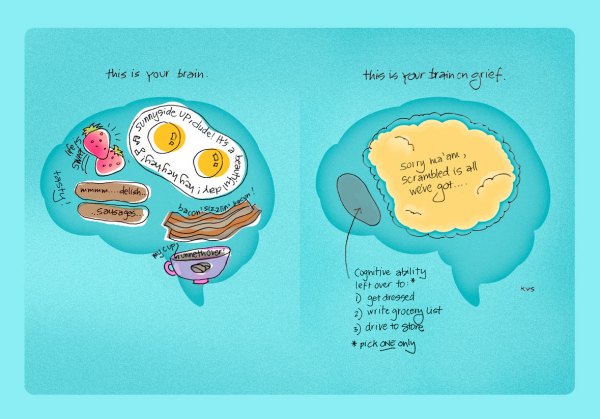
Forgetfulness.  I wrote this post on Grief Brain: It’s a Real Thing! a couple years ago and am always surprised to see it shared repeatedly.  But I think it strikes a chord with any heart walking through grief.  You are not crazy!  You are not experiencing early onset dementia (most likely).  Like other symptoms, get checked out if they persist or worsen.  But odds are, your experience falls within the range of normal for anyone whose life has been shattered by child loss.  Losing things, forgetting things, getting lost in familiar places, missing appointments or bill payments, inability to remember names of people you know well-all of these are common after loss.  In time, the symptoms usually diminish.  They have for me.  I still have to rely on lists and reminders much more often, though.  And that’s OK.
griefbrain1

Inability to Focus.  Like grief brain, this is another cognitive manifestation that’s not only annoying, it can impact life in significant ways.  Before Dominic ran ahead to Heaven, I was an avid reader.  I often had three or four books going at the same time.  I could spend hours focused on a single project.  Not anymore.  I sometimes find it difficult to read a recipe.

I have to take frequent breaks when working on something because my mind gets fuzzy and I just can’t pay attention for more than a few minutes at a time.  Some bereaved parents have to change jobs or careers because they are not able to perform necessary tasks anymore.  This particular symptom has not improved very much for me although I’ve found ways around it.  I use lists to keep an external record of what I should be doing and when.  I mix up mindless chores with ones that require more attention to give my brain a break.  I try to dissect larger jobs into smaller, manageable chunks.  And sometimes I just have to admit that today a particular thing just isn’t happening. 

Appetite or Digestive Issues.  Stress has long been linked to gut problems.  I suspect we’ve all had that “rumbling in our tummy” from time to time even before child loss.  For many of us it’s exponentially worse after.  Some bereaved parents try to stuff emotions by stuffing themselves with food.  Others can’t eat at all.  Still others experience stomach ulcers or bowel disease ranging from acute to chronic.  I was hospitalized twice in the first year after my son’s death for serious colon issues.

Again, don’t ignore sudden or persistent symptoms.  Try to eat well and avoid self-medicating with food.  Added pounds rarely add up to better emotional or mental health.  I let pounds I’d lost ten years ago find me again.  Get help if you need to from someone willing to act as an accountability partner.  I’ve recently joined a friend in setting goals for ourselves and sharing recipes and meal prep.  Try to treat food as another aspect of grief work and manage it the best you can.

the struggle bus

Getting Sick More Often.  Stress lowers the immune system.  That’s a fact.  So when bereaved parents encounter germs (as we all do from time to time) it may well be our bodies don’t have the energy or resources to combat them.  Colds, flu, strep throat, skin infections may all be more likely this side of child loss.  Don’t be discouraged to seek treatment.  There is so much we can’t control in life, but getting antibiotics for an infection is pretty easy.

It’s not in your head, mom or dad! 

Grief has real physical manifestations.   

Don’t be dismissed or denied the care you need. 

Educate your healthcare providers and insist on being heard. 

the weight of grief without words

*photo credit:  The Weight of Grief  Scupture ~ Celeste Roberge*


July Is Bereaved Parents Awareness Month

Certain seasons and topics come around every year.  

I try hard to offer something fresh each time.  

But I reread the post I’ve used to kick off Bereaved Parents Month in the past and really can’t add anything new.  So here it is again.  

If you’ve read it before, consider glancing over it again.  

If you have never seen it, please give it a quick read.  

Don’t miss this opportunity to raise awareness of child loss and its impact on parents and families.  ❤

Bereaved Parents Month

Bereaved Parents Month Post: There Is NO Shame In Getting Help

Shame is a shackle as sure as any chains forged from iron.  

And it often finds its home in the hearts of those who bury a child.

Bereaved parents may feel shame for lots of reasons…Shake Off the Shame


Bereaved Parents Month Post: A Broken Heart

I wrote this post in response to the deaths of Debbie Reynolds and Carrie Fisher in December, 2016.  Debbie died of a broken heart within a day of hearing of her daughter’s death.

It was an opportunity to educate others about the reality of child loss and a parent’s broken heart while the world’s attention was focused on the subject.  

Like so many other things competing for headlines and social media hits, it was only a hot topic for a brief while. 

But for those of us living with the daily reality of a missing child and a broken heart this still rings true. 

I think Bereaved Parents Month is an appropriate time to revisit it.  ❤

debbie-and-carrie

“The world is stunned by the  deaths of Carrie Fisher at 60 and her mother Debbie Reynolds just one day later.

And it should be.”

Read the rest here:  A Broken Heart

Walk A Mile In My Shoes

It’s an old standby-before you criticize someone, walk a mile in their shoes.

But we rarely take time to do that.

Instead we look at another heart and assume that if they are struggling, it’s because they aren’t trying as hard as we might in the same circumstances.

Or we pick apart whatever tiny efforts they are making toward progress because it isn’t fast enough or far enough to suit us.

Then our own path becomes so rock strewn and broken we realize no matter how much energy and positive thinking a body puts forth, there are some roads where an inch a day is a downright miracle.

One thing burying my child is teaching me is this:  Every single person I meet is carrying a burden I know nothing about.

And most are doing the very best they can to bear that load and still do life.

So I give grace.

I speak courage

I extend a helping hand whenever I can.

This life is short and hard and it’s hardly worth adding to another heart’s load.

ugly shoes club

Bereaved Parents Month Post: What The Bereaved Need From Friends and Family During the Holidays

I’m taking the opportunity during July to re-post some articles that have been popular and helpful in the past.  

One of the most trying seasons for grieving parents extends from November through the first week of January. 

The holidays are hard for so many people, but especially for parents trying to navigate these family  focused holidays without the presence of a child that they love.

I know it’s still several months away, but once school starts it seems the weeks roll past faster and faster until suddenly there’s no time to plan and the day is upon us.

I highly recommend speaking to family and friends NOW.  Make plans NOW.  When folks have plenty of time to make adjustments, it is much more likely they will accommodate a grieving heart’s need for change.  

I know it is hard.  I know you don’t truly understand how I feel.  You can’t.  It wasn’t your child.

I know I may look and act like I’m “better”.  I know that you would love for things to be like they were:  BEFORE.  But they aren’t.

I know my grief interferes with your plans.  I know it is uncomfortable to make changes in traditions we have observed for years.  But I can’t help it I didn’t ask for this to be my life.

I know that every year I seem to need something different.  I know that’s confusing and may be frustrating.  But I’m working this out as I go.  I didn’t get a “how to” manual when I buried my son.  It’s new for me every year too.

So I’m trying to make it easier on all of us.  

Read the rest here:  Holidays and Grief: What the Bereaved Need From Friends and Family

Bereaved Parents Month Post: Stuck or Unstuck in Grief-Who Gets To Decide?

“Stuck in grief”-it’s a theme of blog posts, psychology papers and magazine articles.  The author usually lists either a variety of “symptoms” or relates anecdotes of people who do truly odd things after a loved one dies.  “Complicated grief” is a legitimate psychiatric diagnosis.

But who gets to decide?  

What objective criteria can be applied to every situation, every person, every death to determine whether someone is truly stuck in grief?  How do you take into account the circumstances of a death, the relationship of the bereaved to the deceased, trauma surrounding the event or any of a dozen other things that influence how long and how deeply one grieves a loss?

Read the rest here:  Stuck or Unstuck in Grief? Who Gets to Decide?

Be Quick to Listen, Slow to Speak

I’m pretty sure that every single grieving parent I know has gotten at least one private message, text or phone call that starts like this, “I know that I haven’t lost a child, but…” and ends with some sort of advice that seeks to correct a perceived flaw in how the parent is grieving (in public) his or her missing child.

I know I did.  It was the genesis of this post.

But before you hit “send” on that well-meaning missive, you need to know this:  

You have NO CLUE.

None.

Truly.

No matter if you lost a spouse, parent, close friend or favorite pet-it’s not the same thing.

It isn’t even the same thing if you have faced a season when your own child was near death due to accident or disease.

If your home has been demolished due to wind, fire or flood and all its contents lost forever-that is awful and tragic-but not comparable to watching the body of your child lowered beneath the ground.

Just like everyone else who uses social media, what you see in public does not reflect but a tiny corner of the whole picture.

I write every day about loss.  But loss is not all I experience 24/7.  I laugh, I love, I live. 

And while I may post my yearning for Dominic, I speak my heart to my living children every. single. day. 

kids at sea world 2017

My faith has been tried and tested.  I will not be false and pretend that just because I trust the finished work of Christ my heart has had it easy.  

But I’m still holding onto hope with both hands.  

My body has borne the brunt of anxiety and stress and grief.  You can see it in my eyes and in my hips.  

But I’m still standing.

My marriage has been stretched and strained.  

But we are still clinging to one another.  

beach hector and me and boys in sand

So before you suggest ways I might need to trim my sails,

just remember you aren’t sailing the same sea nor facing the same storms.  

before you tell a grieving parent to be grateful which of yours could you live without

Bereaved Parents Month Post: But I Had All That BEFORE!

I absolutely understand that when people say things like, “Just think of all the wonderful memories you have” or “He brought you so much joy” they mean well.

Because it’s true-I have beautiful memories of Dominic.  And he DID bring me great joy.

But I had those things BEFORE he was beyond my reach.

Read the rest here:  But I Had All That BEFORE!