Repost: If You Can’t Say Anything Nice…

There may be some mamas that don’t drill this into their children but if there are, they don’t live south of the Mason-Dixon line.

Every time there was back and forth in the back seat or on the front porch and Mama overheard, we were told, “If you can’t say anything nice, then don’t say anything at all.”

Parents weren’t interested in policing every errant word out of the under 18 crowd’s mouth back in the day.

It was a simple (and effective!) rule:  If what you want to say does not meet the criteria of T.H.I.N. K. (true, helpful, inspiring, necessary, kind) then

Read the rest here:  If You Can’t Say Anything Nice….

Why We Turn Away From Hurting Hearts

The news goes out over Facebook, over phone lines, over prayer chains and everyone shows up.

Crowds in the kitchen, in the living room, spilling onto the lawn.

It’s what you do.

And it’s actually the easiest part.  Lots of people, lots of talking, lots of activity keep the atmosphere focused on the deceased and the family.  The conversation rarely dips to deeper waters or digs into harder ground:  “Where was God?”;  “Why him?”;  “Why do ‘bad’ things happen to ‘good’ people?”

But eventually the busyness and noise gives way to stillness and silence.

That’s when the harder part starts.

Read the rest here:  Why Do We Turn Away?

My Sixth Mother’s Day as a Bereaved Mother

When it first happened all I could think about was getting through a minute, then a day and then all the decisions and days leading up to a funeral or memorial service.  

There’s no road map.  

Even when others come alongside (and many, many did!) there’s just no easy way to navigate that part of the journey.

And then I realized that in addition to all the “regular” days that absolutely, positively  break your heart, I had to forge a path through “special” days.

It was overwhelming!

Mother’s Day was especially challenging that first year.  Our loss was fresh and we’d had to acknowledge and celebrate two graduations and a wedding was about a month away.  How in the world could I honor my living children and also safeguard my broken heart?

We muddled through by having Mother’s Day at my daughter’s apartment co-hosted by some of her sweetest and most compassionate friends.  Not a lot of fanfare, but good food, good company and a quiet acknowledgment of Dom’s absence but also my living children’s presence.

It was a gift. 

This is my sixth Mother’s Day.  Every year is different.  Every year presents new challenges and every year things change.  

Since discovering there is an International Bereaved Mother’s Day my heart has taken advantage of having a day to think about and honor Dominic and then another day to think about and honor my living children.

That helps.  

I wrote this post three years ago but can’t really improve on it so I’ll share it again.  I pray that each heart who finds Mother’s Day hard will lean in and take hold of the hem of His garment. 

It’s really the only way.  

Read the rest here:  Mother’s Day as a Bereaved Mother


I Know Why My Story Scares You

At first all I could feel was pain.

Pain of abandonment, of being misunderstood, of being pushed to the outside edges of groups that used to welcome me with open arms.

But as time passed, I began to understand.

My story scares you.  You are utterly afraid that if child loss can happen to ME, it can happen to YOU.

You’re right.

It CAN happen to you.

And no one wants to be reminded that the one thing every parent fears is not nearly as impossible nor as predictable as we would hope it is.

From the minute we take that baby home from the hospital, safely tucked in the approved and properly installed car seat, we assume we can control the future.  We think that if we eat right, get regular check ups, cover outlets and sharp corners, remove choking hazards and stuff that little mouth full of organic and healthful treats, it’s all good.

Except no one can account for random.  No one can see undetected and unsuspected genetic defects.  No one can predict or protect against every way a child might leave this life before his or her parents.

But we absolutely, positively do not want to think about that.

I don’t blame you.

I didn’t either.

So I understand why you distance yourself from me.  I get why even my presence in a room is sometimes uncomfortable.  I am not upset that you don’t add my name to the invitation list when the occasion is happy and you are afraid I might cast a shadow over the celebration.

I’m a walking advertisement for your worst nightmare.

You can afford to ignore it-and me.

I don’t have that luxury.

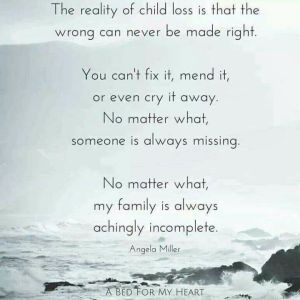
cant-fix-it-my-family-is-always-achingly-incomplete


Please Don’t Ask My Kids How I Am Doing

It may seem like the easiest way to get an inside scoop on how I’m REALLY doing-but don’t do it.

Please don’t ask my kids how I’m doing.

Respect the fact that they have their own grief burden.  Respect family privacy and understand you are putting them in an impossible position.

If you want to know-to REALLY know-how I’m doing, ask me.

Life for us is no different than life for you except every decision, every event, every single thing requires more effort and energy because we carry the additional burden of death and loss.

It’s easy to assume children and young people-even adults in their 20’s and 30’s-are somehow more resilient than they really might be. 

They are often in seasons of activity that serve as cover for deeper, more difficult feelings.  Many beautiful celebrations typically mark these years.  Graduations, weddings, births are wonderful!   But they are complicated for grieving siblings as well as grieving parents.

So be a friend to my kids.  Love them.  Celebrate them.  

And please, please, please treat them as fellow grievers and not simply bystanders to their parents’ grief.

If you want to know about me, just ask.  

Me. 

Not them.  

Repost: Lessons in Grief-Learning to Listen

I admit it:  I’m a fixer.

It’s probably genetic (won’t mention any names!) but it has been reinforced by training and life experience.

When faced with a difficult or messy situation, my mind instantly rolls through an inventory of available resources and possible solutions.

And I tended to cut people off mid-sentence with my brilliant (?) plan to save the day.

But there are things you just can’t fix.

Read the rest here:  Lessons in Grief: Learning to Listen

Instead Of Fixing, Offer Space To Share

I didn’t realize until I was the person who needed comforting how unhelpful and sometimes painful my own past comments were to my suffering friends and family.

There are many important and necessary conversations going on right now about how we talk to and talk about our fellow humans.  I’m thankful folks are learning that words are rarely (ever?) neutral.

They build up or tear down. 

And we are responsible for them.

I wish that along with other areas, we would consider how we discuss and address those who experience painful life circumstances.  But we rarely do.

This is one place where the right words can make such a difference.

Instead of shutting down the broken heart or lamenting soul, we can choose to invite them to share and then stick around to listen.

We can create safe spaces instead of closing the door to further conversation.

We can participate in healing instead of perpetuating the pain.


instead offering compassion.png

Empathy Has No Script

I think if we are absolutely honest, most of us would admit we have few relationships that operate without some kind of script.

We are friends with someone because we like the same hobbies or spend time together at a job or ball park or church.  

We fall in love with someone because they “complete” us and offer companionship, emotional support and stability. 

When the script fails (for whatever reason) we tend to pull away from those  relationships.

But if I choose to enter into the suffering of another, I must do so without a script and commit to the long haul.

I must follow his or her lead, allow him or her to guide my response and refuse to impose my preferences on that hurting heart.  

I’m there to hold a hand and help a heart hold onto hope.  

empathy has no script brene brown

Torches In The Dark

There are so many life circumstances that plunge a heart into darkness.  

Child loss is certainly one of them, although not the only one.  

And when you’re in the dark, stumbling around, trying to avoid the sharp corners and looking, looking, looking for a tiny sliver of light to guide you out, it is terrifying.  

If you don’t have a pocket full of matches or a flashlight or a lantern, you are at the mercy of whoever cares enough to come back for you.

I am so thankful for the friends and family who never tire of my fearful cries when I find myself in dark places.  

They come running.  

They don’t leave me there.  

Sometimes all they have is a tiny candle themselves, a sliver of hope they are clinging to.  But they raise it high , share its glow with me and together we take a step forward toward the brighter light of day.

I will never, ever forget the ones who come to me with a torch.

They help my heart when I can’t help myself.  

They refuse to leave me in the dark.  


you never forget a person who came to you with a torch in the dark

Photo of man with lantern by Marko Blažević on Unsplash

Fix It Or Forget It: Why Unfinished Stories Make Others Uncomfortable

Attention spans are shorter than ever.

It’s easy to understand why.  We live in a world full of sound bytes, memes, tweets and T-shirt slogans.

But life can’t be reduced to such little snippets, even if we wish it could.

Not every biography has the perfect “beginning, middle, end” arch that makes for a good and satisfying story.

Some of us can’t tie up our experiences in tidy boxes, with colorful bows and a lovely tag line that inspires thousands.

gift box with bow

We are living unfinished, messy, hard stories that keep shifting, changing and require us to face mountain after mountain and valley after valley.

And we stumble. 

A lot.

I suppose it’s tiresome for our friends to have to slow down, turn around, bend down and help us get back up over and over and over.

Many of our compassionate companions turn into personal trainers at some point:  “You can do it!  Try harder! Push farther!  You’ve got to work at it!  Don’t give up!  Come on, don’t you want to get stronger, fitter, better????”

personal trainer

The hidden message?  If I wanted to badly enough, would try hard enough, work long enough or get the right help, I could “fix” this.  I could emerge from child loss whole, healed and healthy.

And when I don’t, they get frustrated, disgusted or just plain bored and leave me lonely on the trail.  They walk away and forget-because they CAN forget.

I’ve said it before and I’ll say it again:  If you think it’s hard to watch your friend struggle with a broken heart, a shattered life, doubts and regrets, it’s harder to live it.


You can walk away.  I can’t.  You can go home, close the door and think of something else.  I go home, close the door and am flooded with thoughts, emotions and overwhelming grief.

mixed stages of grief


If I could “fix it” don’t you think I would?

But I can’t.

I will continue to have a messy, untidy, unfinished life this side of Heaven.

And I will keep climbing, struggling and stumbling.

Will you stick around and walk with me?

Or will you walk away?

walking-up-a-hill