Do Good, Be Light, Extend Hope

Dear friends, do you think you’ll get anywhere in this if you learn all the right words but never do anything? Does merely talking about faith indicate that a person really has it? For instance, you come upon an old friend dressed in rags and half-starved and say, “Good morning, friend! Be clothed in Christ! Be filled with the Holy Spirit!” and walk off without providing so much as a coat or a cup of soup—where does that get you? Isn’t it obvious that God-talk without God-acts is outrageous nonsense?

James 2:14-17 MSG

James doesn’t mess around.

He says what a lot of people are thinking but are too timid to speak aloud.

I like that.

We could use a good dose of his brand of preaching in the church today.  Let’s stop pretending that following Jesus is just about getting our theology right.  Let’s stop acting like going to church, serving on committees or teaching Sunday School is the best indicator of where my heart is relative to my Savior.

Let’s face facts:  if my life does not look different than the lives of those who do not know Jesus, then either I don’t know Him or I’m not paying attention to what He’s telling me to do.

I have been blessed on this grief journey by a few dedicated friends who go out of their way to do good, be light and extend hope to my heart when I’m barely holding on.  They have chosen, often sacrificially, to be the hands and feet of Jesus in my life.

And they make a difference!

Sometimes it’s a card in the mail, sometimes a text or message and sometimes a visit-but they DO something.  They might not understand why God is putting me on their heart, but they obey the prompting.

So if the Spirit is nudging you to reach out to someone, don’t ignore Him or put it off. Sure, praying is important.  We are commanded to do that.

But we are also commanded to be physically present and to extend practical help to hurting hearts.  We are supposed to BE the hands and feet of Jesus.

Who knows, I might be the answer to my own prayer that God send encouragement to someone else.

I can choose to do good.

do-all-the-good

I can choose to shine light.

let-light-shine

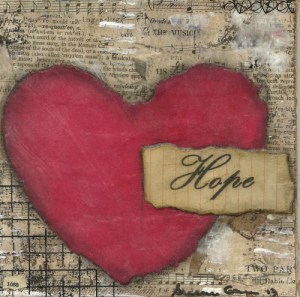
I can choose to share hope.

hope-and-heart

And my small gesture be the very thread that holds a broken heart together.  

If anyone, then, knows the good they ought to do and doesn’t do it, it is sin for them.

James 4:17 NIV


Move Over, Make Room for the Broken

I used to position myself at the end of the pew, just in case someone I’m not too comfortable with might come along and try to sit down.

It saved us both that awkward conversation where they ask if they can join me and I say “yes” with my mouth but “no” with my body language.

Frankly, I was at church to be lifted up so I could face the coming week with power and strength. I didn’t want to be dragged down by their reality of brokenness and sometimes bitter tears.

I don’t do that anymore.

I realize that most of what made me uncomfortable was other people’s pain.

Now I’m the one who’s broken.  I’m the one who can’t get through “Amazing Grace” without blubbering.

And I’m the one that others hope won’t ask to join THEM.

But here’s the deal:  God loves the broken.  Christ came for the broken.  It’s the broken and breathless who long for the Spirit to blow life across their wounded hearts.

It’s the hopeless and fearful that run faster to the safety of their Shepherd.

It’s the worried and weary who are thankful for a Burden-bearer.

When I refuse to move over and make room for the broken, I’m barring the way for the very ones who most desperately need the blessing.  When I want my worship experience to exclude those who haven’t the strength to bring their own hearts before the throne of grace, I’m being selfish.  

And that is sin.

Jesus went out of His way to heal the hurting,

to bless the broken and

to speak strength to the weary.

So now I sit in the middle of the pew and leave room for whoever God brings my way.

I want to be an open door, not a gatekeeper.

“Come to me, all of you who are weary and over-burdened, and I will give you rest! Put on my yoke and learn from me. For I am gentle and humble in heart and you will find rest for your souls. For my yoke is easy and my burden is light.” ~Jesus

(Matthew 11:28-30 PHILLIPS)

Grieving Parents: What Helps and What Hurts

Last February I ran a series of posts about “loving well” during loss.

Other bereaved parents graciously shared both what helped and what hurt in the first few days, weeks and months after losing a child.

I wanted to share this one again because I’ve been reminded recently that it’s hard to know what to do and what to say when a friend or family member is facing the devastating pain of child loss.

If you long to help someone in meaningful ways when they are struggling in a storm of grief, read this:  Loving Well: Some Things Hurt


A Question of Trust: What About Signs?

It comes up often in bereavement groups:

What about signs from loved ones who have gone on to Heaven?  

What about books that tell stories of people who have been to Heaven yet “allowed to return”? 

What about cardinals and butterflies and feathers and dreams?  

It would be so very easy to allow my feelings to rule my heart and to reject the truth of Scripture. It would be less of a struggle to walk this Valley of the Shadow of Death if I could “talk” to Dominic while waiting to join him.

But the Bible is plain:  I cannot trust in anything or anyone but Jesus Christ. Every thing and every one else is fallible and will eventually lead me astray. 

I wrote this a few months ago and hope it’s helpful to other grieving parents:

Read the rest here: Signs

Set it Aside

Good is something you do, not something you talk about.
Some medals are pinned to your soul, not to your jacket.
Gino Bartali

Set aside the tweets and the memes

Set aside the scores and the football predictions

Set aside the latest greatest whatever.

Move it off the table of your heart 

And create space for the truly important:

The drowning people fleeing war torn countries where children are starving or being buried alive in bombed out rubble;

The families displaced-many forever-from homes that were nowhere near a flood plain and who never imagined they would watch a lifetime of memories float downstream;

The frightened ones trafficked for men’s pleasure-praying that someone, anyone, notices and steps in to save them;

The lonely teen unsure of where to turn until his thoughts become so unendurable that only one way out seems reasonable;

The old man or old woman, forgotten and alone, breathing stale air in a home that isn’t home-no one speaking his name, her name-as if they had already passed from this life to the next.

You think it doesn’t matter much.

You think someone else will take care of it

Until it’s you

Waiting for light in the darkness

Looking for hope to hold onto

Begging for help as you’re drowning in despair.

As it is, you boast in your proud intentions.  All such boasting is evil. Therefore whoever knows the right thing to do, yet fails to do it, is guilty of sin.

James 4:17 The Berean Study Bible


The Forgotten Ones: Grieving Siblings

I am always afraid that Dominic will be forgotten.  

I’m afraid that as time passes, things change and lives move forward, his place in hearts will be squeezed smaller and smaller until only a speck remains.

Not in my heart, of course.

Or in the hearts of those closest to him, but in general-he will become less relevant.

But he is not the only one who can be forgotten.  I am just as fearful that my living children will be forgotten.

Not in the same way-they are HERE.

They are participating in life and making new memories, new connections and strengthening old ones.

I’m afraid their grief will be overlooked, unacknowledged-swept under the giant rug of life and busyness that seems to cover everything unpleasant or undervalued.

If the course of a bereaved parent’s grief is marked by initial outpouring of concern, comfort and care followed by the falling away of friends, family and faithful companionship then that of a bereaved sibling is doubly so.

Surviving children often try to lessen a grieving parent’s burden by acting as if “everything is OK”.

But it’s not-it is definitely NOT.

missing them from your side

Their world has been irrevocably altered.  They have come face-to-face with mortality, with deep pain, with an understanding that bad things happen-happen to people they love-without warning and without remedy.

They are forced to rethink their family, their faith and their future without a life-long friend and companion.

Part of their history is gone.

If surviving children are young, it can be so, so easy to mistake the natural enthusiasm and excitement of youth for complete healing.  They are often busy with events, education, work and life and the grief they still feel may go unnoticed-even by themselves.

But they need safe, consistent and compassionate care while they navigate grief and the enduring impacts of sibling loss.  School counselors, grief counselors or mature and emotionally stable adult friends can be very helpful during this process.

It’s important to be alert to danger signals.  Behavioral impacts may present in many ways:

  • Anxiety (situational, tests, generalized)
  • Risk taking
  • Isolation
  • Inability to enjoy previously enjoyable activities
  • Withdrawal from family or friends
  • Depression
  • Self-harming behavior
  • Drug or alcohol abuse
  • Poor grades (may have given up or may not be able to concentrate)
  • Extreme concern for other family members and their safety

If you observe any of these changes, get help.  A grieving parent is rarely able to be the sole source of intensive counsel for a bereaved child-someone outside the grief circle may be a better choice.

Adult children-even those married and with kids of their own-are also changed forever by saying “good-bye” to a brother or sister.  Addiction, depression and physical health issues can surface in the wake of loss.  

It’s not always easy to connect the dots back to grief since life is full of stress and strain and they may need help.

My children have been blessed to have friends and loved ones who give them a safe place to go when grief overwhelms them or when other stressors on top of grief make life really hard.

If you know a bereaved sibling:

  • Reach out.
  • Be an encourager.
  • Don’t assume that because time has gone by, they are all better.
  • They may not want to talk about it and that’s OK.  But if they do, listen.  Without platitudes, without judgement-just be a safe place.
  • And if you notice something that’s just not “quite right” try to get them the help they may need to make it through this hard place.

Bereaved families are often doing the best they can, but they can’t do it alone.  

When you bless my earthly children, you bless me.  When you give them space to grieve, you give me space to breathe. When you encourage them, you encourage my heart too.

Don’t forget them.  

Please.  

Priorities

Browsing a book store (a favorite pasttime) I came on this selection in a collection of poems by Robert Frost:

A Time to Talk

When a friend calls to me from the road

And slows his horse to a meaning walk,

I don’t stand still and look around

On all the hills I haven’t hoed,

And shout from where I am, What is it?

No, not as there is a time to talk.

I thrust my hoe in the mellow ground,

Blade-end up and five feet tall,

And plod:  I go up to the stone wall

For a friendly visit.

It pierced my heart.

How many times have I chosen to ignore a friend’s need for companionship-brushing past importantly as I pursued the day’s tasks?

I’ll get around to it when I have more time,” I think to myself.

And then one day there is no more time.  The friend I kept putting off has left this world for the next and I can’t retrieve the missed opportunities.

Nothing stings like words unsaid, hugs not given or love left bound in a heart instead of set free to bless another.

C.S. Lewis said:

“There are no ordinary people. You have never talked to a mere mortal. Nations, cultures, arts, civilizations – these are mortal, and their life is to ours as the life of a gnat. But it is immortals whom we joke with, work with, marry, snub and exploit – immortal horrors or everlasting splendors. This does not mean that we are to be perpetually solemn. We must play. But our merriment must be of that kind (and it is, in fact, the merriest kind) which exists between people who have, from the outset, taken each other seriously – no flippancy, no superiority, no presumption.”

And I think I don’t have time?

Of all the souls born on this planet, Jesus had the most important work to do.

Yet He purposed to include people at every turn.

He healed the sick.  He spoke hope to the woman at the well and the woman caught in adultery.  He rebuked religious leaders who were more interested in burdening the faithful than guiding them to God.

Jesus walked everywhere-surely it would have been more EFFICIENT to let the Holy Spirit whisk Him from place to place as He did Phillip after speaking to the Ethiopian.

In walking, the Light of the World  was building relationship-He was speaking truth to the twelve who would be the foundation of His church.

And relationship takes time.  There is nothing instant about it.

It is clear from the life of Christ that after His Father, people were His priority.

Few of us will be called to great public tasks or lofty visionary ministry.  But each of us has been called to carry the light and life of our Saviour to every person we meet.

If we are to follow in the footsteps of our Master, then people must be our priority too.

So I will set aside my “to do” list when someone comes calling.  I will cross the street to meet that person I remember from school or church.  I’ll send a card to the sick relative and remind her that I love her and will pray for her recovery.

I won’t lock love in my heart and hoard it like gold.

I’ll shed it abroad so that it speaks courage to everyone I meet.

“Imagine what our real neighborhoods would be like if each of us offered, as a matter of course, just one kind word to another person.”
– Mr. Rogers

A Little Extra Grace

Each day I am reminded by sights, smells, sounds and memories that Dominic is in Heaven and not here.  

But there are moments and seasons when his absence is particularly strong-when I can’t breathe in without also breathing a prayer, “Father, let me make it through this minute, this hour, this day.”

And that’s when I need grace-from family, friends and strangers.

Image result for everyone is fighting a battle you know nothing about quote

Anyone who knows ANYONE that lives with loss knows that Thanksgiving, Christmas, birthdays and remembrance days are sure to be especially hard for those left behind.

What some may not know is that there are other, hidden, pitfalls on this journey through the Valley of the Shadow of Death.

For many bereaved parents the beginning of the school year is one of them.

Even though my son  was long past school age when he left, that shiny penny newness and promise of another year of school, another step toward maturity and the rest of life, another marker on the road to what every parent hopes will be a beautiful future is a painful reminder that my child won’t be doing anything new here on earth.

And a little extra grace goes a long way toward making this season easier to endure.  

  • A bit more patience as I walk slowly across the parking lot, lost in thought and unaware you are behind me trying to get on with life or park your car.
  • A smile when I accidentally bump my cart into yours in the grocery aisle-having just passed his favorite food or smelled coffee and been instantly transported to his finicky passion for all things caffeine
  • Calm responses when I jump to conclusions, cut you off mid-sentence or answer a query with a less-than-kind tone of voice.

Want to be especially encouraging to a parent missing their child in heaven?

  • A text or message or a “thinking of you” card can turn a dismal day into one full of sunshine.
  • Do you have a special memory or memento you could share?  What a gift!

If you see us in these next few days and weeks as thoughts and hearts turn from summer to a new semester, be patient-we are once again reminded that our child’s earthly story has ended.

It’s a hard truth to embrace. 

Every. time.

Move On Already!

How long has it been?  A year, two, eighteen or twenty-five?

When. are. you. going. to. move on?  

Aren’t you over talking about their birth story, their childhood, their school years, their spouse, children, moves and career?  How many funny stories or sad recollections do I have to listen to?????

I mean, really-it’s been soooooooooo00 long since they were BORN!

Sound’s ridiculous, doesn’t it? It IS ridiculous.

We don’t expect parents to “move on” or “get over” their living children.

Why, why, why do we expect parents to move on or get over the ones they’ve had to bury?

My love for each of my children, on earth or in heaven, is life-long.  

I wrote about it here: Love: The Reason I Grieve

What Helps and What Hurts

I am committed to continue to trust Jesus and to look to the Word of God for my hope and direction in this life and in the one to come.

I speak truth to my heart through Scripture, worship songs, testimonies of others who have gone before and remaining in community with other believers.

But I’ve yet to reach the place where I can plan on most days being better days rather than hard ones.

I’m trying.

And I’m working to tease out the influences that make a difference-both the ones that help and the ones that hurt.

So here’s the list so far:

WHAT HELPS

  • Starting the day with Bible reading
  • Writing out a verse or two that speaks hope to my heart
  • Listening to worship music
  • Feeling well-less physical pain translates to an overall sense of well-being
  • Having a plan for the day-even if it is simple and created in broad strokes, knowing what I plan to do gives me a reason to get up and get going
  • Seeking companionship with other believers either via Facebook groups, telephone calls, in person get togethers or messaging.
  • Allowing myself a set time to grieve-cry, pray, lament, or whatever-then moving on with the day
  • Mixing up physical activity with rest-changing my body position often reorients my attitude.
  • Striving to get proper sleep, eating good food (not junk and not mindlessly), exercising and stretching.
  • Crying-if I need to cry I’ve found allowing the tears to fall is much better than fighting them off all day.
  • Retreating when necessary-if I find a situation is too much for me to handle, I give myself permission to retreat.  Most things can be done another day.  Sometimes just granting myself permission means I have the courage to press on and face it.
  • Planning for hard things.  If I know I’m going to have to face a hard thing, then I try to plan it.  I prepare myself by thinking through (as much as possible) various outcomes.  I’m more prepared and usually it goes better than I anticpated.
  • Not overscheduling my days/weeks-it is harder than it used to be to get going in the mornings so I take that into consideration when making appointments.  If I have a busy day on Monday, I will try to make Tuesday open and relaxed.  Having space between commitments gives me time to recoup and minimizes anxiety.
  • Doing as many things via Internet and telephone as possible-I can do needful things even if I’m having a bad day if I don’t have to get dressed and go out to do them.

WHAT HURTS

  • Neglecting my spiritual life-if I don’t read Scripture, don’t engage with other believers and refuse to acknowledge and thank God for the blessings He still bestows-I can quickly succumb to the dark whispers of the enemy of my soul.
  • Ignoring physical needs-when I don’t prioritize sleep, good nutrition, adequate exercise and appropriate pain control (for my RA) then sadness is multiplied and it is so much harder to climb out of the pit of despair.
  • Carrying unnecessary burdens-I cannot MAKE anyone understand the pain and ongoing challenge of child loss.  So when people outside my immediate grief circle question my feelings or try to make me conform to their expectations of what grief should look like and how long it should last, I have to shake it off. If it’s an important and ongoing relationship, I try to help them understand but if they choose not to or if it is a tangential relationship, I let it go.  I refuse to carry the burden of others’ expectations in addition to the burden of burying my child.
  • Being ignored-it hurts to be ignored.  It hurts when someone asks how I am yet doesn’t allow the space and time for me to answer.  It hurts when I answer and they ignore my pain or dismiss it with a story or platitude or Bible verse or just don’t say anything.
  • Being shamed-it hurts for others to shame me by implying that I am not strong in my faith or not trusting Jesus or not hoping hard enough for heaven when I admit I still struggle in grief and still miss my son.
  • Disregarding my triggers:  There are certain situations that I know will guarantee a breakdown, panic or a crying fit.  I avoid them when I can.  If I can’t-then I make a plan of escape (just in case).
  • Being “on display” for others-I am one woman doing the best I can to walk faithfully with Jesus through an unbelievably painful experience.  I am not the Author and Finisher of your faith-Jesus is.  It hurts when I feel like others are watching to see if I’ll make it, if I’ll say the “wrong” thing, if I’ll admit that I doubt.  I want the same freedom others have to grow in my faith and to make mistakes and learn from them.  I don’t want to be a “poster child” for anything.
  • Friends staying away.  I know it is hard to be my friend right now.  You never know what you might get when you call.  But if you ARE my friend, please don’t stay away.  Please reach out even when it makes you uncomfortable.  A good word at the right moment is often the difference between a very bad and very lonely day and a pretty good and generally hopeful one.
  • Hiding my sorrow-when I try to pretend I am stronger than I really am or when I try to hide my tears it takes so much energy and makes me so less capable to do the other things life requires.

These are just some of the things that help/hurt me in my journey.  I would love to have others share what helps/hurts them in theirs.  There’s strength in community.

Leave your thoughts in the COMMENTS below!