Sometimes I’m envious of folks hobbling along in those plastic boots designed to support an injured leg or ankle and aid healing.
Not because of the injury–I’m thankful I’ve never broken a bone-but because it’s an outward warning to anyone who might otherwise be impatient or insensitive that they just can’t go any faster.
I think there ought to be a t-shirt, pin or banner that gives the same kind of warning for those of us walking around with broken hearts and broken lives.
My hardest grief season begins in November and runs to the end of May. Thanksgiving through Dominic’s birthday on (or near) Memorial Day are days full of triggers, memories and stark reminders that one of us is missing.
If I could fall asleep November first and wake up in June I’d do it.
But I can’t so I have to employ all the tricks I’ve learned in the over eight years since Dominic ran ahead to heaven to survive those particularly challenging months.
Here are ten ways I survive hard grief days:
1. I make lists of things to do. I’ve found that if I don’t make a plan for each day it’s far too easy to just lie around and feel sorry for myself. I use index cards but whatever works for you is fine. I list household chores, phone calls to make or notes to write, exercise, errands or whatever. And then I consider them non-negotiable. These are my marching orders and after my morning coffee I start down the list.
2. I do something creative. I crochet or arrange flowers or sew a little. Taking just five or ten minutes to make something beautiful changes my perspective. I have a can opener that takes the lids off without sharp edges and I make magnets for friends and family members or just to have on hand for a little gift.
3. I take a walk. I am thankful I can go outside on my own property and enjoy fresh air and country sunshine. I know not everyone has that option. But even a walk inside your office building or up and down a couple flights of stairs gets the blood pumping and releases endorphins. If I can’t walk, then I at least change my physical position-from sitting to standing, from standing to moving. Body position impacts my emotions.
4. I find something to make me smile. There is scientific evidence to back our common sense experience that smiling lightens our mood and helps our hearts. I read jokes or check out some of my Facebook friends that tend to post funny memes or stories. Sometimes I just “practice” a smile and even that can send feel-good hormones surging through my system.
“Don’t try to win over the haters, you are not a jackass whisperer.” ~ Brene Brow
5. I call or text a friend. Sometimes I just need to know that someone else is aware of my hard day. No one can undo my grief but when I feel there is a witness, it lightens the load somehow.
6. I stay off Facebook and other social media platforms. I love that I’m able to keep in touch with friends and family via social media. But it can be full of drama and negativity as well. So if I’m having a tough day, I remove the potential for it to be made harder due to random comments, posts or photographs.
7. I pet my cats. I have always been an animal lover. But I truly do not know how I could have survived these past four years without the companionship of my cats and other furry friends. Study after study confirms that being in the presence of pets lowers blood pressure and calms nerves.
8. I go with my feelings. There is no rule book that says I have to be tough and hide my tears. If I’m having a hard grief day it is perfectly acceptable to let the sorrow wash over me and let the tears fall. Sometimes fighting the feelings only prolongs my pain. Often a good cry is cleansing and I am much better afterwards.
9. I journal. There are things I need to “say” that are better kept between me, God and my notebook. I have kept a journal for nearly three decades. Many times just writing out my feelings, my fears, my thoughts and my frustrations is enough to take the sting out. There’s something about not keeping it all bottled up inside-even if no other soul reads it-that acts as a catharsis.
10. I copy encouraging quotes or Scripture and hang them prominent places throughout the house. I have notes tacked to my bed post, on my bathroom mirror, taped to the cabinet next to my stove, stuck on the fridge, slid into my wallet in my purse-absolutely everywhere. Because when my heart is hanging on by a thread, the smallest bit of encouragement is often enough to help me hold onto hope.
None of these things undo my grief in the most basic sense.
Dominic is gone, gone, gone and I will not see him or hear his voice until we are reunited in the Presence of our Savior.
But they DO help.
One of the most devastating aspects of child loss is the overwhelming sense that NOTHINGmakes sense anymore and that I have absolutelyNOcontrol.
Choosing helpful habits and actions gives me a way to regain dominion over a tiny corner of my world.
And that little bit of action strengthens my spirit and helps my heart hold on.
It seems to be the nature of humans to listen with an ear to respond rather than an ear to hear.
I’ve done it myself.
Jumped right in with all kinds of suggestions designed to “fix” someone else’s problem.
Or worse, heaped my own experience with something more or less (often less) similar onto an already overburdened heart.
I hate that tendency in myself and I’m working hard to try to change it.
Those who feel compelled to just say SOMETHING often bombard grievers with platitudes, comparisons to their own grief or just empty, frivolous words that require we either stand there dumbfounded or find a gracious way to exit the conversation.
It’s especially painful for a broken heart when a well-meaning someone decides THIS is the moment for a theology lesson.
“God has something planned for you in this” or “God will use this for good”. (Romans 8:28-29)
“We don’t grieve as those without hope!” ( I Thessalonians 4:13)
“All our days are numbered.” (Psalm 139:16)
I get it-death is a heavy subject and the death of a child isn’t something anyone wants to talk about, contemplate or be forced to wrestle with. So it’s often easier to simply say something-anything-do your duty and walk away.
But it is hardly helpful.
Deep grief as a result of unbearable loss is not a teaching moment.
It’s an opportunity to listen well, think carefully about if or when you need to say anything and simply offer compassionate companionship to a broken heart.
Grieving felt hardly like the time for being taught, at least initially. Early grief was my time for pulling out of my past those truths that I had already learned — out of my ‘basement — so that I could begin to assemble them together into something even more meaningful to me than before. It was the time for understanding that even though I had always believed in heaven, it now looked to my perceptions to be more real than this world. It was the time when, even though I already believed in God’s control of the world, I now felt dependent upon him being sovereign over it for all my hopes. It was the time for realizing that even though I already believed that Christ conquered death, I now longed to see death die.Lianna Davis, Made for a Different Land
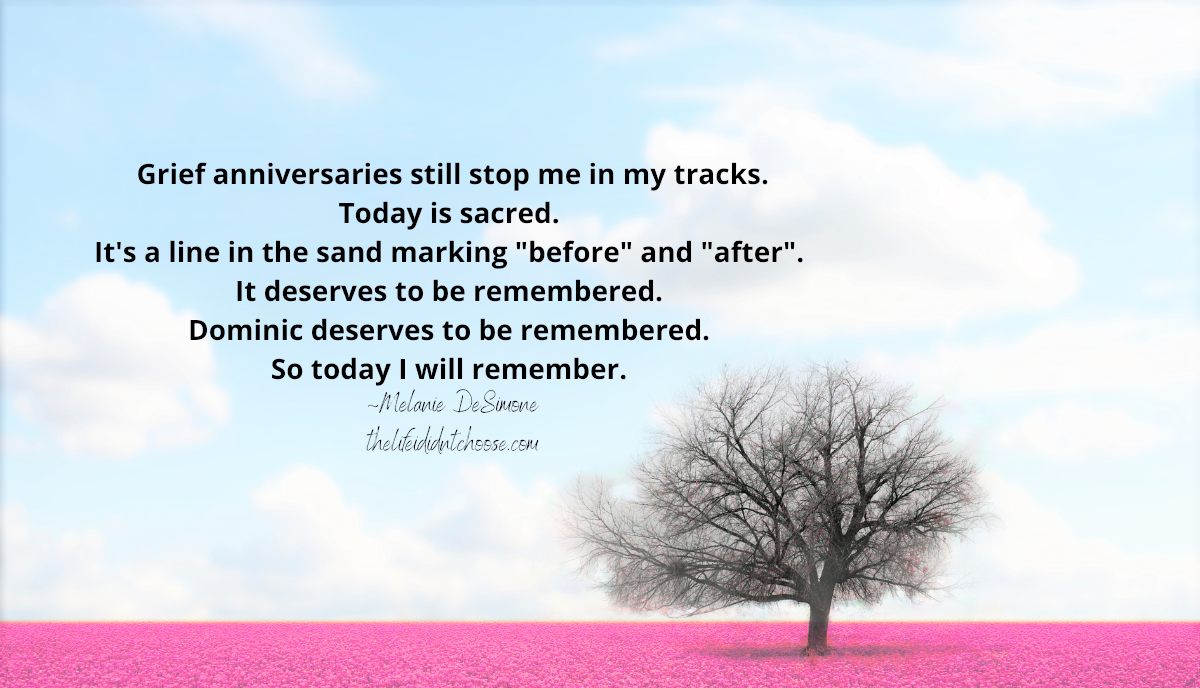
I know I’m not the only one who carries a calendar in my head that threatens to explode like a ticking timebomb.Days that mean nothing to anyone else loom large as they approach.
The date of his death.
The date of his funeral.
His birthday.
My birthday.
The day he should have graduated from law school.
On and on and on.
How can I survive these oppressive reminders of what I thought my life would look like? How can I grab hold of something, anything that will keep my heart and mind from falling down the rabbit hole of grief into a topsy-turvy land where nothing makes sense and it’s full of unfriendly creatures that threaten to gobble me whole?
The fact that so many bereaved parents tell me they don’t feel they can share their experience on their own FaceBook or other social media pages.
That’s just WRONG!
They have been shushed to silent suffering because when they break open the vault of emotions and let others see what’s inside, many people turn away-or worse, they condemn that wounded heart for sharing.
When I was a young mother, my brother used to love to sit back and wait to see how many things I could do at once.
I could hold a baby, iron a shirt and talk on the phone at the same time. I could pick things up with my toes when I didn’t want to disturb the sleeping child in my lap and couldn’t reach the object with my hand.
Four children in six years, breastfeeding, homeschooling and taking care of all the household chores meant that I got pretty darn good at keeping multiple balls in the air at the same time.
Those days are over.
Like so many things at this point in my life I don’t know how much of what I experience and feel is a function of getting older (definitely middle aged here!) and how much is attributable to grief following the death of Dominic.
But this I do know: I am only able to focus on a single task, thought, desire or problem at a time. If I try to multi-task, I might as well cry, “Uncle!” from the start.
It’s a little discouraging.
Often I feel like I’ve wasted an hour or a day or even a week. What exactly did I get done?
But it’s also a kind of freedom.
My household isn’t nearly as busy as it once was so there’s really no need to rush from here to there or stack task on top of task.
I’m learning that taking time, talking to people for as long as they need me, doing something well even if I don’t do it quickly are all perfectly acceptable ways to spend a day.
And while I miss so much of who I was before Dominic ran ahead to heaven, I don’t miss the frantic craziness of trying to do too much in too little time.
I shared this last year around this time in response to many, many comments and questions from bereaved parents about what felt like random or unusual physical manifestations of their own grief.
I hope it helps another heart navigate this life none of us would choose.
It’s a well known fact that stress plays a role in many health conditions.
And I think most of us would agree that child loss is one of (if not THE) most stressful events a heart might endure.
So it’s unsurprising that bereaved parents find themselves battling a variety of physical problems in the wake of burying a child.













 thelifeididntchoose