Lenten Reflections : Letting Go of Regret to Make Space For Growth

Today’s fast is regrets.

That means learning to let go of past mistakes, missed opportunities, woulda/coulda/shoulda.

Because the truth is no one lives backwards.

It’s helpful to reflect on how past actions might have influenced present conditions but it is crippling to hold those thoughts and feelings so close that there’s no room for new ones.

Every one of the disciples ended up being less brave than they had sworn to be. Each carried a heart wound that could have stopped them from fruitful ministry after Jesus rose.

They might have allowed regret to bind them to the past but they didn’t.

Regret empties anticipation, flattens dreams and suffocated hope, because regret is a form of self-punishment. Whereas hindsight lets us learn from the past, regret beats us up with the past.

Alicia Britt Chole

There is no more fertile ground for regrets to flourish than surviving the death of a child (or anyone you love).

It’s even more tempting when the person leaves suddenly, unexpectedly and without any opportunity to at least say, “goodbye”. When Dominic was killed instantly in a motorcycle accident I woke to a world where there would never be a chance to say anything that hadn’t already been said.

It was devastating.

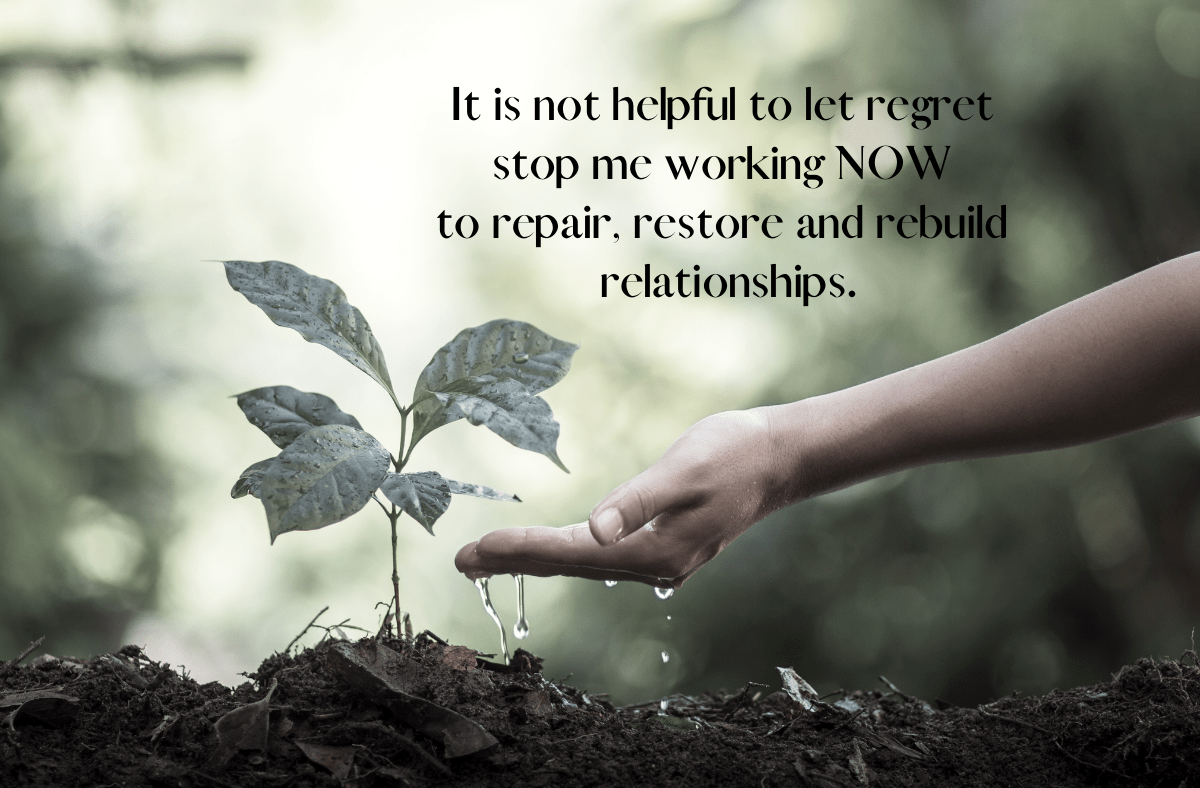
But it’s not helpful to rehearse what I might have said or done if I knew the last time I saw him would be The. Last. Time.

Instead I have to live forward, embrace lessons learned from my past without allowing them to destroy me.

The Lord’s mercies are “new every morning”.

I want to embrace them every sunrise emptied of yesterday’s regrets.

I can face today confident that the Lord who made me will mold me and use me even when I haven’t always (or even often) made the best choices. ❤

*I am sharing thoughts on 40 DAYS OF DECREASE (a Lenten journal/devotional). If you choose to get and use the book yourself, I’ll be a day behind in sharing so as not to influence anyone else’s experience.*

Lenten Reflections: Letting Go To Make Space For Love

Letting go to make space for love is the only true fast.

I have observed Lent off and on for decades.

It’s an opportunity to set aside time and dedicate effort to thinking deeply about the current state of my spiritual life as well as refocus my heart’s affections on my Shepherd Savior King.

Faith, in general, is less about the sacrifice of stuff and more about the surrender of our souls. Lent, in kind, is less about well-mannered denials and more about thinning our lives in order to thicken our communion with God.

Alicia Britt Chole

Today’s fast: LENT AS PROJECT

What that means to me: I want these 40 days to help my heart lean in and take hold of Who Christ is.

I don’t want to measure my “progress” toward doing without or even adding another spiritual discipline to my daily routine.

Self-denial can be a source of pride.

I’m ashamed to admit that have succumbed more than once to a holier-than-thou attitude.

I will refuse to check boxes or add up what I’ve done without. “Thicken my communion with God” is my goal.

I want to be like Mary who poured out the precious oil on His feet disregarding cost, other people’s opinions and without a moment’s hesitation once the Spirit gave her heart the nod.

If you observe Lent, what are you aiming for these 40 days? If you are giving up something, why?

Are you frightened, worried or overwhelmed?

God sees, He knows and He wants you to run to Him.

He will gather you in His arms, wrap you in His love and sing songs of peace over your soul. 

*I am sharing thoughts on 40 DAYS OF DECREASE (a Lenten journal/devotional). If you choose to get and use the book yourself, I’ll be a day behind in sharing so as not to influence anyone else’s experience.*

Mardi Gras and Ash Wednesday-What a Contrast!

I think I will post this link as long as I maintain the blog because I will always be a voice for those whose lives look more like Ash Wednesday than Mardi Gras.

I will continue to speak out for space in our congregations and fellowships that acknowledge life is often hard, often unfair and often more like a broken hallelujah than a high note.

I am not a member of the Church of the Perpetually Cheerful. 

I am a member of the Broken Body of Christ, limping through this world, holding on to hope with both hands.

Read the rest here: Mardi Gras and Ash Wednesday: A Study in Contrasts

Today Is The Second Best Time to Make Amends (or Plant a Tree).

Life is really rather unforgiving, isn’t it?

I can only live forward and there are no do-overs.

No amount of regret can roll back the clock and give me another chance to do it right, do it better or just do it at all.

Read the rest here: The Best Time To Plant A Tree

What Does “Safe” Really Mean?

I remember as a  young mother of four working hard to keep my kids safe. 

dominic and siblings little children at nannys

Next to fed and dry (two still in diapers!) that was each day’s goal:  No one got hurt.  

It never occurred to me THEN to add:  No one got killed. 

Read the rest here: What is Safe?

Oh, How I Need Friends! Two ARE Better Than One.

I’ve thought a great deal about friendship since losing Dominic.  I’ve been blessed by those who have chosen to walk with me and dismayed by some who have walked away.

It takes great courage to sit in silence with those who suffer. We must fight the urge to ward off their pain with chatter.

Quiet companionship requires that we allow our hearts to suffer too.

❤ Melanie

For fifty years I was on the “other side”-the one where I looked on, sad and sometimes horror-stricken- at the pain and sorrow friends or family had to bear.

Read the rest here: Loving Well: Being a Friend

How We Can Make Church a Safe Haven For The Brokenhearted

f you have lived a blessed life where the greatest challenge to your faith has been disappointment and not destruction then I am so, so happy for you. Really.

Some of us have dragged our broken hearts through the church doors out of habit with little hope we might find the genuine comfort we need to survive inside.

Because experience taught us that while it is perfectly acceptable to raise a hand and ask for prayer one or two weeks in a row, it better not become a predictable pattern. Patience with unsolvable and messy ongoing situations runs thin as leaders turn the discussion toward “victory in Jesus”.

But that isn’t what Christ came for-not that we don’t have ultimate and even some temporal victory through Him.

He came for the broken and breathless. He came in the flesh because our flesh is weak and life is hard and bad things happen.

We’ve got to do a better job welcoming and ministering to hurting hearts.

We have to.

❤  Melanie

I am a shepherd.  My goats and sheep depend on me for food, for guidance and for their security.

And every day I am reminded that a shepherd’s heart is revealed by the way he or she cares for the weakest and most vulnerable of the flock.

But most of us are far removed from the daily reminder of pastoral life that was commonly accessible to the authors and readers of the Bible thousands of years ago.  So it’s no surprise that we tend to forget the connection between a shepherd’s life and a pastor’s calling.

Read the rest here: Loving Well: How the Church Can Serve Grieving Parents and Other Hurting People

“Acceptance” Isn’t a Stage. It’s a Lifetime.

In all fairness, Elisabeth Kubler-Ross had no idea her research would be taken out of context and plastered across professional literature and media outlets as a definitive explanation for the grief experience.

But she didn’t mind the notoriety.

And ever since, counselors, pastors, laypersons and the general public have come to expect folks to politely follow the five (sometimes described as six) stages of grief up and out of brokenness like a ladder to success.

It doesn’t work that way.

❤

Sometimes those that walk alongside the bereaved are biding time, waiting for that “final” stage of grief: Acceptance.

And some therapists, counselors and armchair psychiatrists are certain that if the grieving mother or father can simply accept the death of a child, he or she can move on–they can get back to a more “normal” life.

But this notion is as ridiculous as imagining that welcoming a new baby into a household doesn’t change everything.

And new parents have months to prepare.

Read the rest here: Loving well: Understanding “Acceptance”

Grief is a Family Affair: Tips for Interacting With Bereaved Families

I think the mama is often the first person others think about when they hear a child has run ahead to Heaven.

But child loss affects dads too.

And it’s often sibling loss as well.

Grief is truly a family affair-each member is changed by the experience and they ALL need support.

❤

I firmly believe that our friends and extended family want to reach out, want to help, want to walk alongside as we grieve the death of our child

 I am also convinced that many of them don’t because they don’t know how.  

It may seem unfair that in addition to experiencing our loss, we also have to educate others on how to help us as we experience it, but that’s just how it is.

The alternative is to feel frustrated and abandoned or worse.  

Read the rest here: Child Loss: Helpful Tips for Interacting With Bereaved Families

A Grieving Heart

In the last post I shared the difference between mourning and grief. While the outward ceremonies have long passed, the inward struggle to embrace and understand the pain and sorrow of losing my son continues.

If you love someone who has lost a child, perhaps these thoughts might help you understand a bit of their pain and how completely it changes the way bereaved parents encounter the world.

Please be patient. Please don’t try to “fix” us. Please be present and compassionate. And if you don’t know what to say, feel free to say nothing-a hug, a smile, an understanding look-they mean so very much.

 ❤ Melanie

A bereaved parent’s grief doesn’t fit an easy-to-understand narrative. And it flies in the face of the American “pull yourself up by your bootstraps” mentality.

You can’t beat it–it’s not a football game-there is no winning team.

You can’t lose it–it’s not the extra 10 pounds you’ve been carrying since last Christmas.

You can’t get over it–it’s not a teenage love affair that will pale in comparison when the real thing comes along.

You can only survive it.  You can heal from it, but it will take a lifetime and require very special care.

Read the rest here: Loving Well: Understanding the Grieving Heart