Your Child Matters

I know many who read this blog belong to closed online bereavement groups.

That’s a beautiful thing- a place where we can share our pain with others who understand it in a judgement-free zone.

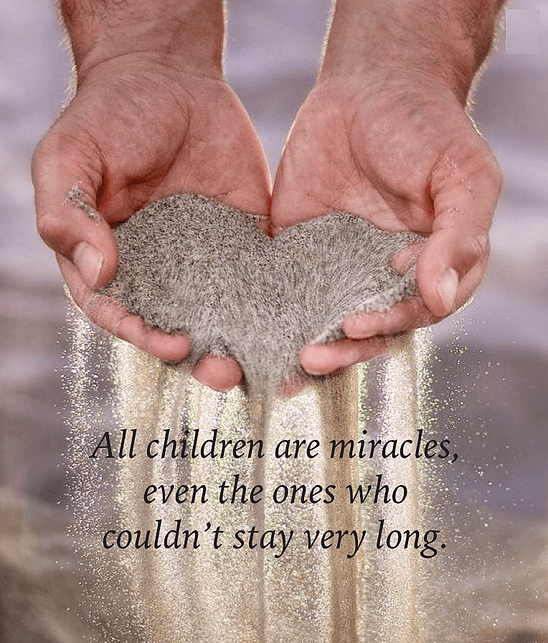
child-and-mama-heart-together

We often post photos and our child(ren)’s story in the closed groups.

But today I want to take a moment to provide a public forum for anyone who wishes to take advantage of it.

Your child matters.

His or her story matters.

Your pain matters.

If you are so inclined, please “speak” your child(ren)’s name in the comments section. Tell us something about your child(ren), tell us what you miss about your child(ren), tell us what made your child(ren) a special light in this world.

(It is a PUBLIC forum so please don’t post anything you don’t want the world to know.)

child existed


Repost: Grief Brain: It’s a Real Thing!

You are not going crazy because you can’t remember your best friend’s name.

You haven’t lost your mind because you can’t find your car keys, or the purse you put them in, or get lost in a store.

It’s grief brain.

And it’s a real thing….

Read the rest here:  Grief Brain: It’s a Real Thing!

Grief Brain: It’s a Real Thing! PART TWO: Coping Strategies

So now that you know you aren’t going crazy, what to do?

Give yourself grace-understand that the old you is not the new you.

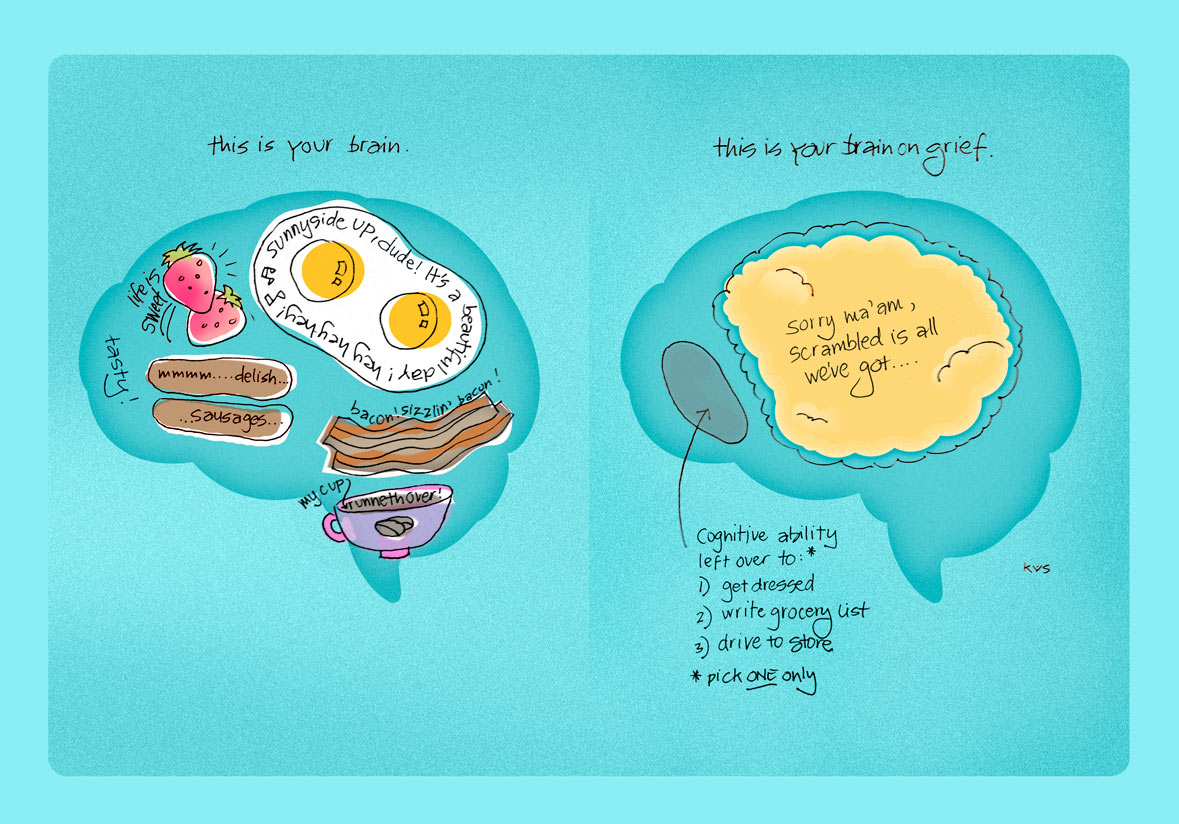
griefbrain

You will not be able to overcome these very real changes by sheer force of will. No matter how talented or together you used to be, it’s unlikely you can operate on that high plane right now. If you try, you will only exhaust the resources you have left.  

So slow down and make room for how grief has impacted your mind.

talk-to-yourself-as-someone-you-love-brene-brown

There are some basic self-care techniques that bear fruit in every area, not only mental acuity:

  • Eat balanced meals or snacks-It doesn’t matter if you WANT to eat.  Consider that you are fueling your body so that it can feed your mind.  Find a protein bar you like or eat easy-to-make salads or sandwiches.  When blood sugar levels are stable, your mind works better.
  • Get as much quality sleep/rest as possible-This is very hard, I know, when the setting sun brings memories and thoughts that make sleep almost impossible.  But research “sleep hygiene” and apply the techniques that might work for you.  Herbal supplements and teas can help as well as prescription medications.
  • Drink enough water-hydration is so very important and easy to ignore.
  • Limit alcohol and/or other stimulants/depressants -any of which can interfere with your ability to think and remember. (Do NOT stop medication unless you do so in concert with your doctor)
  • Exercise-There’s no need to run a 5K. Just a walk around the block or even around your house can get your blood pumping and providing more oxygen to your brain.
  • Get a physical exam to rule out hypothyrodism, diabetes, heart disease, or any other physical cause for your symptoms.  If prescribed treatment, follow the protocol.

brain-cogs-and-light-bulb

Develop work arounds:

  • I simply admit to people I’m meeting for the first time that I will not remember their name unless and until I use it multiple times, and even then I might forget.  It takes the pressure off so I don’t have to pretend when I see them again.
  • I write down EVERYTHING.  If I put something “someplace safe” I jot down the location in my calendar.  If I make an appointment or need to make a phone call, I write it where I can see it.  If I commit to bring something to a potluck meal, I put down what I promised and when it needs to be there.
  • I ask for help.  Like I said before, if I make lunch plans with friends, I ask that they text me the day before to remind me.  If I need extra time to fill out a form, I speak out-I’ve never had anyone refuse.  If I can’t remember something important, I admit it and look it up.  I have given my family permission to tell me when I’m repeating myself.
  • I maintain routines and habits.  Keys-same place,always. I have a carabiner on my purse to attach them when I leave my truck.  Glasses-same place, always.  Medicines in those little seven-day sorted containers.
  • I use the Internet, mail and telephone calls to expedite things and minimize stressful interactions with people.  If I am going out to a restaurant, I look up the menu online so I’m not forced to make a decision on the spot.  I look up and print directions even though my phone can navigate on the fly.  I call ahead to learn how long a repair will take, if items are available and if my prescriptions are actually ready.  I send letters and cards instead of visiting when I’m feeling overwhelmed.

take-control-of-your-life

Lifestyle choices:

  • I aim for balance:  Harder tasks with easier ones; stressful outings with quiet moments; reading with sewing; outside and inside; work and play.  Switching up seems to help keep me sharper somehow.
  • I don’t overcommit.  When someone asks me to do something, unless it is truly an emergency requiring an immediate answer, I consult my calendar.  If I already have a couple commitments for a week, I beg off or reschedule for another time.  I realize that those working outside the home have far less control over these things but perhaps you might ask your boss for some leeway.
  • I group similar tasks and do one thing at a time.  I find that doing things that require the same skillset on a single day increases my ability to do them well.  Shopping, writing notes, cleaning house are things I schedule for one day at a time.  I am absolutely NO GOOD at multitasking anymore.
  • I’m realistic about what I can and can’t do.  It is humbling to admit that I’m no longer tolerant of small children and large crowds.  I used to be able to handle both.  But I just can’t do it, so I limit my exposure.  I won’t serve in the nursery at church and I don’t attend concerts.  That’s just the way it is now.
  • I plan for laughter.  If it doesn’t happen organically, I seek something uplifting and funny to tickle me into laughing out loud at least once a day.  Laughter helps me cope and releases all kinds of feel-good hormones.  With the world of memes at your fingertips, this is an easy thing to do.
  • I refuse to apologize.  Yes, I might say, “I’m sorry” when I forget someone’s name, but I don’t make it a habit to make excuses for my inability to live up to others’ expectations.  I learned early on that anyone who has not walked this Valley can’t really understand anyway.  It frustrates me, adds to stress and does no good.  So I let my “yes” be “yes” and my “no” be “no”.  I’m beyond being embarrassed.

I do the best I can as long as I can.

And when I reach my limit, I admit it without being shamed.


shame-is-the-intensely-painful-feeling-we-are-unloveable-brene-brown


Grief Brain: It’s a Real Thing!

I’m looking right at her.

I know her.  In fact, I’ve known her for years.  But please don’t ask me her name.

I have no idea.

It happens to all of us-meet someone in the store or at the Post Office and you just know you know them, but cannot-for the life of you-remember a name.

file-cabinet

Chatting on, you search mental files desperately trying to make a connection you can hold onto.  Five minutes after she walks away it pops up-oh, yes!  That’s so-and-so from such-and-such.

Imagine if instead of searching mental files without success you can’t even find the file cabinet and start to wonder if one ever existed.

That’s what “grief brain” does to you.

Here are a few more examples of things that actually happened:  

  • Someone would say something to me and I hear them as if it’s another language-I have absolutely NO IDEA what they just said.
  • I had to write a list each morning of the most basic things to do (like eat) so that I didn’t forget to do them. I had to tape the list to the kitchen cabinet because otherwise I lost it.
  • I could no longer walk away from the stove when it’s turned on-I burned more than one pot of peas.
  • There are times I couldn’t remember my phone number or street address when asked.
  • I answered the phone, heard a familiar voice only to be confused about exactly who was on the other end of the line.
  • I became momentarily “lost” on familiar streets or in familiar stores.
  • Sometimes I literally couldn’t remember what day it was.
  • I forgot appointments, meetings and what time church starts on Wednesday night.

confused-huffpo

I began to wonder if I was losing my mind.  

And, in a way, I was.  

At least the mind I had BEFORE my son was killed.

The initial shock was only a beginning.  Ongoing stress and related hormones as well as increased blood pressure, poor sleep, anxiety, profound sadness and being forced to acknowledge my own lack of control bombarded my mind for months.  Pathways I’d relied on for most of my life were changed or destroyed.

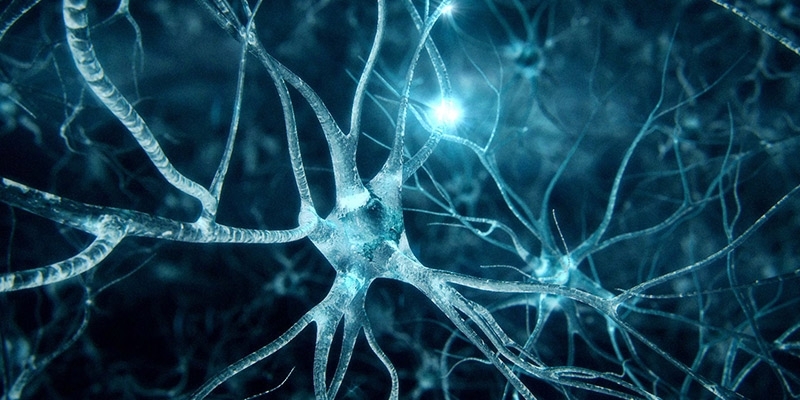
If you think of the brain as an interconnected web of associations, functions and activity, it’s easy to see that rerouting or destroying some of the connections makes it harder to access information and do tasks.
neurons

“[W]hen brain imaging studies are done on people who are grieving, increased activity is seen along a broad network of neurons. These link areas associated not only with mood but also with memory, perception, conceptualization, and even the regulation of the heart, the digestive system, and other organs.”  Prevention Magazine

It’s no wonder that I found it difficult to think and do the most routine tasks after child loss!  

My mind was fundamentally altered.

It’s not as bad now as it was in the beginning.

But I still struggle to remember things that used to come easily.  I still hear words that I don’t always understand.  I depend much more on paper and pencil to keep track of important dates, appointments and phone numbers than I used to.  And I never walk away from the stove.

If I make a lunch date with a friend, I ask that she message me the day before to remind me.  If I don’t comprehend what someone is saying, I request that they repeat it.  I keep a paper copy of important information in my purse and an electronic copy on my phone.

It’s frustrating sometimes, but it is not a moral failure that my brain isn’t as sharp as it once was.

What was embarrassing at first is now something I openly acknowledge. 

I ask for help and I don’t apologize.

It’s really OK.

grief-brain-quote-from-cf

Featured image via: bedraggled & kicking

Rearview Mirror

I talk about Dominic “running ahead” but it feels like Im leaving him behind.

I know he’s the first to Heaven and I know I’ll join him, but my daily experience is that I am the one moving forward and he is the one stuck somewhere, unable to catch up.

I absolutely HATE that his footprint on my life grows smaller with each passing day, each new memory made without him, each event at which his smiling face makes no entrance.

I can’t stop the accumulation of bits and pieces that make it harder to spot his unique contribution to the collage of my life.

I am in no danger of forgetting him.

That’s not what I fear.

But bringing what he still is to me into a conversation, into view for others to see and appreciate is getting more difficult.

When I mention him, people don’t know whether to be sad or happy, question my sanity or rush past hoping I’ll change the subject.

There’s just no natural seque between the living and the dead.

And it hurts my heart to watch the gap grow wider.

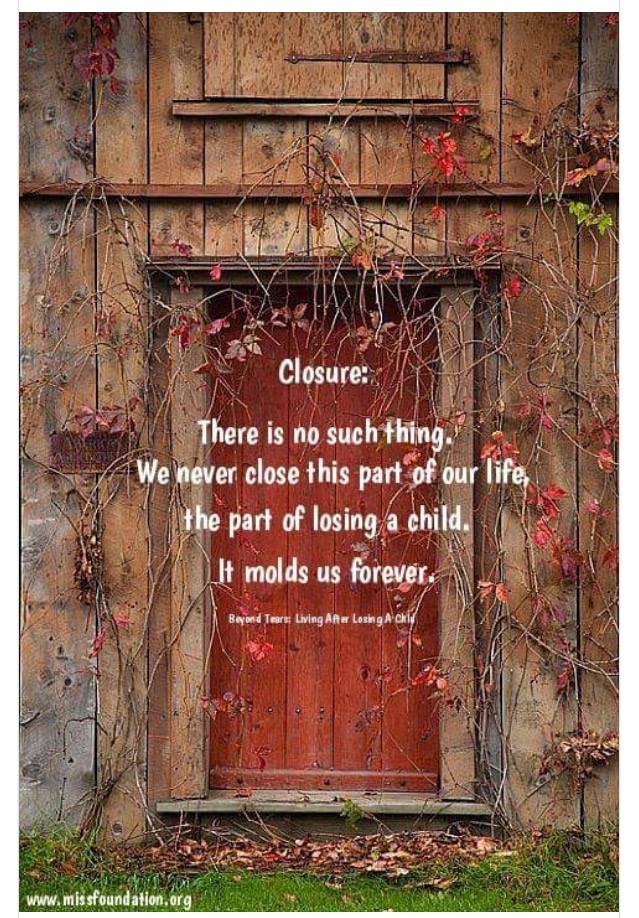
closure-door


Another Day

I wake and you are still gone.

The cats tap-tap-tapping on my arms and face declare the day has begun despite the dark and I need to climb out of bed.

Why?

What difference does it make?

I trudge downstairs, put the coffee on, feed the cats and settle into my chair to read and write.

Habits.

Routine carries me through the day.  There are things that need to be done.

The sun still rises-must be soon now because I hear the rooster’s escalating declaration that he, at least, can see the light.

One cat settles into my lap adding weight and warmth to the morning. I remember when I held you and your brothers and sister.  I never tired of that sweet bundle bearing down on my heart.

I would do anything to feel it again.

But that can’t be.  And I won’t hold your children either.

All of you was taken away.

Every last molecule, every last gene.

Nothing left but flat photos and memories that are increasingly difficult to piece together in rich detail.

The vital essence that sent shock waves through a room, the loud laugh, the snarky comments, the deep, deep voice that made you sound so serious-all gone.

Heaven is a real  place and I know you are there.

But I want you here.

I can’t help it.

All the theological arguments don’t fill the hole in my heart where you are supposed to be.

Shake it off.

Here’s the sun.

Get to it.

Another day.


Tell Me Your Story

One of my greatest fears is that Dominic will be forgotten.

If I ever speak it out loud, people are quick to assure me that he will always be remembered. But I know it isn’t true–unless others allow me to tell my story.

Not the Reader’s Digest condensed version–but the full length director’s cut–the one that takes time to tell and time to hear.

Because the farther away I get from the last living memory of him, the harder it is to think of him in the present tense.  And I know if that’s true for me, his mother, it must be doubly true for others.

We buy tickets to movies, purchase books and cruise the Internet gobbling up other people’s stories.  Yet we often make it difficult for those we know to tell us theirs.

We jockey for attention at gatherings, or worse, give all our attention to electronic devices.  We think we KNOW other people’s stories so we don’t want to bore ourselves with listening again.

The truth is, we know less than we think about the folks we rub shoulders with every day.

Invite others to tell their stories–not just the grieving, but the elderly, the quiet ones in the corner, or the neighbor you’ve only seen from across the way.

Take some cookies, put away your phone and just listen.

(And feel free to share in the comments section too–I’d love to know YOUR story…)