It’s been over two decades since the Towers fell.Hard to believe-no matter how great the tragedy, life goes on.
Like many, I was watching things as they happened that day.
My husband, an architect and engineer, saw the wobble in the first tower and knew, he knew, it was going to collapse. Horrified I began to understand that whoever was still in that building was running out of time.
And I cried, oh, how I cried.It was awful.
Since then I’ve lived my own tragedy.
My son was unexpectedly and instantly taken from us in an accident.
So when I’m reminded of 9/11 my heart takes me right to those left behind.
And while politicians and pundits can debate the reasons for the attack, can argue about what could have been done, should have been done and why and when-they can never answer the real question in the heart of every family who buried a loved one because of the events of that day.
Why MY husband, wife, daughter, son?How do I make sense of this senseless tragedy?
The answer is, “You can’t.”
You cannot know why one person chose to go this way and lived and another went a different direction and died. It’s impossible to understand the series of events that made someone late for work that day but lead another to show up early.
Last minute travel plan changes saved some from being aboard the fateful planes and put others in a seat.
I can’t know exactly why my son lost control of his motorcycle that night. I will live the rest of my life without an answer to that question.
It’s an ongoing challenge to face the discomfort of things NOT making sense. It goes against human nature to acknowledge that the world is far less predictable than we like to believe.
It takes courage to greet each new day with knowledge that ANYTHING might happen-not only beautiful and wonderful things, but ugly and awful things as well.
If I let my heart dwell on the questions of “why?” and “control”, I am paralyzed, unable to take another step.
There’s no clear path through a world filled with the rubble of broken lives and broken people.
So I turn my heart toward Christ and His promise to never leave or forsake me.
And I am emboldened to take the next step because I know He is already there, even in the dark.
I’m always cautious when I write about suicide. It’s not part of my own lived experience and I never, ever want anyone to think that I am trying to represent those for whom it is.
But I know so, so many parents whose children left this life by suicide and don’t want to shy away from the subject just because I need to be careful in addressing it.
Today is World Suicide Prevention Day.
The name, in itself, is fraught with emotion.
Who doesn’t second guess whether they missed a clue that the person they love is so desperate that suicide seems to be the only way out of their pain? I am loathe to add one iota of guilt or doubt on the heart of a grieving parent!
But I think most folks whose loved one completed suicide would join the host of experts and others who say: Pay Attention! Don’t Be Afraid To Ask Hard Questions! Take Comments About Self-Harm Seriously!
It’s absolutely, positively true that some individuals fall quickly and silently down the pit of despair. There are no tell-tale outward signs warn of their intentions.
Many, though, begin the descent in predictable and observable ways.
So today, in honor of those who are missing someone who is no longer here, take a moment to familiarize yourself with these warning signs.
Commit to reach out and to ask hard questions.
Be an encourager and a hope-speaker.
And light a candle.
For the ones who didn’t make it, for the hearts who love them and for the ones who are looking for any sign there is more to this life than pain and darkness.
*If you or someone you know is struggling with mental health, please reach out for help. There are many resources available to provide support and guidance.
National Hotlines:
Crisis Text Line: Text HOME to 741741
988 Suicide and Crisis Lifeline: A 24/7 hotline for immediate support.
There are things to do, places to go, people to see, animals to feed.
I get up, get going and get on with it.
But there are some days that are what I call “Hard Stops” on this journey. They are the days that force my heart to take special notice of the fact that Dominic isn’t here.
Sometimes they are milestone dayslike birthdays or holidays or the anniversary of that awful knock on the door.
Sometimes they are events where he should be there-like seeing his brother one more time before he deploys half-way around the world.
These days make my heart measure the time since I last hugged his neck, heard his voice, saw his strong, square hands reach across the table for the salt shaker-and I am overcome with how long it has been!
Then my heart shifts to the months and likely years I will have to live with this aching empty place where he should be but isn’t and I fear I just can’t do it!
Many days I’m able to distract myself from the sorrow and to live with the missing.
But these “hard stop” days force me to face it head on. and it is overwhelming.
Every. Time.
So what do I do?
When my heart is overwhelmed, I take it to the Rock that is higher than I.
I run to the Refuge of my Faithful Father.
I turn my eyes to my Savior Who will redeem and restore.
I put my hand firmly in the hand of my Shepherd Who will not leave me in this Valley of the Shadow of Death.
And I pray for myself-and every heart having a hard time holding onto hope today-that we will feel the Father’s loving arms around us and that He will give us strength to stand.
It’s hard to explain to anyone who hasn’t walked this path.
Deep pain and unfathomable sorrow stripped me of any reserve, any defense, any padding between the wider world and my oh-so-fragile heart.
I was a walking nerve.
Every awkward and less-than-thoughtful word or deed by friends, family and acquaintances rubbed me raw. I was utterly incapable of extending grace even as I knew I should and understood that most often their intentions were kind.
I had suffered a grievous wound and spent most of my energy just trying to protect what was left of my heart.
All I wanted to do was retreat to the safe cocoon of my own home. I unfollowed people on social media, I screened telephone calls, I rarely ventured out for anything but the most necessary supplies. It was the only way I could provide the space and time needed for my heart to heal enough to bear even the slightest brush with folks who might say or do the wrong thing.
It helped.
Eventually I found the strength to venture beyond the safety of home, family and the few friends with whom I felt comfortable and secure.
I could scroll through Facebook once again without reacting to every single post.
I went back to church and even showed up for covered dish socials where I couldn’t be certain which way the conversation would flow or who might get me blocked into a corner and ply me with questions.
I attended a few large gatherings: graduations, weddings and a Stephen Curtis Chapman concert.
So if you are in the early days of this hard, hard journey, do what you have to and find the safe circle that gives you time, space and grace to help your heart toward healing.
It may take longer than you’d like, but resting from the constant pressure of trying to protect yourself from the hustle and bustle in a world where child loss is misunderstood and frequently ignored will make a difference.
And one day, like me, you might well wake up and realize that what once felt like personal attacks are simply folks saying and doing foolish things because they haven’t been forced to learn the wisdom of compassion through unfathomable loss.
I’m still more sensitive than I used to be.
There are times I just can’t take crowds, unpredictable settings, offhand comments about death, dying, grief and heartache.
But I’m finally able to walk in the world without feeling I have to protect my heart at every turn.
The quote that reverberates in my head is from the dad of one of the shooting victims, “We want people to remember who he was, not how he died.”
The cry of every bereaved parent’s heart.
No matter how our children leave for Heaven, what we want most is for folks to remember the light they were when they were here, impacting others, laughing, living and making a difference.
Dominic left in a tragic, could-have-been-avoided single vehicle motorcycle accident. I’m sure there are people who judge him, who judge me, who think that if it had been THEIR child, they wouldn’t have been going too fast in that curve.
It’s something I live with every single day.
But there’s nothing I can change about that night. There’s no way I can reach back across time and make things different.
So when you interact with a bereaved parent, please don’t focus on the illness or the addiction or the tragic circumstances that transported their child from time to eternity.
Ask them about who they were, what they liked, where they found the most joy in life.
Give them permission to share their life, love and light with you, not only their death.
Our children are so. much. more than how they left this life.
They are potential unrealized, lives lived, love spread to others.
My family has opened our eyes to thousands of mornings knowing the one thing we would change if we could is outside our control.
When the world faced the pandemic these past years, it was a new and disturbing feeling for millions (billions?). We are still reaping the consequences of decisions taken during that time.
Eventually, though, most people’s lives have returned to a semblance of normal that makes allowances for the changes.
But some of us emerged on the other side of that season carrying the new and unrelenting burden of loss.
When my daughter was learning to walk, I would hover near-ready to catch her if she fell.
I covered sharp corners or moved furniture so that the chance of injury was minimized. I clapped and cooed each time she made a little progress-pulling up, cruising around the edge of the sofa and coffee table-those tentative moments when she was brave enough to let go and then plop on her bottom.
And finally, when she made her first unassisted steps between the security of holding on and my waiting arms.
It was a judgement free zone.
I wasn’t looking for technical perfection or measuring progress according to any external metric.
I didn’t rush the process. I couldn’t do it for her. I could only support her own efforts toward the goal we both had in our hearts. I never despised her baby steps.
They were a beginning.
And everything has a beginning.
When Dominic ran ahead to heaven, I felt like I was physically, mentally, emotionally and spiritually knocked to the floor. I had no idea how I was going to make a life after this great blow. I could barely get dressed, much less do anything that took more thought or energy than that.
I was overwhelmed. I had to learn to walk all over again.
And I did it with baby steps, in a judgement free-zone I created for myself where I refused to gauge my progress against anyone else’s.
Because baby steps count.
Here are some of the baby steps I’ve taken and am still taking:
Got up, got dressed, bought groceries.
Cooked dinner.
Cleaned the bathrooms.
Went to church.
Remembered a birthday and sent a card.
Drove to an unfamiliar place to meet someone for lunch.
Exercised.
Made phone calls.
Went to work.
Volunteered.
Slept through a whole night.
Organized a party.
Showed up to graduations, a couple funerals and a wedding.
Kept doctor’s appointments.
Laughed.
I have yet to hit my stride and I don’t think running is in my near future, but I am moving forward. I’m making progress. I don’t have to meet a timetable or get anyone else’s approval.
You plan to mark this day as a special milestone for the rest of your life.
You absolutely, positively NEVER think you will have to mark another one: the day he or she leaves this life and leaves you behind.
But some parents have to mark both. The dash in the middle is shorter than we anticipated, and our child’s life ends before ours.
So how do you do it? How in the world do you observe the polar opposite of a birthday?
Here are some ideas (shared with permission) that parents shared recently in an online discussion sparked by one mom’s very honest admission that she just didn’t have it in her to create another video montage from the same old photos to mark yet another year without the earthly companionship of her precious son:
Don’t do anything. That is an option. We do not have to draw a red circle around THAT day on the calendar, gather folks as if it’s a celebration. As one mama said, “Yes, the day they left us does not need to be ‘remembered’.” For some parents, going to work like it’s a regular day, engaging in whatever normal activities are required, ticking the hours off on the clock until night falls and the earth turns to the next day may be the very best choice. Another mama wrote this: “I have friends who celebrate a ‘heaven day’ for their son. I can’t. I just can’t. If it were up to me, I would probably go camp somewhere all alone, and not move a muscle for the entire day.”
Do something big (or small). Some parents choose this day to hold an annual “Celebration of Life”. It might take the form of a balloon release, or lantern release at home, at a park or other outdoor venue or at the cemetery. It might be lunch or dinner out at your child’s favorite restaurant or at home with your child’s favorite menu. Invite friends and family to join you and ask that they bring a photograph or memory and share. One mom said that such an event kind of happened organically and spontaneously when contacted by her son’s widow: “We went to one of [his] favorite restaurants. Told funny stories about him, talked about how missed he is, then went o his grave and put fresh flowers.”
Serve others. Did your child have a special interest in a particular charity or community organization? Maybe you can spend this day volunteering or raising awareness/money for that group. Often having something to do helps a heart from sinking into despair. If the group allows, maybe put up a sign saying, “Volunteering today in honor of __________” and attach appropriate photos of your child. Some parents whose child died from cancer or suicide or violence participate in walks or fundraisers that highlight those causes.
Encourage Random Acts of Kindness (RAK). I plan to do this one in April. It will be seven years (!) and I can barely stand it. But so many of the comments from Dominic’s friends after he left for Heaven went something like this one, “He was always doing something for someone else. Fixing their car or showing up when they needed an encouraging word.” He was known for his many acts of generosity and kindness and I feel like he lives on in the hearts of others because of that. I had cards printed ( I intentionally let his “dates” off) which I will distribute well in advance of April 12th for friends and family to leave behind when they do a RAK in memory of Dom. Vistaprint and other online publishing companies offer reasonable prices and will guide you through the process step-by-step.
Escape. Lots of us find being at home (alone or in the company of others) too hard to bear. Many received word of their child’s death at home and as the day creeps closer, the memories crowd every corner of mental and physical space and are inescapable. So sometimes parents plan a trip around this time. Go somewhere your child would have loved to go or go somewhere he or she enjoyed visiting. Take photos and post them in honor of your child if you want to.
Focus on family. You may not want to be alone, but the thought of being with anyone outside your closest grief circle is overwhelming. That’s OK. Spend time with the people who, like you, are most affected by your child’s absence. You don’t have to do anything special. You can make room for them to speak or not speak about their grief as they choose. Sometimes just having another warm body in the room is enough to ward of the chill of despondency.
Flip the script. For those of us who believe that this life is not all there is, the day can be one of celebration. Our children have escaped life full of sorrow and trouble and are safe forever in the arms of Jesus, where we will also be one day. Waiting is hard, but waiting is not forever.
Simply allow yourself to feel the full force of missing and grief.“As far as his death day, for me, that is a day when I allow myself to fully feel and express the pain of my loss. It is a way to (temporarily) empty myself of all this pain, so I can breathe again to face another day. I will sit in his sweatshirt, listen to reflective music, cry a lot, talk to him, pray to God, and just allow myself to feel all the pain and emotion that everyday responsibilities cause me to stuff away.” If you can manage it, taking the day off work and giving yourself grace and space to grieve in ways that are denied so often may be the very best way to experience the day.
Here’s a list of ways some parents honor their child on this day:
Giving away stuffed toys with a card or note explaining why.
Taking goodies to first responders and/or nurses who were served their family during an accident or illness.
Handing out Bibles or books in memory of their child.
Making memory baskets for parent whose child will be born straight into heaven.
Adding to a scholarship fund or other charitable fund in honor of their child.
Placing balloons, flowers or other special decorations on their child’s final resting place.
Lighting candles, releasing butterflies, balloons or lanterns.
Placing a memorial advertisement in a local paper.
Do or don’t do whatever helps you make it through those twenty-four hours that represent another year of sorrow, another year of missing.
There is NO wrong way to mark or not mark this day.
It’s up to you and your heart.
And absolutely does not require anyone else’s permission or approval.
I know that when I first stumbled onto a bereaved parent group, it was one of the things I was looking for: evidence that the overwhelming pain of child loss would not last forever.
Some days I was encouraged as those who had traveled farther down this path posted comments affirming that they could feel something other than sorrow.
Some days I was devastated to read comments from parents who buried a child decades ago asserting that “it never gets better”.
Who is right?
What’s the difference?
Do I have any control over whether or not this burden gets lighter?
It was eleven years in April since Dominic ran ahead to Heaven and I’ve learned a few things since then.
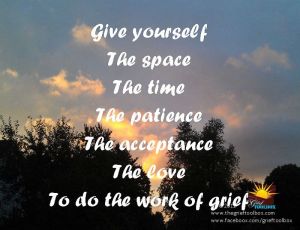
Time, by itself, heals nothing. But time, plus the work grief requires, brings a measure of healing.
If I cling with both hands to my loss, I can’t take hold of the good things life still has in store for me.
Longing for the past all the time only brings sorrow. I cannot turn back time. Days, weeks, years will keep coming whether or not I choose to participate in them. I will rob my heart of potential joy by focusing exclusively on the sorrow I can’t undo.
Daily choices add up. When I lean into the small things required each day, I build confidence that I can do the bigger things that might still frighten me. Making phone calls eventually helps me show up to a meeting or to church. I strengthen my “can do” muscle every time I use it.
Doubt doesn’t disappear. Facing my doubt forces me to explore the edges of my faith. It does no good for me to stuff questions in a drawer and hope they go away. They won’t. I have to drag them into the light and examine them. Doubt is not denial. If God is God (and I believe that He is!) then my puny queries don’t diminish His glory. He knows I’m made of dust and He invites me to bring my heart to Him-questions and all.
My mental diet matters more than I might think. I have to be very careful what I feed my mind. If I focus on sadness, tragic stories, hateful speech and media that feeds my fears and despair then those feelings grow stronger. If instead I focus on hopeful stories, good conversation with faithful friends and inspiring quotes, verses and articles I feed the part of my heart that helps me hold onto hope.
I need a space where I can be completely honest about what this journey is like. Bereaved parents’ groups have been that space for me and have been an important component of my healing. But even there I must be cautious about how much time I spend reading other parents’ stories if I notice that I’m absorbing too much pain and not enough encouragement.
Grief is hard.
It’s work.
And that work is made up of dozens of daily choices that are also often difficult.
I don’t expect to be healed and whole this side of eternity. But I do know that if I consistently do the work grief requires I will be stronger, more whole and better able to lean into the life I have left than if I don’t.
I want to live.
I want to honor my son by living a life that’s more than just limping along, barely making it, struggling for each step.