Child Loss: Helpful Tips for Interacting With Bereaved Families

I firmly believe that our friends and extended family want to reach out, want to help, want to walk alongside as we grieve the death of our child

 I am also convinced that many of them don’t because they don’t know how.  

It may seem unfair that in addition to experiencing our loss, we also have to educate others on how to help us as we experience it, but that’s just how it is.

The alternative is to feel frustrated and abandoned or worse.  

So here’s a list of helpful tips (and a great infographic!) for interacting with bereaved families:  

Express condolences and show you care. Don’t avoid me, please!  You cannot make me any sadder.  I need to hear from you.

friends hugging

Refer to my child by name.  Dominic is STILL my son.  He is still part of my story.  But because he’s no longer visible, his name often goes unspoken.  Please talk to me about him, use his name, tell me a story of how he impacted your life or a memory that makes you smile.  It makes me smile too.

Actively listen and be supportive.  It’s hard to listen to someone tell you how much they are hurting and not offer advice or think of ways to “fix” them.  I can tell you from experience that what I need most on my darkest days is for someone to say, “It IS dark.  I’m so sorry.”  Silence is OK too.  Not every quiet moment needs to be filled with chatter.

listening is a postive act

Understand that each family and family member will grieve in different ways.  You may have observed child loss before but what you saw in one family may not translate to the next.  There are no hard and fast rules for this awful journey.  The age of the child, family background and structure, manner of death-all these impact grief.  In addition, mothers and fathers, sisters and brothers all bring their personalities, stage of life, beliefs and experiences to the journey.  There were five of us left behind when Dominic ran ahead.  We were each devastated but expressed it in very different ways.  Nearly five years later, those gaps have widened, not narrowed.

Fathers grieve too.  Sometimes support focuses almost exclusively on the mother.  In part because of a common notion that mothers are somehow emotionally closer to their children than dads.  In part because many men are less demonstrative and may do a good job hiding grief.  Whatever the reason, don’t assume one parent is dealing “better” with the loss than another (mother or father) just because he (or she) is not crying openly.  No one escapes this awful blow unscathed.
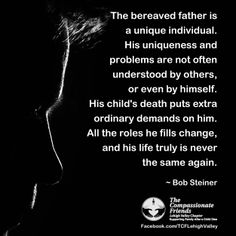
bereaved fathers

Don’t overlook siblings.  Surviving siblings are sometimes referred to as “forgotten grievers”.  If they are very young, people may think they are relatively unaffected by the death of a brother or sister. If they are grown and out of the home, people may figure that the siblings’ own, very full and very busy, lives keep them preoccupied.  While some of that may be true-to an extent-most surviving siblings are deeply impacted by the death of a brother or sister, regardless of age.  Not only have they lost a member of the family and changed birth order, they have also lost the family they knew, the parents they knew and a co-keeper of memories and secrets.  Bereaved parents are often overwhelmed with grief for their living children as well as the child that is missing. One of the best gifts anyone gave me was reaching out to my surviving children.  It helped my heart to know that they had friends who were supporting and loving them well.

kids cartoon

Be yourself.  People often feel awkward and stiff when approaching a bereaved parent or family member.  That’s perfectly understandable.  The bereaved seem so fragile (are so fragile!) that folks are afraid the wrong word or touch might shatter them into a thousand pieces.  But what your friend or family needs right now is the you they’ve always known and loved.  If you are a hugger, hug!  If you are a storyteller, tell stories (appropriate ones, ones of the missing child).  If you are a cook and cleaner, then cook and clean.  Our family was blessed by our friends doing exactly what they had always done-come alongside in their own special way.  So much had changed in our world that familiar touchstones, familiar routines and familiar faces were a real comfort.

Keep in mind words matter.  Now is not the time to try to satisfy your curiosity about exactly “what happened”.  Loud joking is rarely welcome.  Many bereaved families find it hard to laugh in the first days, weeks, months because it feels like betrayal.  Don’t offer platitudes intended to help them “look on the bright side” or consider that “it could be worse”.  There is nothing worse than burying your child.  Nothing.  Listen and take direction from the person you are comforting.  Follow his or her lead.  And if something less than helpful slips out, own it and apologize.

pencil-drawing-bereaved-mother

It’s never too late to reach out.  NEVER.  Sometimes people stay away at first for lots of reasons.  Or they show up for the memorial service and then fade into the background.  After a bit, even if they want to reach out, they may feel embarrassed by the long absence.  Don’t be.  So many people stop calling, visiting and texting within the first weeks that your outstretched hand of friendship will be a welcome beacon of hope.  If you need to, apologize for your absence.  Be honest.  Admit you were scared or whatever.

Then show up. 

Stick around.

You don’t have to be perfect.  

Just be present.  

bereaved families infographic

Child Loss: When It’s Been YEARS-How To Bless a Grieving Parent

Please hear me. 

I do NOT blame you that my son and my sorrow have drifted down your list of “things that need attention”.  Your life is as busy as mine once was and your calendar full of commitments and celebrations that require your attendance.

There is no way you would know it’s 69 days until the fifth anniversary of Dominic’s sudden absence. 

There is no reason for you to be aware that as the southern landscape turns to spring, my heart and mind turn to death.  

But it’s the truth. 

Read the rest here:  When It’s Been YEARS-How to Bless a Grieving Parent

Repost: I Get It-I Really DO Get It

I write a lot about what bereaved parents (me!) wish others knew or understood about child loss and this Valley we are walking.  And I am thankful for every person outside the child loss community who chooses to read and heed what I write.

But I want to take a minute to tell those of you who are not part of this awful “club” that I get it-I really do get itwhen you need to put distance between yourself and me or other people walking a broken road.

We all love to think that life is a never-ending ascent toward bigger, better and more enjoyable moments.

Our children are born and we think only of their future, not their future deaths.

Read the rest here:  I Get It-I Really DO Get It.

Repost: No Way to “Fix” Child Loss

This was shared in a bereaved parents’ group to which I belong and I really like it.

It’s a great reminder to those of us traveling this road that it is a lifelong journey.

It’s also a good explanation of why there is a gap between our experience and those who have never experienced child loss.

Read the rest here:  No Way to “Fix” Child Loss

Another Year, Another Christmas: 25 Practical Ways to Give Holiday Hope to the Grieving

This is the fifth Christmas without Dominic. There really are no words to describe the intersection of holiday cheer and another milestone in this journey of child loss.

I’m not sad all the time-far from it. Often I am very, very happy.

But I will never stop missing him, missing the family we used to be and missing our blissful ignorance of how quickly and utterly life can change in an instant.

And I will never outgrow the need to have others remember him as well, to encourage my heart and the hearts of my family members and to help us make it through another year, another Christmas.  ❤

Here are some great ways to do it:  25 Ways to Give Holiday Hope to the Grieving

Good Answers to Hard (Insensitive,Inappropriate) Questions

I was utterly amazed at the questions people plied me with not long after Dominic’s accident.

They ranged from digging for details about what happened (when we ourselves were still unsure) to ridiculous requests for when I’d be returning to my previous responsibilities in a local ministry.

Since then, many of my bereaved parent friends have shared even more questions that have been lobbed at them across tables, across rooms and in the grocery store.

Recently there was a post in our group that generated so many excellent answers to these kinds of questions, I asked permission to reprint them here (without names, of course!).

So here they are, good answers to hard (or inappropriate or just plain ridiculous) questions:

When asked to do something the week or month or even year after your child left:

  • No.  (It’s a complete sentence.  You do not have to give an explanation.)
  • Thank you for asking me.  I won’t be able to participate this time.
  • I’m so sorry.  This is a hard time of year for me and I just can’t do it.
  • Since my son’s accident, I don’t do well at holidays (or summer, or birthday month).  I can’t take on any extra responsibilities right now.
  • I’m sorry, we will be out of town. (If you really WILL be out of town.)

When asked about the details of your child’s death:

  • Why do you ask? (Stops them nearly every time.)
  • That’s an uncomfortable question that I’d rather not answer.
  • Does it matter?
  • We choose not to talk about his/her death and prefer to talk about his/her life.  Would you like to know something about him/her?
  • I prefer not to relive that trauma, thank you.

When asked, “How are you?”:

  • About as well as you would imagine given the circumstances.
  • Managing to do what must be done but very sad my son (or daughter) is no longer here with me.
  • Trying hard to put the pieces back together.  It’s a struggle every day.
  • Our family is loving one another through the hardest thing we’ve ever experienced.
  • How are YOU?  (Most won’t even notice you didn’t answer and will launch into their own discourse.)

When asked if you think you’re “back to normal” or “over it”:

  • No.  (It’s a complete sentence, see above.)
  • I’ll never be over my child. I’m not over any of my children.  How could I be?
  • My life has been shattered.  I can’t even find all the pieces much less assemble them into whatever normal used to be.
  • I don’t remember what “normal” is.
  • It’s a daily adjustment that I will be making for the rest of my life.

When asked anything at all that seems insensitive, inappropriate or just downright nosey:

  • I’m so sorry, I need to go.  Bye!
  • I can’t talk about that now.
  • Say nothing.  Absolutely nothing.  Until they change the subject for you.
  • How are you?  Your children?  (Or any other question back at them-ignoring theirs)

I am obligated (by my profession of faith) to be as kind and polite as I can be but I am not obligated to answer every question someone asks.  

I’ve found that having some of these pat answers in my pocket helps.  Many of them are good for just about any question that may come my way.  

I try to deflect, demur or redirect.  

But when that fails I’m just as likely to tell the truth, which is often not at all what the person really wants to hear.  

And then they are left scrambling for a way out of a conversation I never wanted to have in the first place. 

Which is fine with me.  

silent with heart

The Importance of Silence: Holding Space so Hearts Can Speak

We do it all the time in the physical world-leave the shopping cart in line with the admonition to the person behind us to “hold our place” while we run to get that forgotten item.

We leave a gap for that minivan to pull in just where the construction cones narrow a highway from two lanes to one.

We open a door and step aside so the elderly lady with her hands full can manage to get through without dropping the load.

But most of us are not as good at it in relationships.

Read the rest here:  Holding Space

Advent of Kindness

Here’s a thought. 

Why not make Christmas about spreading genuine love, grace and mercy instead of about finding the “perfect” gift for already over-flowing lives and living rooms?

no act of kindness kitten

I plan to implement this little calendar and hope to find even more ways to spread kindness this season.

I’ve printed one to carry in my purse and one to hang on the fridge.  I gave some away to fellow church members who, in turn, are giving some away at work.

A cascade of kindness!

advent of kindness

Repost: Bridle Your Tongue

In this journey of loss I have been blessed and wounded by words.

I have been encouraged and disheartened by stray comments.  I’ve been thrown a lifeline and pushed under the raging waves of grief by friends, family and acquaintances who often had no clue they were doing either.

Our words matter. 

Our tongues have the power of life and death.

Read the rest here:  Bridle your Tongue

Grief Triggers

It’s funny what can make my heart race and my eyes fill with tears.

Sometimes it’s obvious- I hear of another son killed in a motorcycle accident.

But sometimes it’s obscure- like when I see someone using a legal pad to take notes.

Either way, triggers take me back to ground zero. They rivet my mind’s attention and my heart’s focus to the very moment I first learned Dominic had left us.

Triggers can happen anywhere, any time. They are often unpredictable and surprising.

And there is not one. single. thing. I can do about them.

Even six plus years into this journey and I am as vulnerable today as I’ve ever been.

I try to limit my exposure. I try to have an escape route. I try to suck up the tears and stifle the sobs.

But sometimes no matter how hard I try, I’m overwhelmed and undone.

overwhelmed woman image with glasses huff post

There’s part of me that wishes I could just move on and rejoin life and the human race calm and collected,  regardless of what memories a sight, sound or smell taps into.

And then there’s part of me that wants the world to sit up and take notice of the ongoing pain and toll child loss inflicts on a parent’s heart.

I’ll be honest, as I’m writing this I still cannot wrap my mind around the fact that one of my children is dead.

pencil-drawing-bereaved-mother

Oh sure, I can relate the series of events, but in my heart of hearts it is as shocking today that Dominic isn’t coming home as it was on April 12, 2014.

I really can’t adequately convey the ongoing sense that this must be a mistake.  There must be something someone has overlooked.  Maybe it was all a dream and he will come walking through the door.

I’m not crazy.

I know that Dominic is dead. I saw his body in the casket. I saw the casket lowered into the ground. I visit his grave to change out the flowers.

But I will never, ever get used to it.

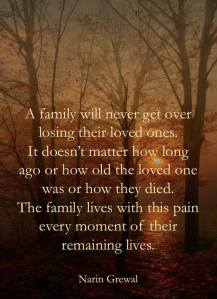
family never gets over the death of a loved one

All it takes is a smell or a sound or any one of a thousand things that I associate with my third child and I’m transported to that awful morning.

So if you see me tear up, shut down or turn away- let me go.

I just need a few minutes to put my game face back on.