Grief Brain: Nine Years and Counting

When I first became aware that Grief Brain was a real thing, it was a blessed relief!

I had long known that physical, mental or emotional stress could alter thinking and make it hard to remember things but I had never experienced such inability to hold even the most basic information in my head or found it nearly impossible to complete simple daily tasks.

It was truly frightening.

And it made life extremely hard.

I think the really, truly awful period of confusion, memory loss and difficulty lasted a good couple of years-not every day as bad as the next or the one before-but it was fairly consistent. I had to use lists, alarms and strict habits (like where I put my keys, the route I took somewhere, etc.) to make it through.

Now, nine years later, it’s not nearly as bad.

That’s partly because I’ve become so good at relying on aids and helps like alarms and calendars and partly because I’ve gotten better at keeping the constant hum of loss compartmentalized in my brain so I can actually think of something else.

But if there is any added stress in the system I regress.

I forget words, names, places, why I’ve walked into a room, where I’m going, what I’m doing and (much to my horror) food in the oven or on the stove.

So if you are in the early days of loss and wonder, wonder, wonder if you are losing your mind, odds are-you aren’t.

It’s just Grief Brain.

It WILL get better.

In the meantime, use whatever helps you do what you have to do.

And be kind to yourself.

Grief: The Necessity of Selfcare

Every family is different. Every loss experience is unique.

Some of us have busy households when one of our children leave for Heaven and some of us are long past full tables and messy teen bedrooms.

Wherever we find ourselves when the unthinkable overtakes us, it’s always hard to continue doing daily tasks bearing a burden of sorrow. So often we settle into a pattern of striving and straining through the deep mire of grief without making time for rest.

I know I did.

Goodness! I still experience seasons when grief waves steal what little breath is left from a breathless and busy life and I can barely function.

It’s then I remind my heart that self care isn’t selfish. It’s necessary.

Absolutely, positively necessary.

❤ Melanie

Looking back I’m shocked at how much I allowed societal norms and expectations to determine how I grieved Dominic’s death.

I withheld grace from myself that I would have gladly and freely given to another heart who just buried a child. Somehow I thought I had to soldier on in spite of the unbearable sorrow, pain, horror and worldview shattering loss I was enduring.

And the further I got from the date of his accident, the more I expected from myself.

Read the rest here: Self Care in Grief

Making Accommodations for Grief

The doctor I see every six months or so for my rheumatoid arthritis always fusses at me.

One of the routine questions is, “How’s your pain level?”

I usually say, “About a three.”

And then she looks at my hands and my feet-at the swollen joints and twisted toes-and shakes her head.

But here’s the deal:  sure they hurt, sure I can’t do all the things I used to do, sure I have to do many things differently than I did them when my hands and feet were unaffected by this disease-but I’m STILL moving and doing what needs to be done.

I don’t really know how to do anything else.

And that’s how it is with this grief I lug around-it’s heavier some days than others-but I’m STILL moving and doing what needs to be done.

I make daily concessions to my arthritic joints and I make concessions to my grief when I need to.

Read the rest here: Accommodating Grief

Grief and Holidays 2023: Practical Ideas for Dealing With Holidays After Loss

It cannot be overstated:  holidays are extremely hard after loss.  Every family gathering highlights the hole where my son SHOULD be, but ISN’T.

There is no “right way” or “wrong way” to handle the holidays after losing a child.

For many, there is only survival-especially the very first year.

These days also stir great internal conflict:  I want to enjoy and celebrate my living children and my family still here while missing my son that isn’t. Emotions run high and are, oh so difficult to manage.

So I’m including some ideas from other bereaved parents on how they’ve handled the holidays.  Many of these suggestions could be adapted for any “special” day of the year.

Not all will appeal to everyone nor will they be appropriate for every family.  But they are a place to start.

Read the rest here: Practical Ideas for Dealing with the Holidays after Child Loss

Bereaved Parents Month 2023: Ten Ways to Survive Hard Grief Days

My hardest grief season begins in November and runs to the end of May.  Thanksgiving through Dominic’s birthday on (or near) Memorial Day are days full of triggers, memories and stark reminders that one of us is missing.

If I could fall asleep November first and wake up in June I’d do it.

But I can’t so I have to employ all the tricks I’ve learned in the over eight years since Dominic ran ahead to heaven to survive those particularly challenging months.

Here are ten ways I survive hard grief days:

Read the rest here: Taking Care: Ten Ways to Survive Hard Grief Days

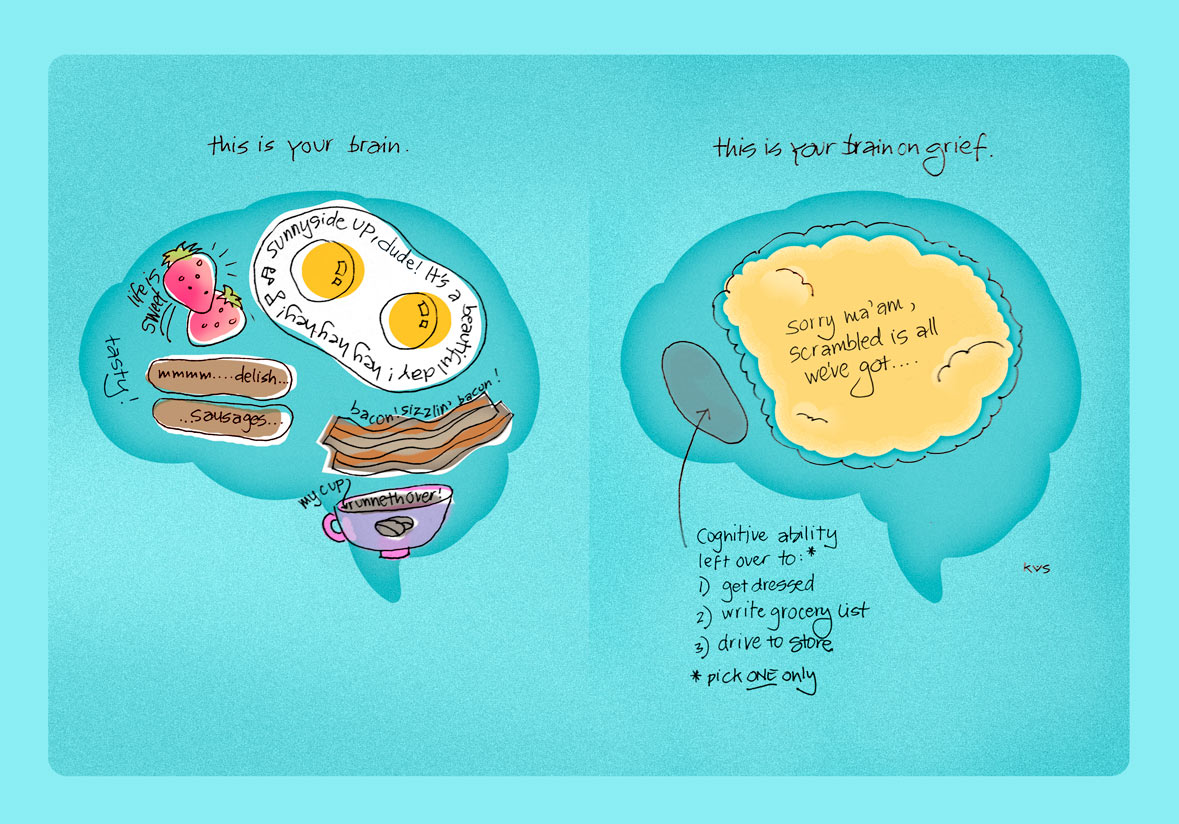
Bereaved Parents Month 2023: Grief Brain is REAL!

Traumatic loss rewires your brain as well as your body.

So here I am, nine plus years into the journey of sudden child loss and I’m reminded once again I am not the same “me” I once was.

Our newest grandbaby made an early entrance into the world last spring and I did Mama D duty with his big brother for nearly a month. It was a delight to be with my three year old grandson but it was also challenging for this aging/post trauma brain.

Trying to navigate (super simple) routes to and from the hospital, to and from preschool, and to and from the closest grocery store led to more than one U-turn and long way around. Sure I could use my phone’s GPS but I kept thinking I’ll finally remember next time.

I should know better by now…

❤ Melanie

I’m looking right at her.

know her.  In fact, I’ve known her for years.  But please don’t ask me her name.

I have no idea.

It happens to all of us-meet someone in the store or at the Post Office and you just know you know them, but cannot-for the life of you-remember a name.

file-cabinet

Chatting on, you search mental files desperately trying to make a connection you can hold onto.  Five minutes after she walks away it pops up-oh, yes!  That’s so-and-so from such-and-such.

Imagine if instead of searching mental files without success you can’t even find the file cabinet and start to wonder if one ever existed.

That’s what “grief brain” does to you.

Here are a few more examples of things that actually happened:

Read the rest here: Grief Brain: It’s a Real Thing!

Bereaved Parents Month 2023: Physical Manifestations of Grief

Grief is not *just* feelings. It is so much more.

I shared this last year around this time in response to many, many comments and questions from bereaved parents about what felt like random or unusual physical manifestations of their own grief.

I hope it helps another heart navigate this life none of us would choose. 

❤ Melanie

It’s a well known fact that stress plays a role in many health conditions.  

And I think most of us would agree that child loss is one of (if not THE) most stressful events a heart might endure.  

So it’s unsurprising that bereaved parents find themselves battling a variety of physical problems in the wake of burying a child.  

Read the rest here: Physical Manifestations of Grief

Bereaved Parents Month 2023: Good Answers to Hard (Insensitive, Inappropriate) Questions

I was utterly amazed at the questions people plied me with not long after Dominic’s accident.

They ranged from digging for details about what happened (when we ourselves were still unsure) to ridiculous requests for when I’d be returning to my previous responsibilities in a local ministry.

Since then, many of my bereaved parent friends have shared even more questions that have been lobbed at them across tables, across rooms and in the grocery store.

Recently there was a post in our group that generated so many excellent answers to these kinds of questions, I asked permission to reprint them here (without names, of course!).

So here they are, good answers to hard (or inappropriate or just plain ridiculous) questions:

Read the rest here: Good Answers to Hard (Insensitive, Inappropriate) Questions

Bereaved Parents Month 2023: Surviving Siblings

Grieving parents often face the additional challenge of trying to help their surviving children process the death of a sibling.

While there are many factors that influence how a particular child understands and works through his or her grief, age at time of bereavement plays a significant role.

Children’s grief can look very different than that of the adults around them.

And that grief may resurface later on as the child grows and matures, even long after the death of a loved one.

Read the rest here: Sibling Grief Reactions By Age Group

Stress Impacts Grief

It would be so helpful if there was an app to track stress like there is to track spending.

Wouldn’t it be marvelous to get an alert that said, “Low Balance”, for mental, physical and psychological reserves like the one you can get for your bank account right before you are heading to overdraft territory?

But there isn’t.

And few of us are very good at gauging just how much is left in our mental wellness accounts which means we often keep giving when the well is more than dry.

I’d be lying if I said I spend the same amount of time crying, lamenting and bent over in agonizing pain that I did in the early days of mourning Dominic. I’ve found a way to keep him close, to trust his soul to Jesus and to (largely) live in the present instead of always longing for the past.

There are days, though…

Read the rest here: How Stress Impacts Grief