Word Of The Year 2024

It’s kind of funny that a new calendar and a new year prompt folks who’ve been perfectly content to coast through the old one to make bold declarations of change. 

I suppose it is the nature of humans to pause at the threshold and think crossing over means something more than a single footstep. 

I’m tempted to join in from time to time myself.

The thing that stops me is a fundamental understanding that no matter what prayers, proclamations or promises we lift, declare or make to ourselves or others, time has a way of unraveling them all. 

Still, when I began to see social media prompts to “pick a word” for 2024, I actually entertained it for a few seconds. 

Instead of inspirational words like “perseverance”, “joy”, “presence”, “love”, etcetera, the only word that came to my mind was “boundaries”. Which sounds kind of selfish and not all that aspirational. 

I think it probably springs from a place deep inside my soul. 

A place I don’t often explore and even more rarely pay attention to. But a place I probably (definitely!) need to listen to and take seriously. 

I have joked since turning sixty that if someone wants to mess with me “they picked the wrong decade!”. 

Easier said than done. 

A lifetime of bending over backwards (the name of my imaginary yoga studio) has bent my heart, life and personality toward giving in and giving up. Child loss took so much out of me that what was a tendency BEFORE is practically a policy AFTER. 

Too often it’s too much trouble to try to explain why I need space, time, love, attention and just common courtesy. So I stuff, stuff, stuff and do whatever someone asks regardless of how much it costs in terms of time, effort or energy. 

I’m trying to learn how to say (without being snarky) I don’t think I can meet a person’s expectations. I’m trying to learn how to take up space and quit shrinking into a corner. 

I won’t lie. 

It’s hard. 

And I’ve been met with resistance. 

But this year I’m determined to make it stick.  

Emotional Exhaustion: Spoon Theory Applied to Child Loss

We like to think we are invincible, full of infinite energy and able to handle anything life may throw at us. It’s understandable considering Western society places a premium on heroic endurance in the face of adversity or challenge.

Truth is, though, our emotional, physical and mental energy are not infinite. We ALL have an absolute rock bottom where we simply cannot do one. more. thing.

And living with child loss means I exhaust my resources sooner than many.

I love this concrete representation of my limitations. It has helped me understand that it’s OK to say, “no” and it’s human to have to.

I hope it gives you courage to do the same. 

❤ Melanie

The basic idea is that everyone starts with a finite number of “spoons” representing the energy, attention and stamina that can be accessed for any given day. When you do something, you remove a spoon (or two or three) based on the effort required.  When you have used up all your spoons, you are operating at a deficit. 

Like a budget, you can only do that so long before you are in big trouble.

Read the rest here: Spoon Theory Applied to Bereavement

Bereaved Parents Month 2023: I STILL Need Grace and Space

It took me a little while to realize that if I was going to survive this lifelong journey I had to make some changes in how and when I responded to requests to do something, be somewhere or participate in outside events.   

Because no matter how worthy the request, there was only so much of me to go around and I was forced to spend nearly all my energy and time and effort on figuring out how this great wound was impacting me and my family.

I cannot overemphasize how much strength and energy is needed to do the work grief requires.

Read the rest here: Grace and Space

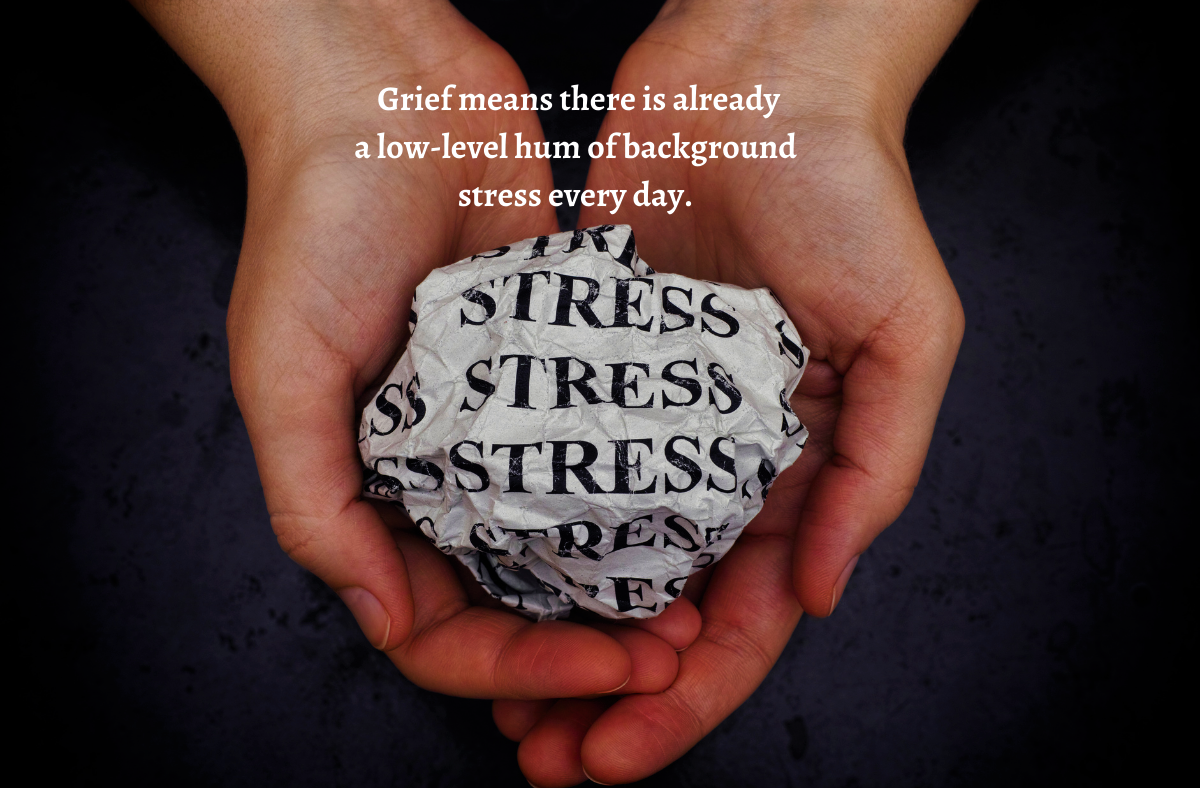
Stress Impacts Grief

It would be so helpful if there was an app to track stress like there is to track spending.

Wouldn’t it be marvelous to get an alert that said, “Low Balance”, for mental, physical and psychological reserves like the one you can get for your bank account right before you are heading to overdraft territory?

But there isn’t.

And few of us are very good at gauging just how much is left in our mental wellness accounts which means we often keep giving when the well is more than dry.

I’d be lying if I said I spend the same amount of time crying, lamenting and bent over in agonizing pain that I did in the early days of mourning Dominic. I’ve found a way to keep him close, to trust his soul to Jesus and to (largely) live in the present instead of always longing for the past.

There are days, though…

Read the rest here: How Stress Impacts Grief

Please Don’t Ask My Kids How I Am Doing, Ask Me

It may seem like the easiest way to get an inside scoop on how I’m REALLY doing-but don’t do it.

Please don’t ask my kids how I’m doing.

Respect the fact that they have their own grief burden.  Respect family privacy and understand you are putting them in an impossible position.

Read the rest here: Please Don’t Ask My Kids How I Am Doing

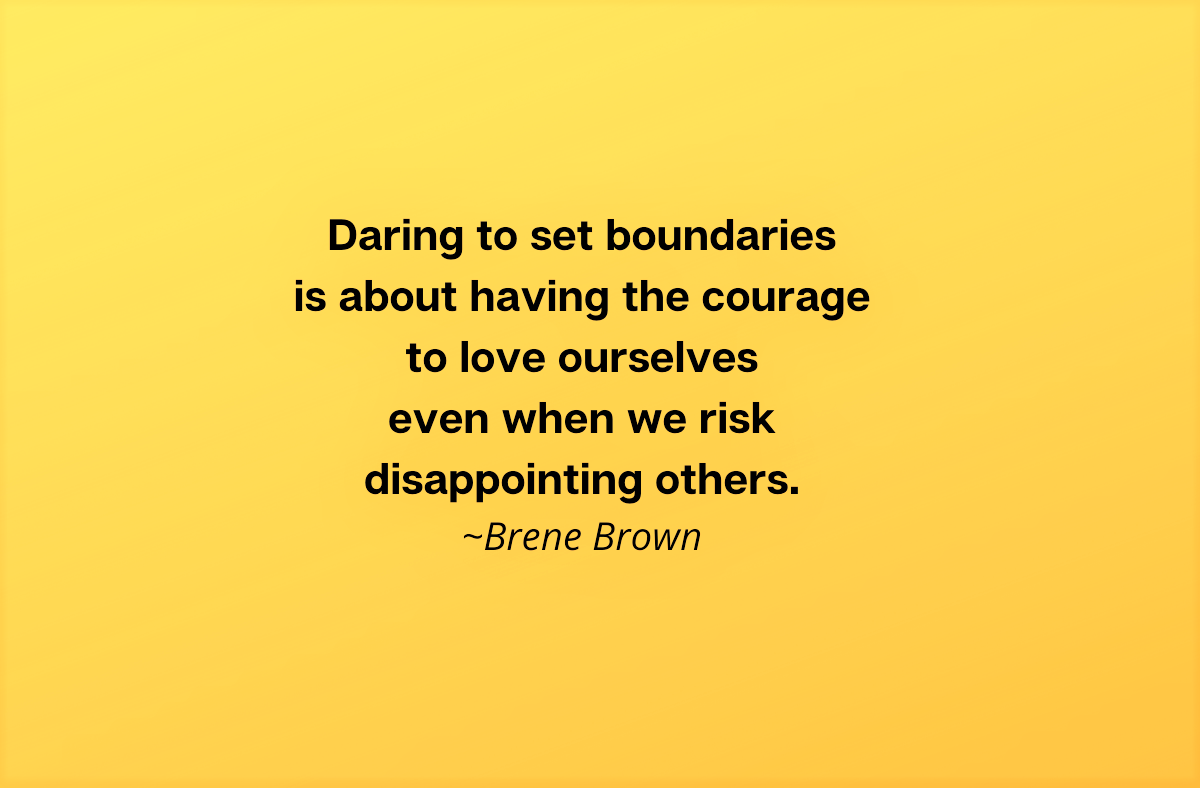
Grief Work: Setting Healthy Boundaries

As a people-pleasing first born who hates conflict, giving in has always been  easy for me. It’s only later that I wish I hadn’t.  

So for most of my life, setting personal boundaries has been challenging.

But in the aftermath of child loss, healthy boundaries are no longer optional, they are necessary for survival.  

So what are healthy boundaries?

Read the rest here: Healthy Boundaries in Grief

How Much is TOO Much When Sharing?

For the most part, I’m pretty transparent.  Because secrets don’t serve anyone well.  

If I pretend to be stronger than I really am, I hide the truth that it is Christ in me that gives me strength.

If I don’t admit that certain words or actions hurt my heart, I enable thoughtless behavior.

If I only parrot “Sunday School” answers when someone asks about my faith in relation to my loss, then I silence other hearts wrestling with questions and pain in light of God’s sovereignty and love.

If I hide my tears, my pain, the missing then I minimize this great loss, And I will not make losing Dominic small.

Read the rest here: How Transparent Should I Be When Sharing?

Don’t Let The Outside Fool You

What a blessed relief it was to drive up our winding lane and enter home after my husband’s surgery!

I am absolutely overwhelmed by the encouraging words and prayers lifted on our behalf. If you’ve raised your voice to Heaven, begging for relief, only to have your hopes dashed, then you understand how amazing it feels to have prayers answered.

I am happy, happy, happy to report that my husband is doing well.

A couple days ago he had a follow-up appointment to remove the staples from his incisions and there was no sign of infection. He was warned by the doctor not to mistake the lack of evidence declaring major surgery on the OUTSIDE with what they did to him on the INSIDE.

He was solemnly adjured to continue to take it easy for several more weeks so that deep and necessary healing could occur.

Because my mind is never all that far away from thinking about Dominic, loss, my own grief journey and the many who join me here walking the same broken road, I quickly found myself comparing Hector’s surgery to the experience of child loss.

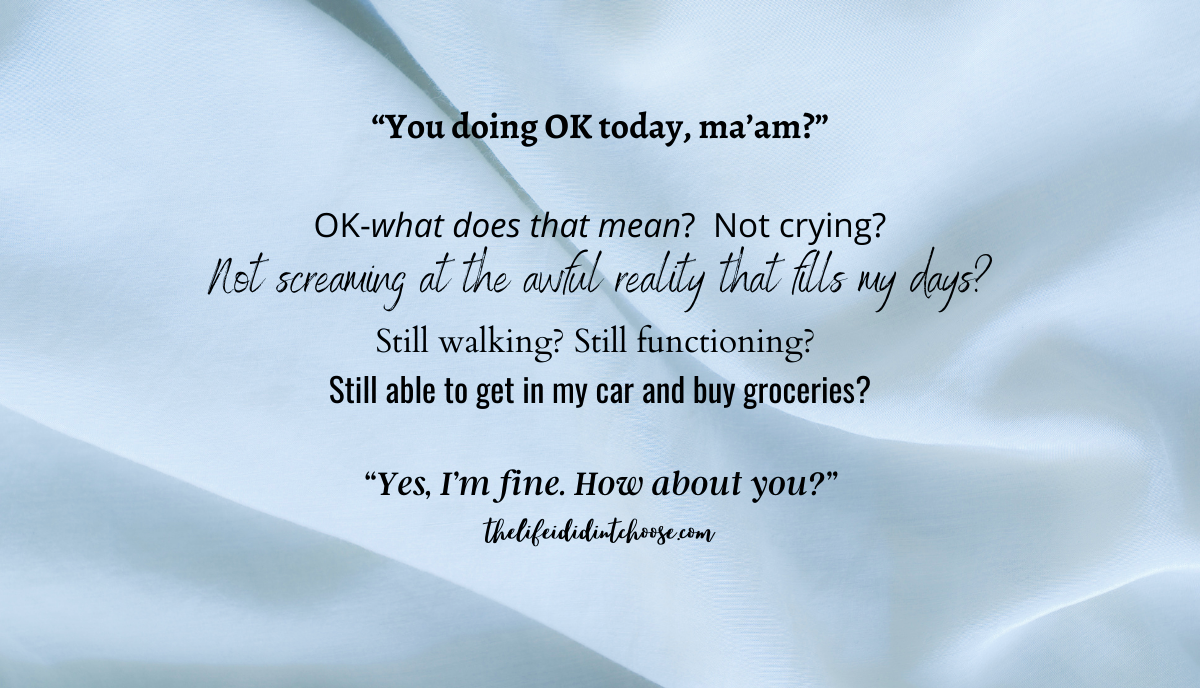
From the outside-very soon after all the formal visiting, meal bringing and memorial service or funeral-most bereaved parents look “fine”.

We have to.

The world doesn’t stop turning because our world imploded.

Work, life, family duties, household chores, and all the ordinary things determined by hours and calendars keep rolling along.

But on the inside, every bit of who we are, how we feel, what we think has been devastatingly poked, prodded, ripped apart and rearranged.

And just like there is no substitute for TIME in physical healing, there is no substitute for TIME in emotional, mental or spiritual healing either.

So if you are fresh on this path, new to the rigors of trying to “do life” while mourning your precious child, recognize that there is oh, so much damage where people can’t see.

Even when (or if!) you are able to return to some semblance of normal, to carry on with duties and obligations and even muster a smile for special occasions, your wounded heart will require special care.

Don’t let others hurry you along or dismiss your very real need to maintain safe boundaries to protect it.

My husband’s body will bear scars from his surgery although the inner works will undoubtedly heal fine. I’m thankful for modern medicine that makes it possible.

It’s not so easy to heal a broken heart.

I’m convinced that while there is a measure of healing in this life it will never be complete until eternity.

But I’m certain that healing can only occur when we give ourselves the grace, space and time necessary to do the work grief requires.

Healthy Boundaries and Forgiveness

I do not believe that in offering genuine forgiveness I am required to again submit myself to another person’s hurtful or sinful behavior.  

I do believe that forgiveness releases that person from past offenses against me but it does not release them to continue to wound my heart.

And I will stand up any time, anywhere and defend my. right to create healthy boundaries between my heart and someone who has proven, time and again, that they intend to do just that.

Read the rest here: Forgiveness and Healthy Boundaries

Griefwork: Is It OK To Put Some Friendships on “Hold”?

A few years ago I spent the weekend with a small group of bereaved moms.

For our last session together, I solicited anonymous questions from the group that I promised to try to answer and discuss further.

There were lots of good ones but one of the most poignant was this:

Is it OK to put some friendships on hold because the interaction is no longer encouraging to me? I leave lunches together sad because their lives are going fine and I’m in such pain.

A Grieving Mom

My heart went out to this mama for so many reasons!

First, even in her grief she was concerned about doing the right thing, about being a good friend and about rightly interpreting the situation. She knew her friend wasn’t actively harming her. In fact, the friend was most likely trying hard to come alongside and encourage her heart.

But it still hurt.

And so she wanted to know if she was obligated to “grin and bear it” or if she could graciously and authentically set a boundary that meant a little (or a lot!) of distance between this friend and herself-hopefully for only a season.

This is one of the hard truths and difficult conundrums that inform the lives of many grievers. It certainly was part of mine for a long time.

I craved compassionate companionship from concerned friends and family while, at the exact same moment, longed for solitude and seclusion from “ordinary” life.

How in the world could the world just go on? How in Heaven’s name did the entire universe not take note of my great and irreplaceable loss?

For months (probably, honestly, for a couple of years!) there was always a subscript to every conversation and face-to-face interaction that read like Subtitles for a foreign film. And some folks lives were just too beautiful, too happy, too much like the one I wished I still had to endure the emotional burden that gap produced for my wounded heart.

So I had to limit my interaction with them (for their sake AND mine).

I unfollowed (NOT unfriended!) people on social media. They were none the wiser that the hap-hap-happy posts they splashed everywhere weren’t appearing in my newsfeed and I wasn’t constantly confronted by my own envy and sorrow.

I sent cards for occasions instead of showing up at certain celebrations. I chose them thoughtfully and wrote meaningful and sincere messages. I didn’t have a single person react badly that their wish was on paper instead of in person.

I withdrew from some of the groups where this kind of “humble bragging” was encouraged and promoted. It was a long, long time before I went to a women’s event that wasn’t focused on child loss.

No one really noticed.

And for those few relationships that were so close I couldn’t graciously or subtly move away, I told my friend that while I valued them, wanted very much to stay in touch and support them and didn’t want everything to be about ME, I needed to let them know certain topics might make me uncomfortable or sad.

So we tried to get together around activities that lent themselves to “in the moment” conversation. We didn’t linger long over lunch or on the phone. We walked in a park or went to a movie.

In time, as I did the work grief requires and as I grew stronger and better able to carry this burden called “child loss”, I was able to ease some of the boundaries I had put in place to protect my heart.

I never, ever want child loss (or any other hard life event or trauma) to become an excuse for my bad or unkind behavior.

But grief is work and requires so much time, energy and effort!

If I hadn’t made space and given myself the necessary grace to do that work I would not have found the measure of healing I now enjoy.

So, yes, dear heart-it’s OK to set boundaries.

It’s OK to pull back from some relationships to foster healing.

And it’s OK to reach out and let people back in, too, when your heart feels more whole again.