I know that when I first stumbled onto a bereaved parent group, it was one of the things I was looking for: evidence that the overwhelming pain of child loss would not last forever.
Some days I was encouraged as those who had traveled farther down this path posted comments affirming that they could feel something other than sorrow.
Some days I was devastated to read comments from parents who buried a child decades ago asserting that “it never gets better”.
Who is right?
What’s the difference?
Do I have any control over whether or not this burden gets lighter?
As an introvert (who can, if pressed pretend not to be!) my energy is restored when I interact with one or two folks or no one at all. A dream afternoon is writing while listening to nothing louder than the wind chimes outside my door.
I treasure solitude.
Since Dominic ran ahead to Heaven, I find I need even more alone time than before.
That quiet place is where I do my most effective grief work, undisturbed by interruptions and distractions.
But I need to be careful that solitude doesn’t shift into isolation.
I have to remind my heart that spending time with others keeps me from falling so deeply down the well of despair that all I see is darkness.
I need human interaction to keep me connected to a world that, quite frankly, I might sometimes just as soon leave behind.
So how can I tell the difference between solitude and isolation?
Here are a few questions that help me figure that out:
Do I feel lonely, neglected or abandoned? If my alone time feels less like a gift and more like an unwelcome burden then it may be isolation rather than solitude.
Where are my thoughts taking me? Being alone is often the only way to “hear” my own thoughts without having to block out the noise and activity of other people. If I am sitting with myself, processing hard things or even beautiful things, resolving internal conflict, conjuring new ways to deal with difficult relationships or situations then solitude is doing its work. If, instead, I find my mind tangled up in fearful knots, filled with negative self-talk or unable to break a downward spiral into despair then I probably need to find someone to talk to.
Am I getting stronger or being drained? After the holidays or other hectic seasons I need time alone to recharge my batteries. Often it is almost a day-for-day exchange. I can feel tension melting away and strength returning. My mind begins to clear and life doesn’t feel so overwhelming. Solitude grants space for my body, mind and soul to be refreshed. When it slides into isolation I can feel the shift. Instead of waking refreshed and eager to greet a free day, I wake to dreading another long one alone. Instead of energy rising in my spirit, I can feel it draining away. Instead of thinking kindly of friends and family who choose to leave me be, I’m resentful no one has checked up on me.
Is there a helpful rhythm to my days alone or am I counting the hours until sundown? When I’m enjoying solitude, the hours feel like a welcome opportunity to do things (or not do things!) at my own pace and according to my own preferences. I sit with pen in hand and jot down a list knowing that if I complete it or if I don’t the only person I have to answer to is myself. No pressing appointments and no worrisome commitments. When I’m isolating, the hours feel like a long march through deep mud-every step tedious, treacherous and exhausting. I’m alone but I’m not getting any benefit from it. If I’m enduring instead of enjoying then I’m isolating.
Do I have an endpoint in mind? When I look ahead at a week on my calendar, I try to balance alone time with social commitments. A day or two alone (or with limited human interaction) is solitude. A week holed up in the house is isolation. If I find myself pushing off needed outings (to the grocery store, to run errands) then I ask myself, “why?”. Often it’s because I’ve drifted from solitude (helpful alone time) to isolation (unhelpful hiding).
I can shift myself out of isolation by choosing just one small social interaction.
I might text or message a friend, go to the grocery store and make a point of speaking to the clerk, call someone or show up at a church or community event even if I sit in the back and slip out early.
I’m never going to be that person who is up for every outing. That’s just not how I’m made and child loss has intensified my need for solitude.
But I don’t want to be alone and lonely, sinking deeper and deeper into a pit of my own making.
It’s the subject of everything from romantic comedies tohundreds of books.
“Men are from Mars, women are from Venus” and all that.
So it shouldn’t surprise those of us walking this Valley that our spouse may be grieving very differently than we do. But it often does. Because everything is amplified when it echoes off the high mountains on either side.
And just when we need it most-for ourselves and for extending to others-grace is often in short supply.
So differences become offenses and offenses stack like bricks to build a wall between us and the one person as intimately connected to our missing child as we are.
Instead of holding each other up, we sometimes tear each other down. Instead of leaning in, we pull away. Instead of talking, we tune out.
Instead of crying together, we cry alone.
Even when we open up and try to address these differences it often ends in disagreement or is met with silence.
That’s discouraging.
I firmly believe that grief doesn’t really change the fundamentals in a relationship but it magnifies them. We all have cracks in our marriages. Two imperfect people do not make a perfect couple regardless of how lovely the photos might be.
Child loss makes the cracks more evident. What might be ignored otherwise, becomes unavoidable. Add gender differences to the load of grief and it’s no wonder many of us struggle.
So how can a marriage survive?
Here are a few pointers:
Admit that you and your spouse are different people. Your life experiences, gender and personality affect how each of you grieve. Different isn’t better or worse, it’s just different.
Purpose to assume the best and not the worst of your spouse. When he or she makes a comment or shoots you a “look” don’t immediately ascribe dark motives. It may be she’s having an especially bad day or he is tired or distracted.
Look for common ground. When you are both in a neutral environment and rested, ask your spouse what they need from you. Then listen without being defensive. It could be that seeing you cry upsets him so that’s why he tries to shut you down. She might long to hear him say their child’s name aloud. Even if nothing changes, sometimes being heard makes a difference.
Consider couples’ counseling. Having someone outside your immediate grief circle listen to and guide you through feelings, concerns and problems is almost always helpful. It might only take a few sessions to give you both the tools necessary to walk yourselves through the rough patches.
Talk TO your spouse instead of ABOUT him or her. This can be a hard one! I think we all need a safe friend or two who will let us vent. That’s healthy. But it’s not healthy to talk about our spouse to others in what amounts to a bid for support of our own opinions and prejudices. Gathering wood for the fire of offense is easy. Putting out the blaze (even if you want to) is hard.
Remember that when feelings fluctuate, commitment carries you through. Grief isn’t just one emotion, it’s a tangled ball of emotions. On a given day you might feel sad, disoriented, angry, anxious and despondent. All that emotional weight is added to whatever else you may be feeling about your spouse. Sometimes it’s just too much to bear and running away seems like the most logical answer. But it’s not. We can never run far enough or fast enough to get away.
There’s no magic to marriage before or after child loss.
It’s mostly work.
We can choose to do that work together in spite of our differences.
We can choose to grow stronger instead of growing apart.
Still standing. ❤
****FULL DISCLOSURE****
My husband and I do not do this perfectly or even close to perfectly. But we are still trying. At different points in this long (almost) six years, we’ve been better or worse at all of it. So don’t think if you are struggling it means you can’t hang on. Sometimes it’s by the tips of your fingernails, but if you refuse to let go, you can make it.
There are many days throughout the year that present special challenges to grieving parents.
Some are known only to their hearts and require escaping to the secret place where memories are stored and love is kept.
But others loom large on every calendar.
Thanksgiving. Christmas. Hanukkah.
Those require both invisible strength and a very visible public presence at family gatherings and other holiday events.
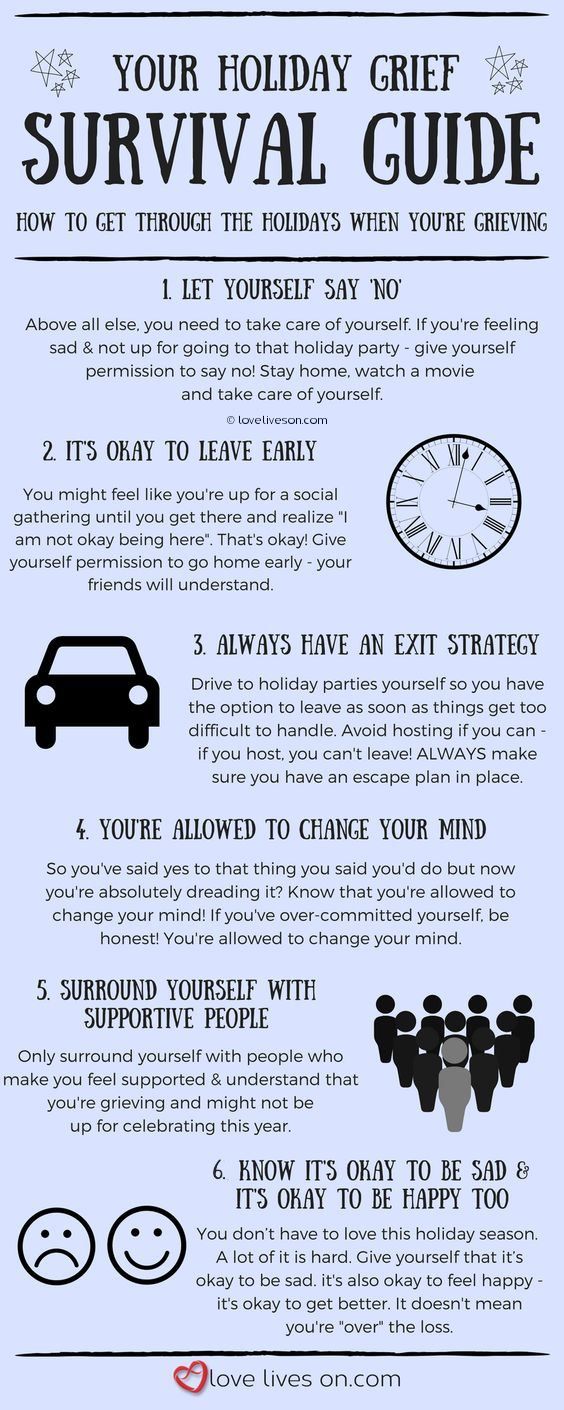
I’ve written lots of posts on how to make it through the holidays but I really like this succinct and easy-to-share Holiday Grief Survival Guide infographic. It covers the basics and is a helpful way to shepherd a hurting heart through the holidays. ❤
We are days away from plunging headfirst into the rough and tumble holiday season.
Thursday is Thanksgiving and I don’t know about you, but it seems that once I eat the turkey and dressing, the clock moves faster and the days crowd one another in a race to Christmas and the end of the year.
So I want to take a minute to think about how important it is to make and maintain space for grief during this busy season.
You have to do it.
I know, I know-where to fit it in between family gatherings, social engagements, mandatory office parties and children’s pageants?
If you don’t, though, the grief will out itself one way or another.
So may I offer the following practical suggestions for this upcoming holiday season?
It’s a nearly universal human tendency to try to fit another’s experience into our own.
Even though I try hard not to, I still often find myself saying things like, “I know just how you feel” or, “This worked for me, it ought to work for you”.
Trouble is, grief is as individual as a fingerprint.
The life that was shared before loss, the circumstances surrounding the loss, family structure, support systems (or lack thereof!), age, social connections, faith, friends and fears all shape how a particular person experiences and processes loss.
Some of us have safe people in our circle and can talk things out with them.
Others need a professional counselor to work through specific trauma associated with loss.
Still others are internal processors and require lots and lots of time alone.
One heart finds comfort pouring over old photographs and watching old videos.
The next can’t bear to look at any of it.
Exercise strengthens him but drains her.
Social situations paralyze some of us and help pull others out of our shell.
Frequent graveside visits are a means of connection for one person and only a reminder of death to another.
The list could go on and on.
So I’ll say it again:
However you make it through this Valley is just fine. There’s no right way or wrong way to grieve.
As long as you are not harming yourself or others (physically or emotionally) then carry on, dear heart.
It cannot be overstated:holidays are extremely hard after loss. Every family gathering highlights the hole where my son SHOULD be, but ISN’T.
There is no “right way” or “wrong way” to handle the holidays after losing a child.
For many, there is only survival-especially the very first year.
These days also stir great internal conflict: I want to enjoy and celebrate my living children and my family still here while missing my son that isn’t. Emotions run high and are, oh so difficult to manage.
So I’m including some ideas from other bereaved parents on how they’ve handled the holidays. Many of these suggestions could be adapted for any “special” day of the year.
Not all will appeal to everyone nor will they be appropriate for every family. But they are a place to start.
When I wrote it, I was writing my personal feelings after a couple of years trying to fumble through holidays with friends and family. It was an honest expression of how hard it was and continues to be to navigate the stress-filled season of Thanksgiving through New Year’s Day.
I’m not sure I’ve grown any more skillful in fitting all the pieces together-especially as our family grows and moves in different directions-but I continue striving to keep the lines of communication open and to try to acknowledge and accommodate everyone’s needs as best I can.
“I know it is hard. I know you don’t truly understand how I feel. You can’t. It wasn’t your child.
I know I may look and act like I’m “better”. I know that you would love for things to be like they were: BEFORE.But they aren’t.
I know my grief interferes with your plans. I know it is uncomfortable to make changes in traditions we have observed for years. But I can’t help it. I didn’t ask for this to be my life.
I know that every year I seem to need something different. I know that’s confusing and may be frustrating. But I’m working this out as I go. I didn’t get a “how to” manual when I buried my son. It’s new for me every year too.“


![How A Phone Call a Day [Almost] Keeps the Panic Away](https://thelifeididntchoose.com/wp-content/uploads/2019/01/hey-are-you-ok-memes-com-16222478.png?w=500)








 thelifeididntchoose