What Helps and What Hurts

I am committed to continue to trust Jesus and to look to the Word of God for my hope and direction in this life and in the one to come.

I speak truth to my heart through Scripture, worship songs, testimonies of others who have gone before and remaining in community with other believers.

But I’ve yet to reach the place where I can plan on most days being better days rather than hard ones.

I’m trying.

And I’m working to tease out the influences that make a difference-both the ones that help and the ones that hurt.

So here’s the list so far:

WHAT HELPS

  • Starting the day with Bible reading
  • Writing out a verse or two that speaks hope to my heart
  • Listening to worship music
  • Feeling well-less physical pain translates to an overall sense of well-being
  • Having a plan for the day-even if it is simple and created in broad strokes, knowing what I plan to do gives me a reason to get up and get going
  • Seeking companionship with other believers either via Facebook groups, telephone calls, in person get togethers or messaging.
  • Allowing myself a set time to grieve-cry, pray, lament, or whatever-then moving on with the day
  • Mixing up physical activity with rest-changing my body position often reorients my attitude.
  • Striving to get proper sleep, eating good food (not junk and not mindlessly), exercising and stretching.
  • Crying-if I need to cry I’ve found allowing the tears to fall is much better than fighting them off all day.
  • Retreating when necessary-if I find a situation is too much for me to handle, I give myself permission to retreat.  Most things can be done another day.  Sometimes just granting myself permission means I have the courage to press on and face it.
  • Planning for hard things.  If I know I’m going to have to face a hard thing, then I try to plan it.  I prepare myself by thinking through (as much as possible) various outcomes.  I’m more prepared and usually it goes better than I anticpated.
  • Not overscheduling my days/weeks-it is harder than it used to be to get going in the mornings so I take that into consideration when making appointments.  If I have a busy day on Monday, I will try to make Tuesday open and relaxed.  Having space between commitments gives me time to recoup and minimizes anxiety.
  • Doing as many things via Internet and telephone as possible-I can do needful things even if I’m having a bad day if I don’t have to get dressed and go out to do them.

WHAT HURTS

  • Neglecting my spiritual life-if I don’t read Scripture, don’t engage with other believers and refuse to acknowledge and thank God for the blessings He still bestows-I can quickly succumb to the dark whispers of the enemy of my soul.
  • Ignoring physical needs-when I don’t prioritize sleep, good nutrition, adequate exercise and appropriate pain control (for my RA) then sadness is multiplied and it is so much harder to climb out of the pit of despair.
  • Carrying unnecessary burdens-I cannot MAKE anyone understand the pain and ongoing challenge of child loss.  So when people outside my immediate grief circle question my feelings or try to make me conform to their expectations of what grief should look like and how long it should last, I have to shake it off. If it’s an important and ongoing relationship, I try to help them understand but if they choose not to or if it is a tangential relationship, I let it go.  I refuse to carry the burden of others’ expectations in addition to the burden of burying my child.
  • Being ignored-it hurts to be ignored.  It hurts when someone asks how I am yet doesn’t allow the space and time for me to answer.  It hurts when I answer and they ignore my pain or dismiss it with a story or platitude or Bible verse or just don’t say anything.
  • Being shamed-it hurts for others to shame me by implying that I am not strong in my faith or not trusting Jesus or not hoping hard enough for heaven when I admit I still struggle in grief and still miss my son.
  • Disregarding my triggers:  There are certain situations that I know will guarantee a breakdown, panic or a crying fit.  I avoid them when I can.  If I can’t-then I make a plan of escape (just in case).
  • Being “on display” for others-I am one woman doing the best I can to walk faithfully with Jesus through an unbelievably painful experience.  I am not the Author and Finisher of your faith-Jesus is.  It hurts when I feel like others are watching to see if I’ll make it, if I’ll say the “wrong” thing, if I’ll admit that I doubt.  I want the same freedom others have to grow in my faith and to make mistakes and learn from them.  I don’t want to be a “poster child” for anything.
  • Friends staying away.  I know it is hard to be my friend right now.  You never know what you might get when you call.  But if you ARE my friend, please don’t stay away.  Please reach out even when it makes you uncomfortable.  A good word at the right moment is often the difference between a very bad and very lonely day and a pretty good and generally hopeful one.
  • Hiding my sorrow-when I try to pretend I am stronger than I really am or when I try to hide my tears it takes so much energy and makes me so less capable to do the other things life requires.

These are just some of the things that help/hurt me in my journey.  I would love to have others share what helps/hurts them in theirs.  There’s strength in community.

Leave your thoughts in the COMMENTS below!


Come Sit With Me: How Job’s Comforters Got it Wrong

I want to make sense of the senseless.

I want to draw boundary lines around tragedy so I know what precautions can keep it far away from  me.

But God is in control.  Not me.

How Job’s comforters got it wrong…


Prayers I Still Pray, Part II

As I mentioned yesterday, prayer after loss is complicated for me.  I wrote a post months ago The Problem of [Un]Answered Prayer that addressed this.

But I AM able to pray Scripture-especially the prayers of Paul, which are centered on asking God to strengthen others and to expand their understanding of His love, compassion, power and grace.

Here are two more that I find helpful:

Philippians 1:9-11

phil 1_9 feet

I pray

  • that ___’s love may abound more and more in knowledge and depth of insight,
  • that___may be able to discern what is best, and
  • that____may be pure and blameless until the day of Christ,
  • that___will be filled with the fruit of righteousness through Jesus Christ-to the glory and praise of God.


Colossians 1:9-12

Father, I pray

  • that You will fill___with the knowledge of Your will through all spiritual wisdom and understanding,
  • that___may live a life worthy of You, Lord,
  • that____may please You in every way,
  • that___will bear fruit in every good work,
  • that___will grow in the knowledge of You,
  • that___will be strengthened with all power according to Your glorious might,
  • that___may have great endurance and patience,
  • that___will joyfully give thanks to You, Father, who has qualiied them to share in the inheritance of the saints in the kingdom of light.

Today by Your Spirit make real all their inheritance in Christ Jesus.

col 1_9

It Changes Everything

Part of the reason I share my story is to provide insight for people who haven’t lost a child into the hearts and lives of those who have.

But mainly it is to be a voice for and to encourage other parents walking this valley by letting them know they aren’t alone, their feelings and experiences are perfectly normal and that just as welcoming a child into your family is a life-altering event, saying good-bye to a child is a life-altering event. 

We do not expect a mom to “get over” the changes having a baby brings to her everyday experience, and we should not expect a  bereaved mom to “get over” the changes burying one brings either.

Want to help?  Read:  Loving the Grieving Heart

Please-Just. Listen.

It’s hard-it’s hard to stay the words that come unbidden to mind and threaten to fly out of your mouth.

It takes restraint.  And patience.  And wisdom.

But when I finally open my locked box of hurt and pain and memories and heartache-please, please-just listen.

I know better than you that nothing anyone says, or does or hopes to do can change the facts.

Dominic’s not here-he’s there.

And I also know that makes you feel helpless.  I feel helpless too.

I’m not looking for pity.  I don’t want attention.  I have no desire to make you sad.

I have to let it out or I’ll burst.  If others saw the fullness of emotions brimming in my heart they would stand amazed that I could push them down and keep them inside so much of the time.

But speaking my sorrow is empowering.  

It provides a witness.  It means that he matters, that I matter and that this awful reality is recognized by someone other than just me.

When you shut me down or shut me out I. am. crushed.

Again.

In the end, you can walk away.  You have another life to go back to.  My pain is tangential to the reality of your every day.

It is central to mine.

So, please-encourage my heart with compassionate presence and just listen.

presence best gift


Safe Friends

I hope you have one.  

That one person who knows your greatest joys and deepest pain and keeps it locked in her heart as if the secrets were her own.  

She is a gift from God to me, that friend.  

She’s the one I call when I’m wracked with sobs and the words won’t come.  She knows it’s me and just waits on the line until I can speak. She gets my jokes, knows my weaknesses, my strengths and helps me steer a better path on this hard road called “Life”.

She is a safe friend.

listening is a postive act

A safe friend listens.  

Just listens.  

She isn’t formulating an answer while I am talking, she isn’t rounding up cliches or Bible verses or platitudes meant to make her sound wise and shush my sharing.  She hears my heart even when my words might not make sense.

A safe friend sees.  

Really sees.  

She looks in my eyes and pays attention to my expression. She notices when my smile doesn’t match the tone of my words or the silent language of my hands.

She won’t let me by with a quick, “I’m fine!” meant to brush off the real need to spill my guts.

A safe friend stays.  

As long as it takes.

She doesn’t leave in the middle of a hard conversation.  Even if life gets in the way, she will come back and pick it up.  She checks in with me and doesn’t let time unwind the threads that bind us together.  If I don’t contact HER, she contacts ME.


A safe friend walks with me.  

No matter how steep the path, no matter how rocky the road. We might be hobbling along, broken together, but she keeps going and she keeps me going.


A safe friend encourages me to look to Jesus.

She admits that she doesn’t have all the answers.  She agrees that there are many things we will have to wait to understand.  But she reminds me that for this, we have Jesus.  We have a High Priest Who was tempted in every way yet was without sin.  We can enter boldly into the Holy of Holies because by His blood the veil is rent.

She doesn’t issue spiritual ultimatums that undermine, instead of strengthen, my faith in Christ.

friends pick us up


A safe friend doesn’t cut me out of her life when my life is a mess.  

Even if the mess is of my own making.  She helps me untangle the knot, own up to the sin, reach out to Christ and make amends.


A safe friend doesn’t just “happen”.

She allows the grace and mercy and love of Jesus to mold her heart so that He can use her.

Everyone NEEDS a safe friend.

Anyone willing can BE that friend.

kindness


More Grieving Hearts-What Grieving Parents Want You to Know

Two weeks.

Two families added to the roll call of those who have lost a child-suddenly, without warning.  

Two more sets of parents, grandparents, siblings, cousins plunged beneath the sea of sorrow.

And those are only the ones I know about-the ones whose lives touch my own.

Every day we are shoulder-to-shoulder with people carrying a load that threatens to undo them.  If you haven’t experienced child loss you probably think you can imagine how it feels.

I know I did.

But I was wrong.

THIS is what it feels like:  What Grieving Parents Want Others to Know

hands and coffee

I am NOT Crazy!

It was just over a year after Dominic’s accident and a friend forwarded an article about odd behaviors of those who were “stuck’ in grief.  Along with the forward was a little tag, “Reminds me of you.”

It hurt my feelings.

And it was inappropriate.

Because not only had I not participated in any of the listed behaviors (most of which anyone would deem odd and some that were actually harmful) but as far as I could tell, I was doing pretty good, considering.

Considering I went to bed one night with four children alive and well and woke in the wee hours of the next day to the news that one was dead.

No warning.  No good-byes.

Just gone.

In the months since that day I had gotten up each morning and taken care of necessary tasks.  I was not abusing alcohol, drugs or food.  I was still exercising when I could.

And I was engaged with my family -working with them to put the pieces of our shattered lives and hearts back together again.

Yes, I cried.  A lot.  No, I didn’t like to be around crowds.  I stayed at home much more than before. I struggled with anxiety when anything out of the ordinary happened.  I found small talk hard to follow and forgot things (still do). And I was not participating in many “extra” activities.

I slept with Dominic’s pillows every night-it was a way to touch what was left of him.

But I was functioning.

My friend’s reaction to the fact that I was “still” grieving after a year is not all that unusual.

I speak to bereaved parents who are often made to feel by others as if they should “be over” the death of their child.

They are told to “move on”.

Or, in faith circles, to “be happy he is in heaven”.

Most mental health professionals agree that child loss is probably the most difficult loss anyone has to bear.  

A simple Google search will turn up dozens of articles that support this understanding of a parent’s heartache and lifelong struggle to embrace the pain of losing a child.

Yet most people are unaware of this fact.

So I’m here to tell you-grieving mama, grieving dad-you are NOT crazy!  

You are not overreacting to one of the most awful things that can happen to someone.  Out of order death is devastating!

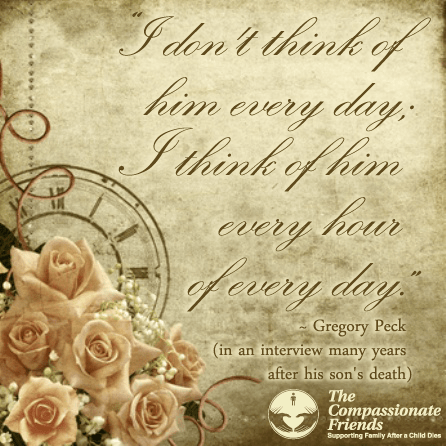
When asked about his son years after he had died,  Gregory Peck replied:

every day

As I’ve written in a previous post Am I Normal?

No one thinks it strange that the ADDITION of a child is a life-long adjustment.

So, why, why, why is it strange that the SUBTRACTION of a child would also require accommodation for the rest of a mother’s life?

I understand that if you haven’t walked this path, you can’t REALLY know what it’s like-even if you try.

I don’t want you to know this pain by experience.

It’s awful and unrelenting.

What I do want you to know is I am NOT crazy for missing my son.  I am NOT crazy for wishing I could turn back the clock.

I am NOT crazy because this devastating, paradigm shifting, unbelievably painful event still impacts my everyday life.

Please don’t treat me like I am.

The best help a friend can offer is a listening ear-no judgement-and a hug that says, “I love you. And I’m sorry.”

changed for life


Leaning on the Everlasting Arms

Growing up digesting Disney fairy tales can warp your sense of reality.

There are no unblemished princes or perfect princesses out there.  The bad guys don’t always get what they deserve and the good guys don’t always win.

At least not here on earth.

Read the rest here:  Messy Lives, Merciful Savior

Silence Doesn’t Serve Anyone Well

One of the reasons I write is to share my grief experience with others.

I realized when tossed into the ocean of sorrow that of all the things I had heard about or read about, surviving child loss was never mentioned.  

Oh, someone might comment that so-and-so had LOST a child, but then the conversation quickly moved on to more comfortable topics.

But if we don’t talk about it, we can’t learn to live through it.

Silence doesn’t serve anyone well.

I agree with Mr. Rogers:

Anything that’s human is mentionable, and anything that is mentionable can be more manageable. When we can talk about our feelings, they become less overwhelming, less upsetting, and less scary. The people we trust with that important talk can help us know that we are not alone.”
― Fred Rogers

spotlight3

During the course of my lifetime I have seen many topics dragged from behind closed doors out onto the stage and under the public spotlight.

Frankly, some of them could have remained in darkness as far as I’m concerned.

But there is something still taboo in polite conversation–something hushed with awkward silence should it ever be spoken aloud in a crowded room–mention GRIEF and eyes drop to the floor or someone hastily throws an arm around you and says, “There, there–it’s going to be alright.”

I don’t blame them. Remaining in the presence of great pain is uncomfortable.

In my growing up years I don’t remember anyone speaking about death and grief for longer than the time it took to go to a funeral home visitation and stand by the grave as the casket was lowered in the ground.

What came AFTER the loss–not a word.

We need to talk about it.  We need to educate ourselves about it.  Because, like my EMT son says, “No one gets out of here alive.”

You WILL experience grief in your lifetime.

I pray the people you lose are full of years and ready to go–that you get to say “good-bye” and all the important things have been said and done so you aren’t left with extra emotional baggage in addition to the sorrow and missing.

But you never know.  Neither you nor I are in control.

And even in the one place where it would seem most natural to talk about life and death and grief and pain–our churches–it still makes those who are not experiencing it uncomfortable.

Yes, there are grief support groups.  And, yes, they are helpful in ways that only a group made up of people who understand by experience what you are going through can be.

But much of life is spent rubbing elbows with folks unlike ourselves, with parents who know the fear of losing a child but not the awful reality.

And just a little bit of openness, a little bit of education and a little bit of understanding would make such a difference.

We don’t want pity.

compassion and stay with you


We aren’t looking for special accommodations that single us out and mark us as “needy”.

But we long for understanding and compassion and the opportunity to tell our stories.