I mention that today is a hard day to someone who knows my story and the words fall with a loud “thud!” between us.
I don’t know whether to pick them up or not and she isn’t having anything to do with them.
So I move on to another topic. Clearly this one isn’t going anywhere.
There are lots of ways to send messages of disapproval. You can “just say NO” like kids are told to do in anti-drug and anti-bullying campaigns. You can rant and rave and argue and rail against someone or something in person and on social media.
Or you can just ignore someone when they spill what matters to them like an offering on the ground at your feet.
The opposite of love is not hate.
It’s indifference.
The opposite of support is not opposition.
It’s looking the other way.
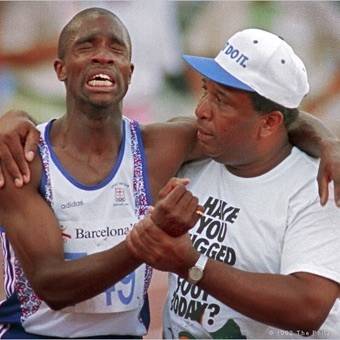
Strangers line streets to cheer marathoners on-offering cups of water and words of affirmation.
“You can do it!” “Keep going!” “You are more than half-way there!” “Don’t give up!”
And yet many of us are running the race of our lives without a cheering section.
I get it–you are so very tired of the fact that I am so very tired. I have worn out the welcome mat to the door of your heart. It DOES get old when I bring the same baggage with me each time we talk.
Trust me, I’m working hard at unpacking it. I’m doing all I can to lighten my load and what I ask you to help me carry.
But it is a slow, slow process.
And every time I need help or encouragement and don’t get it, another brick is added to the suitcase.
You might think you are helping me learn to ignore the pain by ignoring my mention of it but I don’t have that luxury.
It’s my heart wound, not yours.
It’s my child buried, my child not here, my child gone from sight-how exactly should I ignore that? Which of your children could you put away for a lifetime and forget was ever here?
Not the one with the dozens living in the house and stinking up the placebut the one who relies on her furry pal to get her through hard days.
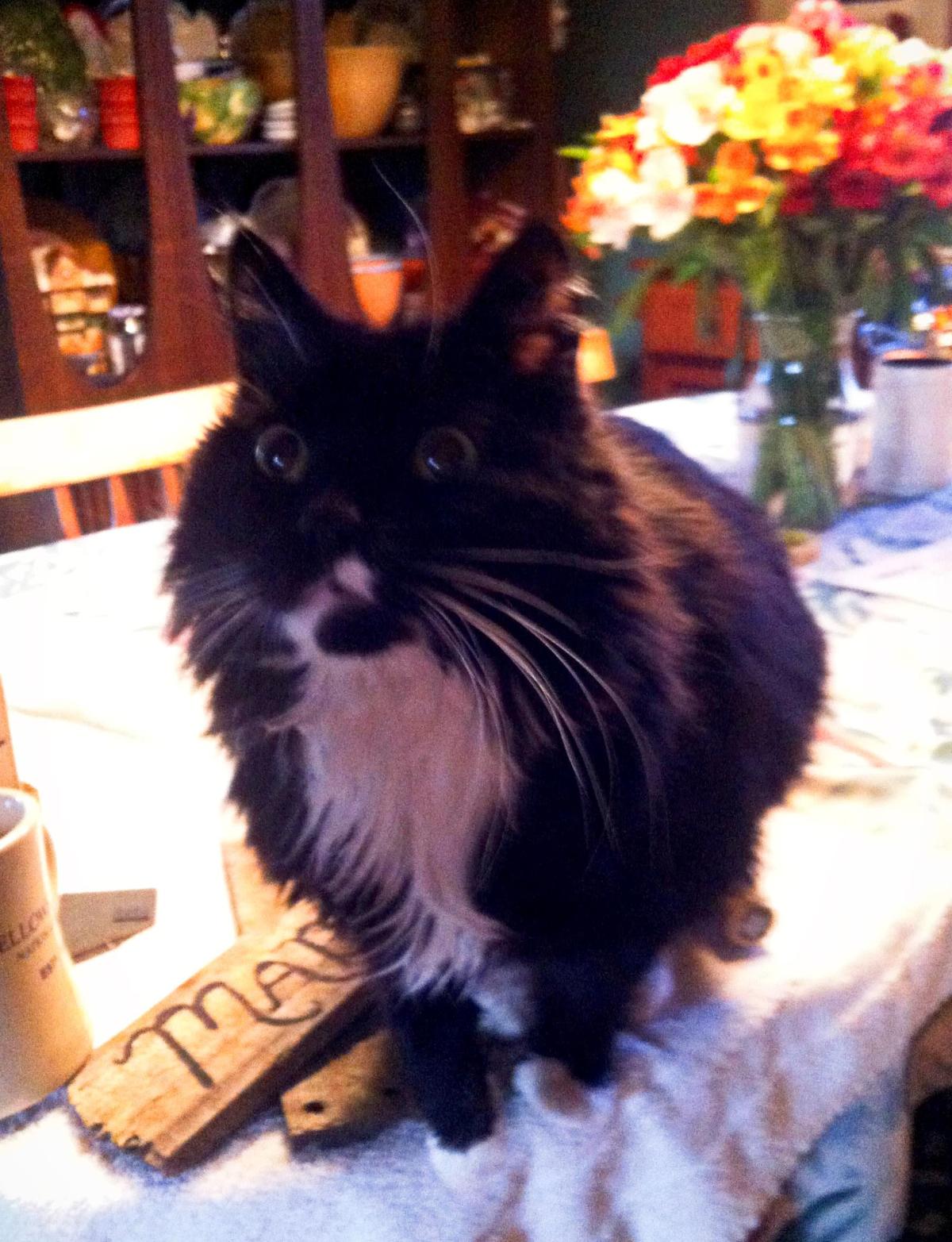
I raised Roosevelt from the day he was born.
His mom was a sickly outdoor cat that had never made it through a successful pregnancy and was not a candidate for being spayed because she wouldn’t have survived the anesthesia.
So the day I heard a tiny“mew”outside my window I hardly expected the sight I beheld. Here was mama kitty utterly amazed that she had birthed a baby, walking off the edge of the porch with a tiny black something still attached by the umbilical cord.
She could have cared less.
I grabbed scissors and a towel and rescued the little darling without much hope of his surviving.
But he did.
That was seven hospitalizations, two surgeries and one giant heartache ago.
He has become my comfort companion, my purring pal, the one who knows before I do that my RA is flaring, my heart breaking.
I am thankful for this oasis of comfort in a desert of hurt.
I am thankful that the God Whomade mealsomade animalsto bring healing in the midst of heartache. Oh, so thankful for a husband that puts up with my crazy“save everything that breathes”personality and doesn’t mind if a cat sneaks up the side of the bed in the middle of the night to get cozy in the covers..
When Dominic died, I remember sitting in my chair as the parade of sweet friends and family came over to cry with us. Roosevelt sat with me the entire time. His warm body reminded me that I was still here even when my limbs seemed to float away into the ether and my mind wasn’t entirely certain that what I saw or heard was real.
I have learned to count my blessings.
And while the majority of them walk on two legs, at least one has four.
The news goes out over Facebook, over phone lines, over prayer chains and everyone shows up.
Crowds in the kitchen, in the living room, spilling onto the lawn.
It’s what you do.
And it’s actually the easiest part. Lots of people, lots of talking, lots of activity keep the atmosphere focused on the deceased and the family. The conversation rarely dips to deeper waters or digs into harder ground: “Where was God?”; “Why him?”; “Why do ‘bad’ things happen to ‘good’ people?”
But eventually the busyness and noise gives way to stillness and silence.
That’s when the harder part starts.
The long hours of nightime darkness that invite questions that demand answers. The quiet hours of daylight that insist on playing a home movie of the years that went before. Forcing me to wrestle. Tossing me in the ring of trying to reconcile this tragedy with my worldview.
And many people turn away from the spectacle.
Even good, loving, Christ-following friends find it hard to stick around and watch.
Because it challenges their worldview too.
It makes them wonder if what they have always believed about God is true. It makes them fearful that if it could happen to my son and to me, it could happen to their child and to them. Ir raises questions, they’d rather not answer.
And they don’t have to answer them-YET-because their lives haven’t been turned upside down and inside out.
So they run.
They stop calling, they stop coming and they keep their distance in public spaces.
It hurts.
A lot.
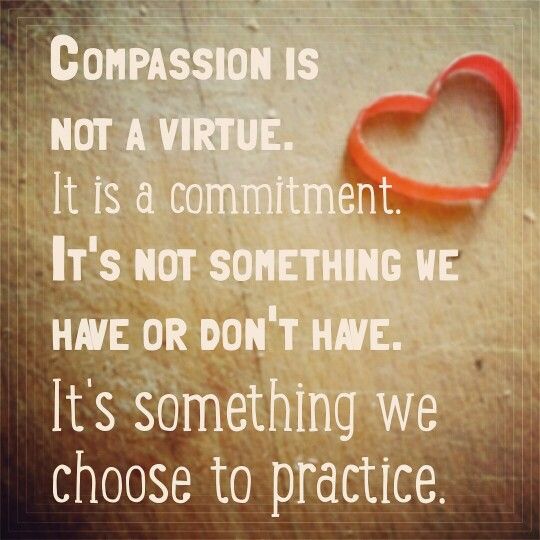
It’s human nature to avoid pain. No one marches headlong into suffering. Empathy requres energy. Compassion demands opening your heart to the hurt hiding inside someone else’s.
I understand, truly I do.
If I could find a place where sorrow and longing couldn’t find me, I would stay there forever. But I can’t. I have to carry this load, I have to face the tough questions, I have to work hard to give my heart a chance.
It is so much easier when others come alongside. I feel so much stronger when others choose to call courage to my broken heart. I find great comfort in knowing that someone is willing to risk their own comfort to bear witness to my pain and struggle.
Please don’t lower your eyes and hide.Raise them and help heal.
I know it’s hard and you don’t have to, but please don’t turn away.
You’d be surprised how soon people start expecting a bereaved parent to jump right back into the responsibilities and activities they shouldered or enjoyed before burying a child.
I know the rest of the world didn’t stop when mine did, but I was truly amazed that some people in my circle seemed unaware mine had stopped at all.
As I’ve written before here the funeral is not the end of grief’s journey, it’s quite near the beginning. It took a year for me to just convince my heart Dominic wasn’t coming back. It took longer to begin to understand how very different I am now and to embrace those changes.
I simply cannot do some things I once did.
And some of the things I can still do, I do differently or not as well. So I have to say, “no”more often than I used to-even when others don’t understand why.
But there’s a fine line between self-preservation and complete withdrawal.
I try to walk it each time someone asks me to take on a new responsibility, join a new project or agree to a new commitment.
I am honest about the fact that while I may say “yes” I might have to back out.
I’m also realistic about my new limitations-lower noise tolerance, greater anxiety when things change unexpectedly, inability to sustain small talk for more than a couple of minutes. So if the request means I am likely to hit my personal wall before I can meet expectations, I decline.
I’m also learning that I can use my grief as an excuse to get out of things I just don’t like.
And I don’t want to do that.
I can play the “child loss” card and push others away when it isn’t healthy. I can dig a hole and hide and then whine when no one comes to look down my pit to check on me.
So instead of rejecting every request out of hand, I respond-honestly-that I will think about it. And I do.
By slowly choosing thoughtful engagement I’m expanding my social circle again. I’m learning that if I push myself just a little bit, I get stronger and better able to handle the next thing.
I’m learning who this new “me” really is and what her limits are. I’m also learning that she has new strengths.
I’m still not as involved in anything as I once was. I don’t expect that I ever will be again. But I’m not a hermit.
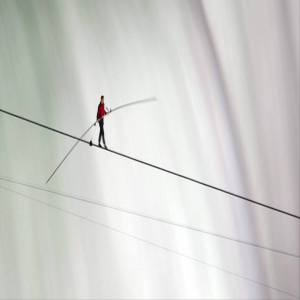
It’s a balancing act-I’m slowly learning to walk this line.
I’ve lived with invisible chronic disease for a decade.
From the outside looking in, you’d hardly know that I am often in great pain. I make daily choices about what I will do and what I won’t do based on what I can doand what my body refuses to do.
I take medication. I do all the things I’m supposed to doto help my body heal.
But I cannotMAKEthe healing happen.
No matter how hard I wish it were different,no matter how carefully I manage my treatment,healing comes (or doesn’t) in its own time.
I’m pretty sure that most people have experienced something similar if they’ve broken a bone or had a bad bout of bronchitis or pneumonia.
Other than following the advice of your doctor and taking your meds on time, resting and eating well, there’s not much you can do to force your body to get well.
A broken heart is just the same.
All I can do is place myself in the path of healing. I can feed my soul with truth and drink living water from God’s Word.
I can lean in and rest in the promise that Jesus will redeem and restore.
I can do the work that grief requires.
And working on healing takes energy, effort and time–lots and lots of TIME.
I cannot hurry the healing.
Please understand that as inconvenient, uncomfortable and disconcerting it may be for YOU, it is immeasureably more so for ME.
As I continue to walk this Valley, my heart asks the question, “What does healing look like?”
Fewer tears?Check.
More laughter? Check.
Better able to function? Check.
I’m definitely not as fragile as I was in the days and weeks and first months after Dominic left us.
I can do what life requires without falling apart (most of the time).
If you run into me out and about, I make small talk and answer questions about my family without breaking down.
So, from the outside looking in it seems the gaping wound of loss has healed pretty well.
But if I lift the lid of my heart ever so slightly, I’m amazed at how much it still hurts. I’m astonished by the depth of pain and sorrow just under the facade ofOK.
I cannot claim to have reached some higher plane of healing or restoration yet. I’m not sure I will this side of heaven.
And the pain of loss has tainted the joy I feel in what remains.
Instead of brilliant technicolor, my life is now lived in sepia tones that warn what joy I have could be stolen at any moment.
The lesson I’ve had stamped with fire on my heart is this: Love is the only thing that matters in the end.
Love God.
Love people.
So the path to healing means I lean in and love Him and love the people He has given mewith everything I’ve got.
I can’t claim to be satisfied with this life I’m living.
I do not like this path I am forced to walk, this darkness that hides the light, this pain that burrows deepin my bones.
But I can say I’m learning not to fight it.
Sometimes I still pitch a fit.
Sometimes I still yell at the sky, “Where were You?” Sometimes I lie down in the floor and beg for relief. Sometimes I quietly rebel with only a single tear.
Most days though, I get up and give in.
I turn my face to the rising sun and choose to carry on. I submit my heart, again, to the One Who created it.
I don’t struggle.
I don’t fight the facts that greet me.
“I don’t think the way you think. The way you work isn’t the way I work.” God’s Decree. “For as the sky soars high above earth, so the way I work surpasses the way you work, and the way I think is beyond the way you think. Just as rain and snow descend from the skies and don’t go back until they’ve watered the earth, Doing their work of making things grow and blossom, producing seed for farmers and food for the hungry, So will the words that come out of my mouth not come back empty-handed. They’ll do the work I sent them to do, they’ll complete the assignment I gave them.”
Isaiah 55:8-11 MSG
I am not God.
His thoughts are not my thoughts.
His ways are not my ways.
His plans are bigger than me, bigger than my hopes and dreams, bigger than anything I can imagine.
He has created me for His glory-not the other way around.
So I join with thousands who sing:
Have Thine own way, Lord,
Have Thine own way;
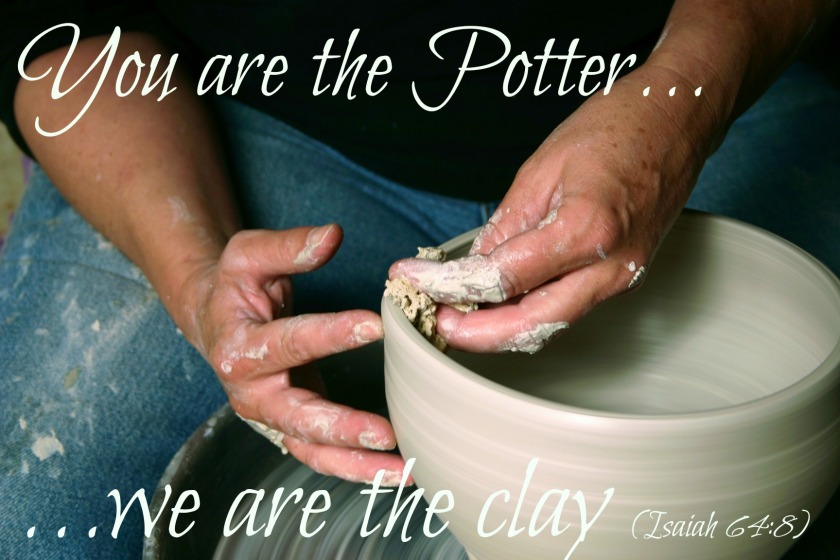
Thou art the Potter,
I am the clay. Mould me and make me After Thy will, While I am waiting, Yielded and still.
Have Thine own way, Lord,
Have Thine own way; Wounded and weary, Help me, I pray.
Power, all power,
Surely is Thine, Touch me and heal me, Savior divine.
When news that Dominic left us spread, our yard was filled with friends and family here to help bear the burden of grief and loss.
Our house was bursting with people and food and phone calls-more coming and going than our gravel lane had seen in a lifetime of living up in the woods.
It was beautiful and terrible all at the same time. Beautiful because we were not alone in our sorrow and terrible because it was due to that sorrow they were here.
In those days between the accident and the funeral I was boundary-less.
People hugged me, fed me, cleaned my house, cut my grass, tended the animals, asked me questions, told me stories and I just accepted it-whatever “it” was-because I was utterly unable to do anything else.
But in the weeks that followed, as the pain made itself more at home in my heart-as it expanded to fill every nook and crevice-I realized that I had to put up some fences.
My oldest son was getting married just a couple months after the accident.
There’s a lot of stuff to do for a wedding as most folks know. So I got a phone call one week after Dominic’s funeral and the person on the other end launched into a long saga regarding a minor detail and expected me to 1) listen attentively; 2) care as deeply as they did about something that absolutely didn’t matter; and 3) join with them in light-hearted, laughter-filled banter.
I just. couldn’t. do. it.
So I didn’t.
I politely but firmly explained that I was unable to continue the conversation and that in future they needed to contact me through my son. I promised I was 100% committed to making the wedding happen, to doing my part and to being as happy as possible on the day.
But until then, unless it was a true emergency, please leave me alone.
Drawing a boundary created space for me to DO what needed to be done without the added burden of extra emotional baggage.
Before Dominic left us I was a “yes” person.
Smiling stylish woman showing sign excellently, isolated on red
Need help with an event?Why, sure I’m available.
Need someone to take your Sunday School class? Absolutely.
Keep your toddler? Just drop him off-we’ll play with the critters all day.
Phone call counselor and Homeschool Help Hotline-that was me.
Not anymore.
I’ve learned that if I am to have the energy needed to do necessary things, I have to protect my heart. I am too weak to carry everyone else’s burdens. If I am going to survive this journey I’ve got to prioritize.
I still listen.
I still help.
But I do it in a more healthy way-with respect for myself as well as others.
It is OK to say, “No.”And I don’t have to offer a reason. It’s a complete sentence all on its own.
All of my children had urged me over the years to draw boundaries. But I had grown from a parent-pleasing first born into a people pleasing adult and I just couldn’t do it.
Dominic even crafted a wire sign that hung on my kitchen curtains in the shape of a cursive “no”.
He made me repeat the mantra: Lack of planning on your part does not constitute an emergency on my part.
He’d be proud of me for finally taking his advice.