Grief Brain-Eight Years and Counting

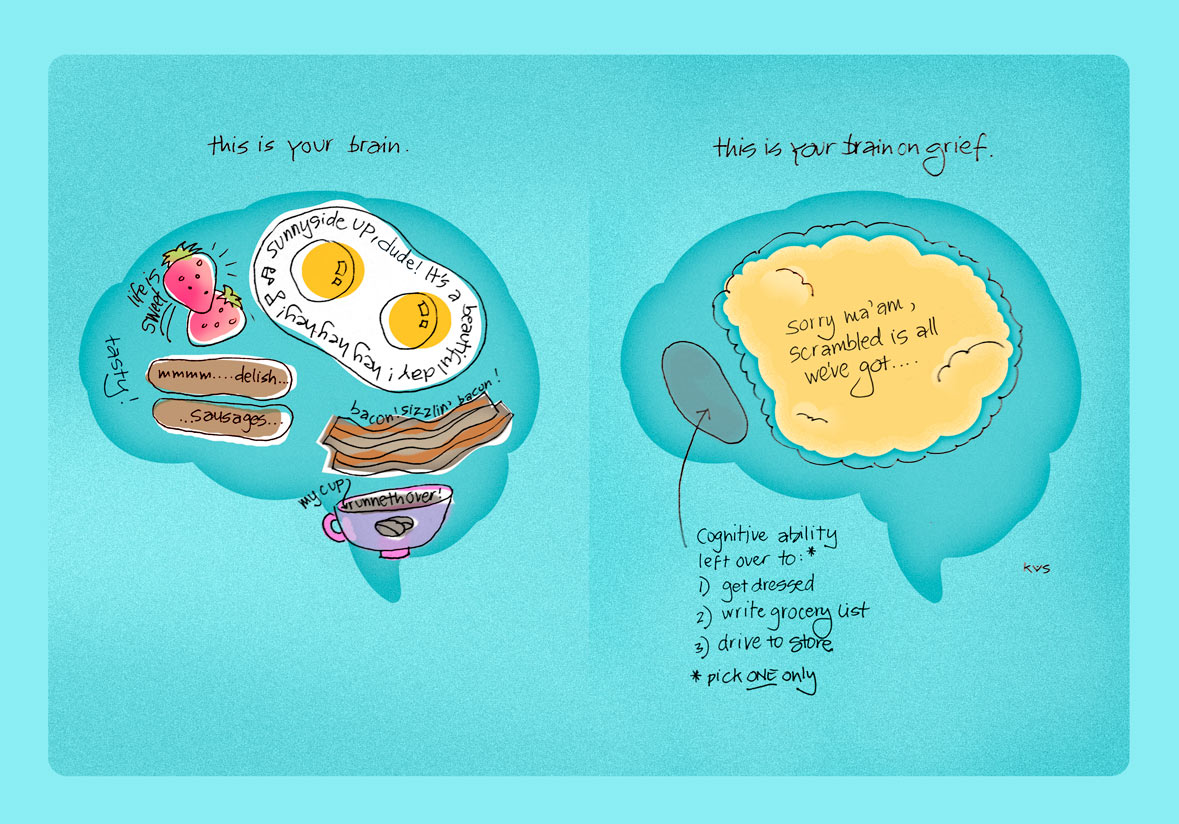
When I first became aware that Grief Brain was a real thing, it was a blessed relief!

I had long known that physical, mental or emotional stress could alter thinking and make it hard to remember things but I had never experienced such inability to hold even the most basic information in my head or found it nearly impossible to complete simple daily tasks.

It was truly frightening.

And it made life extremely hard.

I think the really, truly awful period of confusion, memory loss and difficulty lasted a good couple of years-not every day as bad as the next or the one before-but it was fairly consistent. I had to use lists, alarms and strict habits (like where I put my keys, the route I took somewhere, etc.) to make it through.

Now, eight years later, it’s not nearly as bad.

That’s partly because I’ve become so good at relying on aids and helps like alarms and calendars and partly because I’ve gotten better at keeping the constant hum of loss compartmentalized in my brain so I can actually think of something else.

But if there is any added stress in the system I regress.

I forget words, names, places, why I’ve walked into a room, where I’m going, what I’m doing and (much to my horror) food in the oven or on the stove.

So if you are in the early days of loss and wonder, wonder, wonder if you are losing your mind, odds are-you aren’t.

It’s just Grief Brain.

It WILL get better.

In the meantime, use whatever helps you do what you have to do.

And be kind to yourself.

Struggling With Others’ Expectations in Grief

I hate microwaves that have the “quick minute” presets! 

It takes MORE time for me to undo that feature and tap in how long I want to nuke my food than it would if it weren’t set up that way.

And sometimes I feel as if “undoing” is a great deal of what I do as a griever.

I have to dispel others’ expectations of what I should be feeling, doing or thinking.

I have to help them understand that unless you have been here, you CAN’T understand.

I pray they never understand.

Read the rest here: The Problem With Microwave Presets: Struggling with Others’ Expectations in Grief

Fault Lines: Social Anxiety and Bereaved Parents

I’m no geologist, but from what I understand, earthquakes are nearly always “about to happen”.  Fault lines guarantee it.  Pressure is building underneath the surface of the earth and when it reaches a level that can no longer be contained, it spews.

Can I just let you in on a secret?

Bereaved parents are full of fault lines.

Read the rest here: Fault Lines: Bereaved Parents and Social Anxiety

Tiny Flickers of Light Help Guide My Heart Home

A fellow bereaved mom commented on my recent holiday post with this question: How do you make joy, when your heart has no joy?

It was a good and honest query. One that stopped me in my tracks.

Read the rest here: Flickers Of Light, Guiding My Heart Home

THIS is Why I’m Exhausted! Spoon Theory and Bereavement

We like to think we are invincible, full of infinite energy and able to handle anything life may throw at us. It’s understandable considering Western society places a premium on heroic endurance in the face of adversity or challenge.

Truth is, though, our emotional, physical and mental energy are not infinite. We ALL have an absolute rock bottom where we simply cannot do one. more. thing.

And living with child loss means I exhaust my resources sooner than many.

I love this concrete representation of my limitations. It has helped me understand that it’s OK to say, “no” and it’s human to have to.

I hope it gives you courage to do the same. Melanie

The basic idea is that everyone starts with a finite number of “spoons” representing the energy, attention and stamina that can be accessed for any given day. When you do something, you remove a spoon (or two or three) based on the effort required.  When you have used up all your spoons, you are operating at a deficit. 

Like a budget, you can only do that so long before you are in big trouble.

Read the rest here: Spoon Theory Applied to Bereavement

Self Care Isn’t Selfish

Every family is different. Every loss experience is unique.

Some of us have busy households when one of our children leave for Heaven and some of us are long past full tables and messy teen bedrooms.

Wherever we find ourselves when the unthinkable overtakes us, it’s always hard to continue doing daily tasks bearing a burden of sorrow. So often we settle into a pattern of striving and straining through the deep mire of grief without making time for rest.

I know I did.

Goodness! I still experience seasons when grief waves steal what little breath is left from a breathless and busy life and I can barely function.

It’s then I remind my heart that self care isn’t selfish. It’s necessary.

Absolutely, positively necessary.

Looking back I’m shocked at how much I allowed societal norms and expectations to determine how I grieved Dominic’s death.

I withheld grace from myself that I would have gladly and freely given to another heart who just buried a child. Somehow I thought I had to soldier on in spite of the unbearable sorrow, pain, horror and worldview shattering loss I was enduring.

And the further I got from the date of his accident, the more I expected from myself.

Read the rest here: Self Care in Grief

Season of Unfeeling. Sometimes Grief =Numb.

I’ve thought long and hard about that season of “un-feeling”.

Why did my heart shut down? Why the long silence when no emotion pierced my soul?

I think it was necessary.

I think a body and mind and heart can’t operate for too long at warp speed. I think that just like fainting is a response to the brain needing oxygen, numbness is a response to the soul’s need for respite and time to heal.

So if you are in the season of numb, you’re neither crazy nor alone.

Read the rest here: Why Don’t I Feel A Thing? Sometimes Grief = Numb.

Grief and Holidays 2022: What the Bereaved Need From Friends and Family

I wrote this six years ago when I realized how hard it was for wounded hearts to tell friends and family what they needed around the holidays.

It’s been shared more than 145,000 times which might reflect that it hits the mark for at least a few folks. My prayer is it makes a difficult season a little less so.

If it speaks for you, feel free to share and let the ones you love know how they can make a hard season slightly easier on your heart. 


“I know it is hard.
  I know you don’t truly understand how I feel.  You can’t.  It wasn’t your child.

I know I may look and act like I’m “better”.  I know that you would love for things to be like they were:  BEFORE.  But they aren’t.

I know my grief interferes with your plans.  I know it is uncomfortable to make changes in traditions we have observed for years.  But I can’t help it I didn’t ask for this to be my life.

Read the rest here: Grief and Holidays:What the Bereaved Need From Friends and Family

Griefwork: Is It OK To Put Some Friendships on “Hold”?

A few years ago I spent the weekend with a small group of bereaved moms.

For our last session together, I solicited anonymous questions from the group that I promised to try to answer and discuss further.

There were lots of good ones but one of the most poignant was this:

Is it OK to put some friendships on hold because the interaction is no longer encouraging to me? I leave lunches together sad because their lives are going fine and I’m in such pain.

A Grieving Mom

My heart went out to this mama for so many reasons!

First, even in her grief she was concerned about doing the right thing, about being a good friend and about rightly interpreting the situation. She knew her friend wasn’t actively harming her. In fact, the friend was most likely trying hard to come alongside and encourage her heart.

But it still hurt.

And so she wanted to know if she was obligated to “grin and bear it” or if she could graciously and authentically set a boundary that meant a little (or a lot!) of distance between this friend and herself-hopefully for only a season.

This is one of the hard truths and difficult conundrums that inform the lives of many grievers. It certainly was part of mine for a long time.

I craved compassionate companionship from concerned friends and family while, at the exact same moment, longed for solitude and seclusion from “ordinary” life.

How in the world could the world just go on? How in Heaven’s name did the entire universe not take note of my great and irreplaceable loss?

For months (probably, honestly, for a couple of years!) there was always a subscript to every conversation and face-to-face interaction that read like Subtitles for a foreign film. And some folks lives were just too beautiful, too happy, too much like the one I wished I still had to endure the emotional burden that gap produced for my wounded heart.

So I had to limit my interaction with them (for their sake AND mine).

I unfollowed (NOT unfriended!) people on social media. They were none the wiser that the hap-hap-happy posts they splashed everywhere weren’t appearing in my newsfeed and I wasn’t constantly confronted by my own envy and sorrow.

I sent cards for occasions instead of showing up at certain celebrations. I chose them thoughtfully and wrote meaningful and sincere messages. I didn’t have a single person react badly that their wish was on paper instead of in person.

I withdrew from some of the groups where this kind of “humble bragging” was encouraged and promoted. It was a long, long time before I went to a women’s event that wasn’t focused on child loss.

No one really noticed.

And for those few relationships that were so close I couldn’t graciously or subtly move away, I told my friend that while I valued them, wanted very much to stay in touch and support them and didn’t want everything to be about ME, I needed to let them know certain topics might make me uncomfortable or sad.

So we tried to get together around activities that lent themselves to “in the moment” conversation. We didn’t linger long over lunch or on the phone. We walked in a park or went to a movie.

In time, as I did the work grief requires and as I grew stronger and better able to carry this burden called “child loss”, I was able to ease some of the boundaries I had put in place to protect my heart.

I never, ever want child loss (or any other hard life event or trauma) to become an excuse for my bad or unkind behavior.

But grief is work and requires so much time, energy and effort!

If I hadn’t made space and given myself the necessary grace to do that work I would not have found the measure of healing I now enjoy.

So, yes, dear heart-it’s OK to set boundaries.

It’s OK to pull back from some relationships to foster healing.

And it’s OK to reach out and let people back in, too, when your heart feels more whole again.

What Can I Do? My Family Won’t Talk About My Missing Child!

At first everyone talked about him.

It’s what people do just after a person leaves this world and leaves behind only memories.

It comes natural before the unnatural fact of child loss settles in and begins to make everyone uncomfortable.

But at some point after the funeral and way before the tears dried up, people stopped feeling easy mentioning his name.

Read the rest here: Help! My Family Won’t Talk About My Missing Child.