Which Weighs More?

Remember the childhood riddle, “Which is heavier, a ton of bricks or a ton of feathers?”

feathers

It was great fun to catch someone giving the wrong answer.

Because, of course, a ton is a ton is a ton.  Weight is an absolute measure.

But it takes fewer bricks to reach that quota although it takes just as much strength to lift the burden.

weights-dumbbells

One thing I’m learning in my grief journey is that there are so many people carrying a load.

I find my compassion radar has been fine-tuned to hear even the faintest whisper of hurt in someone’s voice, to see the tiniest gleam of a tear, to notice the smallest stoop of shoulders or the beginning of a frown.

And while some of us have had our ton of pain and sorrow delivered via bricks-suddenly, forcefully and overwhelmingly dumped-others have acquired their ton over a lifetime of disappointment, struggle and testing.

They both weigh a ton.  

And they both require great strength to carry.

It’s a challenge to resist the urge to rank my experience on a continuum of pain.

Although I bridle when people compare their loss of a pet or job to my loss of a child (as I wrote about here), I do try to extend grace when others expose their own wounds.

I want to comfort other people with the comfort I have received.  Not only the comfort from Christ-which is the ultimate comfort-but also the comfort I’ve received from wise friends and caring sisters-in-loss.

I want to be a listening ear, a compassionate heart and an outstretched hand.

Reaching Out to Help Someone in Despair

I want to be a witness, a fellow traveler on the journey, an encourager.

Grief

is grief

is grief.

A ton is a ton is a ton.
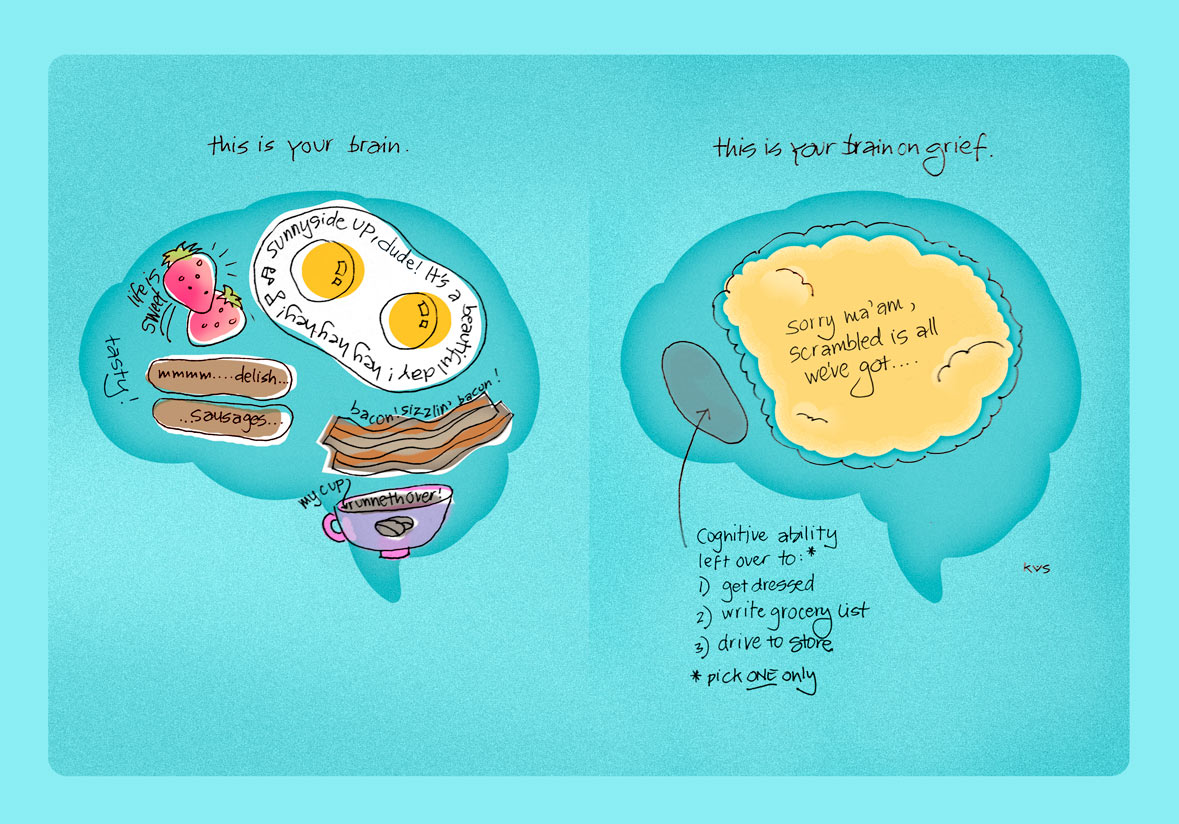
Grief Brain: It’s a Real Thing!

I’m looking right at her.

I know her.  In fact, I’ve known her for years.  But please don’t ask me her name.

I have no idea.

It happens to all of us-meet someone in the store or at the Post Office and you just know you know them, but cannot-for the life of you-remember a name.

file-cabinet

Chatting on, you search mental files desperately trying to make a connection you can hold onto.  Five minutes after she walks away it pops up-oh, yes!  That’s so-and-so from such-and-such.

Imagine if instead of searching mental files without success you can’t even find the file cabinet and start to wonder if one ever existed.

That’s what “grief brain” does to you.

Here are a few more examples of things that actually happened:  

  • Someone would say something to me and I hear them as if it’s another language-I have absolutely NO IDEA what they just said.
  • I had to write a list each morning of the most basic things to do (like eat) so that I didn’t forget to do them. I had to tape the list to the kitchen cabinet because otherwise I lost it.
  • I could no longer walk away from the stove when it’s turned on-I burned more than one pot of peas.
  • There are times I couldn’t remember my phone number or street address when asked.
  • I answered the phone, heard a familiar voice only to be confused about exactly who was on the other end of the line.
  • I became momentarily “lost” on familiar streets or in familiar stores.
  • Sometimes I literally couldn’t remember what day it was.
  • I forgot appointments, meetings and what time church starts on Wednesday night.

confused-huffpo

I began to wonder if I was losing my mind.  

And, in a way, I was.  

At least the mind I had BEFORE my son was killed.

The initial shock was only a beginning.  Ongoing stress and related hormones as well as increased blood pressure, poor sleep, anxiety, profound sadness and being forced to acknowledge my own lack of control bombarded my mind for months.  Pathways I’d relied on for most of my life were changed or destroyed.

If you think of the brain as an interconnected web of associations, functions and activity, it’s easy to see that rerouting or destroying some of the connections makes it harder to access information and do tasks.

neurons

“[W]hen brain imaging studies are done on people who are grieving, increased activity is seen along a broad network of neurons. These link areas associated not only with mood but also with memory, perception, conceptualization, and even the regulation of the heart, the digestive system, and other organs.”  Prevention Magazine

It’s no wonder that I found it difficult to think and do the most routine tasks after child loss!  

My mind was fundamentally altered.

It’s not as bad now as it was in the beginning.

But I still struggle to remember things that used to come easily.  I still hear words that I don’t always understand.  I depend much more on paper and pencil to keep track of important dates, appointments and phone numbers than I used to.  And I never walk away from the stove.

If I make a lunch date with a friend, I ask that she message me the day before to remind me.  If I don’t comprehend what someone is saying, I request that they repeat it.  I keep a paper copy of important information in my purse and an electronic copy on my phone.

It’s frustrating sometimes, but it is not a moral failure that my brain isn’t as sharp as it once was.

What was embarrassing at first is now something I openly acknowledge. 

I ask for help and I don’t apologize.

It’s really OK.

grief-brain-quote-from-cf

Featured image via: bedraggled & kicking

Death Is Awful

I have friends who have not only buried a child (some have buried more than one) but have also buried parents, siblings, in-laws and other people close to their hearts in a very short span of time.

And I am appalled when they recite the trite comments doled out by others meant to patch broken hearts and sweep the leftover pieces under the rug of social propriety.

Let me just say this:  Death.  Is.  Awful.

Full stop.  No easy change of subject or laughter allowed to make the hearing of it softer.

It should be hard.

It should make us pause.

We should stop in our tracks to acknowledge the passing of the breath of God from a person’s body.

Death is an unavoidable reminder that the world is not as God intended it to be.  It’s a reminder of the cost of sin.  It’s a reminder that our time is short.  And it’s a reminder that we are NOT in control.

Those are very uncomfortable truths.

My hope in Christ makes those truths bearable but it does not make facing the death of those I love hurt less.

A broken heart is a perfectly natural and reasonable response to the awfulness of death and to the absence of the presence of one I love. Great grief is the price of great love.  

There’s a scene in The Magician’s Nephew where a little boy named Digory meets Aslan. His mother is sick, and he wants to ask for Aslan’s help, but he’s afraid. Lewis writes:

Up till then he had been looking at the Lion’s great front feet and the huge claws on them; now, in his despair, he looked up at its face. What he saw surprised him as much as anything in his whole life. For the tawny face was bent down near his own and (wonder of wonders) great shining tears stood in the Lion’s eyes. They were such big, bright tears compared with Digory’s own that for a moment he felt as if the Lion must really be sorrier about his Mother than he was himself. “My son, my son,” said Aslan. “I know. Grief is great. Only you and I in this land know that yet. Let us be good to one another.”

For those outside this great grief, it seems helpful to toss words like bandaids but it’s not.

I’m sure you mean well when you try to circumscribe my grief-to give limits to its expression and duration.

But unrealistic expectations make it more difficult to bear the burden I’m already carrying. Your words add to this weight of sorrow and pain that I cannot untie from my bent back.

carrying-a-heavy-load

Presence-often SILENT presence-is the balm for my wounded soul.

But please: Don’t say it’s not really so bad. Because it is. Death is awful, demonic. If you think your task as comforter is to tell me that really, all things considered, it’s not so bad, you do not sit with me in my grief but place yourself off in the distance away from me. Over there, you are of no help. What I need to hear from you is that you recognize how painful it is. I need to hear from you that you are with me in my desperation. To comfort me, you have to come close. Come sit beside me on my mourning bench.

~Nicholas Wolterstorff, Lament for a Son


The Complex World of Child Loss

On the other side of child loss, many things that used to be easy just aren’t anymore.  

It takes so much energy to get through a day and navigate the minefields of conversation.

I wrote this a few months ago as I was pondering this aspect of my new life:

“One of the things I’ve been forced to embrace in the wake of child loss is that there are very few questions, experiences or feelings that are simple anymore.”

Read the rest here:  It’s Complicated


Can’t Fake It Forever

There’s a common bit of advice in grief circles:  Fake it until you make it.

It’s not bad as far as it goes and can be pretty useful-especially just after the initial loss and activity surrounding it.

Like when I met the acquaintance in the grocery store a month after burying Dominic and she grabbed me with a giant smile on her face, “How ARE you?!!! It’s SO good to see you out!!!”

I just smiled and stood there as if I appreciated her interest, a deer caught in headlights, silently praying she’d live up to her talkative past and soon move on to another target.

Faked it.

Boom!

BUT there comes a time when faking it is not helpful.  In fact, it’s downright dangerous.

Because if I fake it long enough and get good enough at it, I can convince myself that I have done the work grief requires.

Grief will not be ignored forever.

It bubbles up in physical symptoms and sleepless nights. It boils over in anger and impatience and anxiety and nervous habits.

There is no way through but through.  It has to be faced head on.

Life circumstances kept me distracted and busy for the first four or five months after Dominic ran ahead to heaven.

IMG_1790

I cried, screamed and was heartbroken-I definitely had my moments. But for the most part I functioned at a pretty high level.

It wasn’t until things slowed down that I had my come apart. And it caught me by surprise.

I was forced to sit in silence and face the feelings.  I was compelled to hear my heart shatter-over and over again.

I’ve now had 33 months of this burden of sorrow.  Almost three years to think about, work on and pray through the pain.  

I’m learning to pay attention to my own heartbeat, to my body, to my triggers, to my joy-bringers, my joy-stealers and my limitations.  I’m beginning to accept the bellycrawl progress through this tunnel of darkness by focusing on the bright light at the end.  

I still fake it sometimes-it’s not worth it to me to get into a long conversation with that person I only see every year or so.  Too much time, too much energy and too little reward.

But I’m learning to be more genuine with the people that matter most.  I’m learning to be honest about how I feel, what I need and how much I can do.

And I refuse to allow busyness to creep up on me so that I don’t have the time and energy to continue doing the work grief requires.  

not-required-set-yourself-on-fire-life-daily-quotes-sayings-pictures


Hardest Prayer I Have Ever Prayed

jesus-christmas

It is portrayed so sweetly in Christmas plays and Christmas movies:

Mary bowing her head in response to the angel Gabriel’s announcement that she has been chosen to bear the Saviour.

I don’t know what went through her mind before she answered.  I’m not sure she had a clue what submission to God’s will would look like as it played out across the months and years.

I only know that she was willing.

And God honored her willingness to bend her knee and her heart regardless of the unknown cost.

I’m not as noble as Mary.  I didn’t answer quickly when God allowed my life to be turned upside down.

I kicked and screamed and resisted as long as I could.

But who can fight Almighty God?

How can I carry on if I resist the Only One Who can carry me?

My heart still balks.

It. Is. Still. So. Very. Hard.

But I bow my head and heart each morning and ask for the grace to make it true:

“Behold, I am the servant of the LORD; let it be to me according to your word.” ~Luke 1:38

hand-coffee-roosevelt


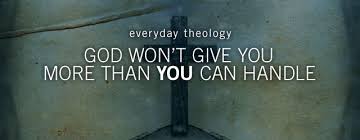
Exploding the Myth: God Doesn’t Give You More Than You Can Handle

blessings-come-through-rain-drops

You know, I don’t expect those outside the Body of Christ to have good theology-that’s like expecting me to be able to explain thermodynamics.  

Ain’t gonna happen-it’s outside my scope of understanding and practice.

I do expect those who have spent a lifetime reading Scripture, studying Sunday School lessons and listening to sermons to know better.

But many don’t.

“God doesn’t give you more than you can handle” is bandied about freely among those who, if they thought about it before they said it, know it isn’t true.

god-doesnt-give-you-more-than-you-can-handle

Usually it’s tossed at someone going through a tough time in an effort to encourage them.

Can I just let you in on a secret?  It is NOT encouraging.  At. all. Not one bit.

Because what’s implied is that I SHOULD be able to handle this.

But I can’t.

And it lets you off the hook.  

It’s like I’m drowning and instead of diving in to rescue me, you’re giving swimming lessons from the safety of the shore.

It’d be much more helpful if you threw me a lifeline.

life-preserver

God routinely gives me more than I can handle.

It’s one tool He uses to turn my heart to Him.  It’s one way He helps me understand (although He knows it already)  that I absolutely cannot handle it by myself.

So instead of sending the message that I should be able to handle this-join me in the dark place, hold my hand as we walk together and help me feel God’s love through you.


presence best gift


I Don’t Want to Know The Future

Many years ago my grandparents had a lovely Fiftieth Anniversary Celebration with family and friends.

My dad videotaped it and the tape was full of fun moments where my grandmother was smiling, laughing and having a wonderful day.

It was a short time afterward that she began to show signs of dementia and not very long after that she left us.

We watched the videotape a year or two after her leaving and I thought, “What a mercy she didn’t know what was coming!”

Those moments were full of unadulterated joy because a sorrowful future was hidden from her heart.

What a mercy that curves in the road obscure my vision and mountaintop to mountaintop hides valleys in between.

I am so very thankful that I did not live the 23+ years I had with Dominic knowing his accident was coming. I was free to love him without fear.

If I, like God, knew the end from the beginning my heart could never bear the burden of foresight.

But He, in kindness, withholds the knowledge from my feeble frame and leads me step by step each day.


i-dont-know-what-tomorrow-holds-but-i-know-who-holds-tomorrow


The Power of Lament to Make Room for Thanksgiving

Thanksgiving was always my favorite holiday.

I loved everything about it:  the color scheme, the food (I love, love, love to cook-it was never a burden), family and friends gathered around the table, and the wonderful slowness of the day as it lingered into nightfall.

It was more flexible than Christmas for including all sorts of folks who otherwise didn’t have someplace to go. Living near colleges meant that  we welcomed students from around the world-we might have two or three dozen laughing faces milling about.

happy-thanksgiving


It was wonderful.

And I loved going around the circle, tummies bursting, to share what people were thankful for and why.

When Dominic left us everything  changed.

Oh, I was (and still am) so very thankful for so very many things-my family, daily physical provision, ongoing care and love of friends, the enduring faithful mercy of God.

photo (20)

But there’s something else too:  there is deep sorrow at the unavoidable FACT that when God COULD have stepped in and changed an outcome, He DIDN’T.

pain-behind-every-tear

And I’m having to learn to open my heart to thankfulness while also bearing witness to this pain.

Praise and lament in the same breath.

I have plenty of company.

be broken brennan manningThe world we live in is full of pain and suffering.  Injustice reigns.  We make our way through thorns and by the sweat of our brow.

It is just plain hard.

The psalmist acknowledges that.  He doesn’t rush past the pain.  He doesn’t gloss over the broken places.

He empties his heart of the feeling that God has forgotten.  But he doesn’t stop there-he chooses to bring the emptiness back to the only One Who can fill it up again.

Like the psalmist, I’m learning  that I must exhale before I can inhale.

I must admit the burden of hopelessness to make room for the blessing of hope.

“With my voice I cry out to the LORD: with my voice I plead for mercy to the LORD.”

I ADMIT I FEEL ABANDONED:

In the path where I walk
they have hidden a trap for me.
Look to the right and see:
there is none who takes notice of me;
no refuge remains to me;
no one cares for my soul.

AND YET I WILL CHOOSE TO TRUST:

I cry to you, O LORD;
I say, “You are my refuge,
my portion in the land of the living.”

IN THE HOPE THAT GOD HEARS:

Attend to my cry,
for I am brought very low!

SO THAT MY TESTIMONY MAY BE ONE OF PRAISE:

Bring me out of prison,
that I may give thanks to your name!

Psalm 142, selected

As I sit at the table, cherishing the companionship of those I love and missing the one I can no longer see, I will embrace thanksgiving and lament.

I will exhale and inhale.

I will beg for grace and mercy because I can no longer beg to be spared from sorrow.

I will ask for eyes to see and a faithful heart while I wait.

worn snow


It Takes a Lifetime

I was reminded once again this week how the events surrounding death and burial are inadequate indicators of the profound change that has taken place in the lives of those left behind.

Standing at the graveside of a precious friend’s father, I remembered watching Dominic’s earthly shell lowered beneath the ground.

I was wholly unprepared for the days and weeks and months that followed.

No one had told me it was only a beginningLoving Well: Transitioning From “Good-bye” to Grief