Making Space for Brokenness at the Table of the LORD

As we enter the week on the Christian calendar when most churches celebrate the death, burial and resurrection of Jesus Christ, I am reminded that often we race past the road that lead to Calvary and linger at the empty tomb.

But to understand the beauty of forgiveness and the blessing of redemption, we MUST acknowledge the sorrow of sin and the burden of brokenness.

When our sacred spaces draw boundaries around what we can bring to the Lord’s Table, we exclude the very ones who are desperate for the bread and cup.  When we treat the path as unimportant and only acknowledge the destination, we discourage those that are struggling to keep up.  When we welcome only the triumphant, we exclude those that are trying.

Let’s throw open the doors to the church and

Clear the way for the Lord in the wilderness [remove the obstacles]; Make straight and smooth in the desert a highway for our God. (Isaiah 40:3 AMP)

Let’s invite the outcasts, the limping, the hurting and the broken to the table.

Let’s declare to the wounded that in Christ there is healing!

As I’ve written before: “The truth is that none of us escape hardship in life.  All of us have hidden heartache.  We all have cracks in our polished persona.”

Read more:  Beautiful Broken


Am I Normal?

Believe me, no one wonders more than I if the things I’m feeling, the things I’m doing and the rate at which I am healing is “normal”.

I belong to a couple of bereavement support groups and a recurring theme is, “Am I crazy?  Is this the way it is supposed to be?”

Sometimes grieving parents wonder these things because of their own misgivings.

But often, we question our feelings and experience because of external pressure.

And that is unfortunate and unfair.

When a mom brings her new baby home from the hospital, people are quick to remind her that life “will never be the same”.

She is encouraged to seek advice and help from friends and family and given space and time to figure out this new way of being.  As the years pass, she might express frustration and concern over the challenges of going back to work, sleepless nights, feeding issues, potty training, and dozens of other, everyday struggles that result from welcoming this little person into the family.  And that is just the beginning. 

No one thinks it strange that the ADDITION of a child is a life-long adjustment.

So, why, why, why is it strange that the SUBTRACTION of a child would also require accommodation for the rest of a mother’s life?

My heart grew larger when Dominic was born and the space that is his cannot and will not be filled by anyone or anything else.

I am learning each day to work around this empty spot.  I am becoming stronger and better able to carry the weight of grief that I must bear.

I can do many of the things I used to do before the only place I could visit Dominic was at the cemetary.

But I have to do them differently.  I need more help.  It takes more time. And sometimes I find after I plan to go somewhere that I am just not able to go after all.

I will never “get over” burying my son.

There will always be another mountain to climb, another loss to mourn, another hurdle to clear in this grief journey.

Dominic is part of me.  That didn’t change when he went home to be with Jesus.

The absence of his presence is EVERYWHERE.

And just for the record–missing the child I love for the rest of my life is perfectly normal.


Loving Well: Being a Friend

I’ve thought a great deal about friendship since losing Dominic.  I’ve been blessed by those who have chosen to walk with me and dismayed by some who have walked away.

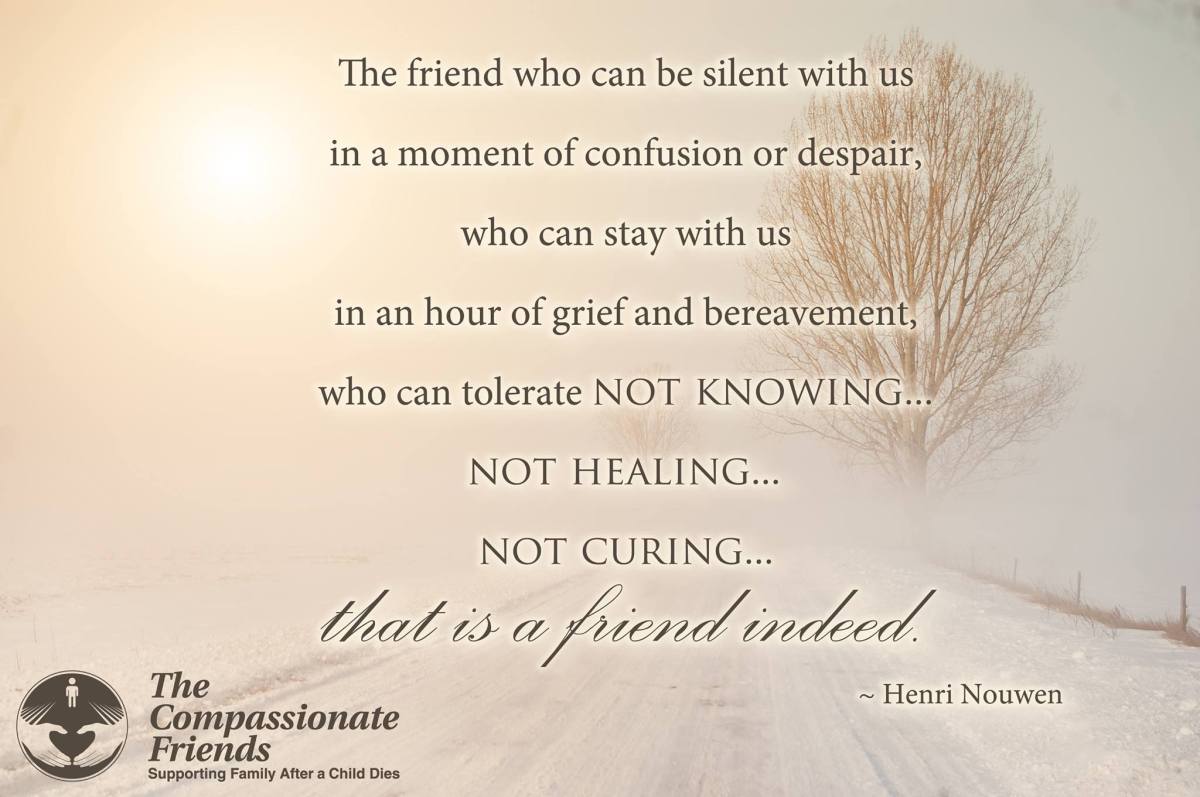
It takes great courage to sit in silence with those who suffer. We must fight the urge to ward off their pain with chatter. Quiet companionship requires that we allow our hearts to suffer too.

For fifty years I was on the “other side”-the one where I looked on, sad and sometimes horror-stricken, at the pain and sorrow friends or family had to bear.

I wanted to help.

I wanted to say the “right thing”.  I wanted to express how very much my heart hurt for them and that I badly wished I could carry some of their load.

Sometimes I think I did a pretty good job of reaching out and touching the wound and offering a little bit of comfort.  But other times, I would say nothing because I didn’t know what to say.

Now I am the one bent under the burden of grief-my heart and body and soul laboring to carry the weight of burying a child.  And there are those who are brave and reach out to me and offer words or hugs or prayers and their efforts give me strength and comfort.

Walking through the Valley of the Shadow of Death, these gestures are lights in the darkness, hope for my heavy heart and encouragement for a weary body.

“Two are better than one, because they have a good reward for their toil. For if they fall, one will lift up his fellow. But woe to him who is alone when he falls and has not another to lift him up! Again, if two lie together, they keep warm, but how can one keep warm alone? And though a man might prevail against one who is alone, two will withstand him—a threefold cord is not quickly broken.”

Ecclesiastes 4:9-12

It’s tempting to avoid someone when their world is dark.

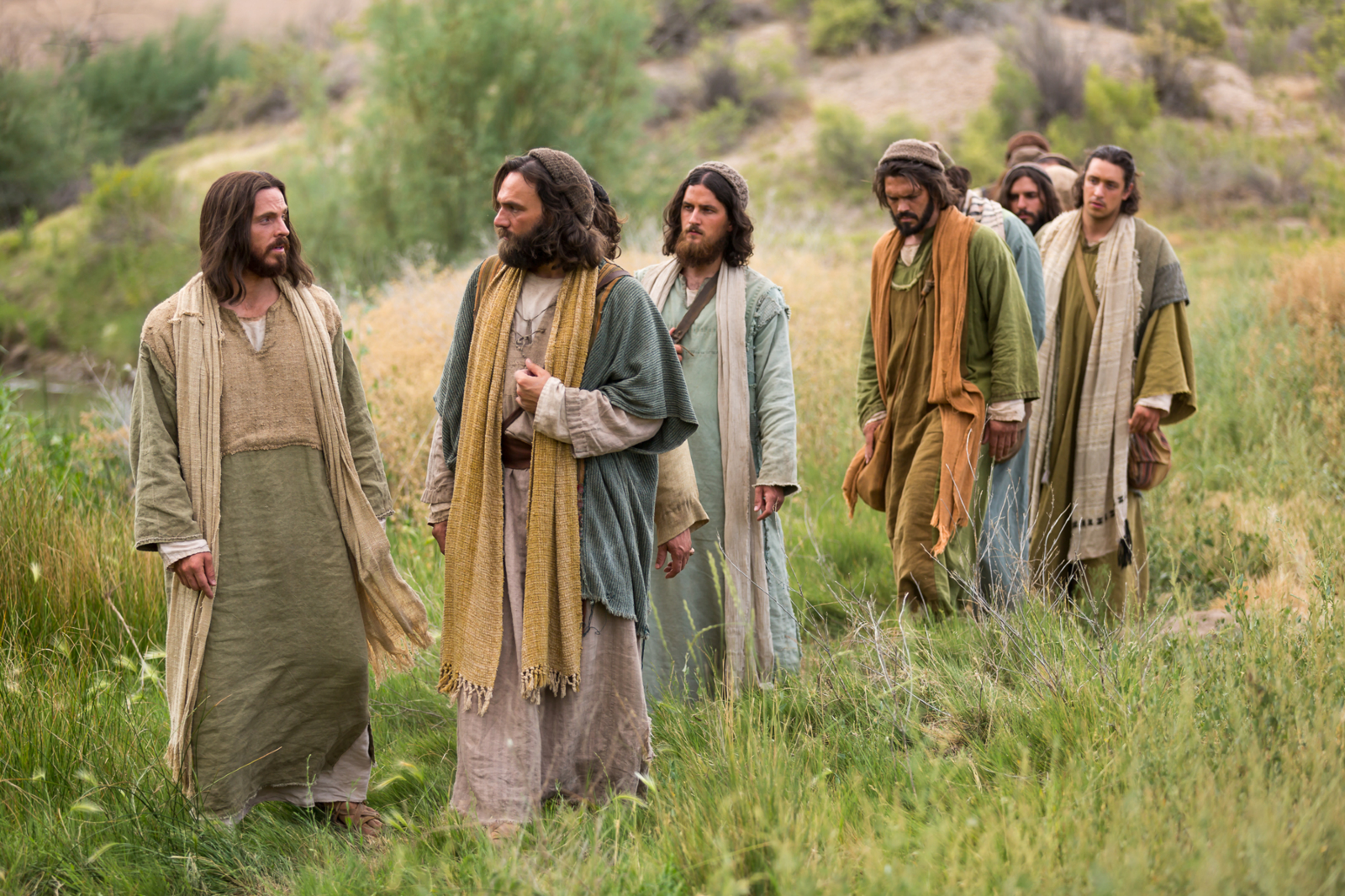
It’s uncomfortable to choose to enter their pain.  But Jesus has called us to walk beside the suffering, to encourage the disheartened and to lift up the ones who stumble.

There are no magic words to erase heartache.

Only presence.

And isn’t that why Jesus came?

We are most like our Savior when we are willing to leave our place of comfort and venture into the threatening world of another’s pain and suffering.

“Christ Jesus, who, being in the form of God, did not consider it robbery to be equal with God, but made Himself of no reputation, taking the form of a bondservant, and coming in the likeness of men. And being found in appearance as a man, He humbled Himself and became obedient to the point of death, even the death of the cross”

(Philippians 2:5-8)

Loving Well: How the Church Can Serve Grieving Parents and Other Hurting People

I am a shepherd.  My goats and sheep depend on me for food, for guidance and for their security.

And every day I am reminded that a shepherd’s heart is revealed by the way he or she cares for the weakest and most vulnerable of the flock.

But most of us are far removed from the daily reminder of pastoral life that was commonly accessible to the authors and readers of the Bible thousands of years ago.  So it’s no surprise that we tend to forget the connection between a shepherd’s life and a pastor’s calling.

Jesus called Himself, “the Good Shepherd” and He told Peter to “feed My sheep”. The relationship of shepherd to sheep is important if we are to understand how God wants His church to function.

Many churches serve more people than the number of animals in my care. And a pastor is only one person.  He (or she) cannot personally meet every need of every member of the congregation.

Still, a pastor is in a unique position to demonstrate priorities to a church and lead by example in ministering to the weakest and most vulnerable among them.

So how can a pastor lead the church to love the grieving and other hurting people well?

Cultivate a Culture of Compassion:

Does your local body welcome the wounded?  

Like those carrying the pain of burying a child.  Or the burden of chronic physical disability. Or the unceasing struggle of overcoming addiction.

Pain is a reminder that this world is broken. It’s uncomfortable to feel it, to be near to someone who is feeling it. We try so hard to “fix” our own and other people’s pain.  And sometimes if we don’t feel like we can fix it, we ignore it.

A cold shoulder wounds as much as hurtful words. Acknowledgement is as great a blessing as an extended hand.

Compassion means “to suffer alongside”.  It requires getting to know someone and listening to their story.  It means inviting others into your life, not only your pew.

Is your congregation too busy to truly SEE? The business of the church is people.

If we are to minister to the broken, we must reach out to them.  The first step is to welcome them in.  Then show them that you care.

Come alongside, bear witness to the tears, lay a hand on an arm, reach out with only love-often in silence. This is compassion, it touches the soul of one who hurts and reminds them that pain is not all there is.

No one should leave a church service ungreeted.  No one should leave feeling more alone than when they entered the building.

Communicate the Cost of Compassionate Response:

God is the God of inexhaustible resources, yet sometimes we act as if we are in a zero-sum community.  If we give too much over here, there won’t be enough over there.  But God has promised to supply every need according to His riches in glory.  

If we are to live in true fellowship with one another, loving one another through thick and thin, then it will be costly.  Ministry requires giving of resources, energy and time.

I have written elsewhere that, “There is no substitute for walking with the wounded.  It is costly, it is painful, it is hard.”

But it is what we are called to do.

God Himself stepped into His creation to feel the pain of brokenness, to bear the price of sin and to open a Way for restoration and redemption.

We shouldn’t set a time limit or a resource cap when we minister to those He has placed in our midst.

Commit to Continue:

Compassion says, “I see your pain.  I hurt with you.  Let me stay with you until you feel better.  And if you never feel better, I’ll still be here.”

Compassion requires conscious commitment to push back against our tendency to forget those who live with ongoing challenges.

Ministering to hurting people rarely leads to a tidy final chapter that wraps loose ends into a comfortable narrative.We need to be honest about this.  A weekly program is not going to be enough.

Pastors can help a congregation remain focused on compassionate response so that members do not abandon the broken to sit alone with their pain.

True ministry involves RELATIONSHIP.  And relationship is time-consuming.

But relationship is at the center of the Gospel of Jesus Christ.  No longer separated from God by our sin, we are invited to His table–welcomed into His family.

We are all broken.  And without the compassionate love of our Savior, we are all without hope.

When we welcome the wounded, we are living the Good News.

Watch what God does, and then you do it, like children who learn proper behavior from their parents. Mostly what God does is love you. Keep company with him and learn a life of love. Observe how Christ loved us. His love was not cautious but extravagant. He didn’t love in order to get something from us but to give everything of himself to us. Love like that.

Ephesians 5:1-2 MSG


Loving Well: Just Say His Name

I know you are afraid.

You think that speaking his name or sharing a memory or sending me a photo will add to my sorrow.

I understand.

But even when it costs me a split second of sharp pain, it is truly a gift to know that Dominic lives on in the hearts and minds of others.  It gives me courage to speak too.  It creates space where I can honor my son.

It helps keep him alive.

“I mean, they say you die twice. One time when you stop breathing and a second time, a bit later on, when somebody says your name for the last time.” ~Banksy

I know you’re busy.  I know your life is full and bustling with so many people and activities demanding attention that you don’t have any to spare.

It is easy to forget.

He wasn’t your child. The date of his homegoing isn’t etched into the marrow of your bones, it isn’t scribed on the inside of your eyelids.

Every time the calendar screams “12” I make one more chalkmark on my heart counting the days since I saw him last.

But please remember.  Please don’t let the day slip by and not acknowledge that it is as important a milestone to me and my family as his birthday.

I know you’re scared.

Death is scary.  Even for us who trust Jesus.  And the death of a child just trashes the notion that we are in control, that we can fully protect the ones we love from all harm.

But you are frightened of what you cannot comprehend.

I am living the reality of your greatest fear.

Be brave.  Step out and welcome me in.

Give space for the longing to hear my son’s name, to know my son matters, to relive some of the happy moments and funny times and even some of the hard days.

I can sit by myself and remember him.

But sharing him with you breathes life into the recollection and speaks hope to my heart.

It fuels the fire that helps me see that even when I’m not here to carry him into the land of those still living, someone else will do it for me.

Love is stronger than death even though it can’t stop death from happening, but no matter how hard death tries it can’t separate people from love. It can’t take away our memories either. In the end, life is stronger than death.

—Anonymous


Loving Well: Some Things Hurt

Before I lost Dominic, I know that I, like others who had never experienced the death of a child, undoubtedly said and did things that were hurtful instead of helpful.

I painfully remember sharing at a Thanksgiving women’s gathering and, meaning to encourage the ladies, said something like, “I think we are able to better face the big disappointments or trials in life, but find the daily drip, drip, drip of unfulfilled expectations to be a greater challenge.”

 A bereaved mom in attendance set me straight (in a very kind and gracious manner!).

That exchange has come often to my mind in these months after burying my son. I wish I could go back and have a do-over.

I hope that my pain has made me more compassionate, more sensitive to those around me.  I pray that I will extend grace and mercy to everyone I meet.  I want to be a light, not a candle-snuffer!

I’m convinced that most people want to bless and not hurt.

So here is a list of things (from my own experience and from the experience of others) that can be particularly damaging to bereaved parents when dealing with their loss:

Offering platitudes and quoting Bible verses is unhelpful.

Don’t say, “At least you have your other children.”  Which of your own children are you willing to give up?

“God needed another angel!” This is just bad theology as well as unhelpful.  God doesn’t need anything and my child is not an angel.  He is a redeemed member of the Body of Christ and in heaven with Jesus.

“He or she isn’t suffering anymore.”  That may very well be true, but it’s not comforting to hear it.

“All things work together for good…” I may believe that in my heart of hearts, and may come to feel it again one day, but in the days immediately following my son’s death, I didn’t need to be reminded.

“He (or she) wouldn’t want you to be sad.”  How do you know what my child would want? Being sad and expressing my pain honors his or her memory.

“God will use your son’s death to bring people to Jesus.” Yes, He might.  But He did not need my son to die in order for anyone to receive Christ.  He may use my son’s death, but I will speak honestly and say that I would not have exchanged Dominic’s life for anyone.

“It could have been worse” or any sentence beginning with, “At least…”. My child is dead.  I cannot have him back.  I’m sure there are more painful ways to lose a child besides a motorcycle accident,but it is a matter of degree, not kind. Just please, don’t.

“Don’t try to make your grief ‘equal’ to the parents. Sometimes in an effort to comfort we might say things like “I understand how you feel. I was devastated when my grandfather, or aunt, or best friend died”.  My mom and sister proceeded my daughter in death and their loss, as difficult as it was, didn’t even come close to how difficult it has been to lose her.  And don’t compare the loss of your beloved pet to the loss of someone’s child. JUST DON’T! Almost everyone I know who has lost a child has had their loss compared to that of someone’s pet. My daughter’s death was compared to that of someone’s pet lizard.”

Asking for details of the cause of death or the conditions surrounding the death of any child is not helpful.  If a parent wants to talk about it, listen.  Otherwise, keep curiosity in check.

“I did not appreciate [a close family member] persisting to know why our son took his own life. I don’t want to tell her as she will dwell on that forever and I want to celebrate his life, not his death. I also didn’t appreciate those folks telling me to stay strong. I am strong, but if I wanted to be a puddle, I am allowed to do that too.”

Please don’t label us as “strong”–you may mean it as a compliment but we hear it in many ways.  One way might be that we are not honoring our child by grieving hard enough.  Another way might be that we are expected to act strong even when we don’t feel strong.  Trust me, you have no idea what it costs a bereaved mama to hold back the tears.

“I get so tired of people telling me I’m so strong also. I too am a puddle often but no one sees me during these days alone.”

It’s true that no one can fully comprehend our pain if they have not felt it.  But it is possible to educate yourself about ways to support grieving parents.

“I wish people were more understanding but the problem with that is about the only way to understand is to go through it and I don’t want that for anyone.”

Please don’t withdraw from us as if we have a communicable disease.  I know it makes you uncomfortable to be around me and my grief.  It makes me uncomfortable too.  But companionship and encouragement can mean the difference between grieving well and being overwhelmed by sorrow.

“I wish one of my good friends had reached out to me more. See we both work for the school system so we had the summer off. I never once heard from that friend all summer. It really hurt.”

“When I got home my church family was there then suddenly I was home alone. Everybody left me home ”

Show up to the funeral.  Put aside petty differences.  Extend grace.  It’s not about you.

“His father didn’t even come. Not even to the funeral. No one brought food or sent flowers. Not even after the funeral. I was left alone a lot frightened and confused. Within a few months I was homeless.”

Be the church.  Be the person that writes notes weeks and months after the funeral. Check in with grieving parents and keep checking in.  Even if they don’t return a phone call, the act of letting them know you care is meaningful.

“After the funeral, there was a huge sense of abandonment from everyone. I don’t think that was intentional by anyone (except my family members, lovely!) but yeah…..there were hundreds of people at his funeral, and I probably didn’t know half of them. I wanted to thank people, but didn’t know who to thank! Lot of support, but when it was over…….it was over.”

“[Some close family members] were total jerks about the entire ordeal, so if there were anything really, I wish they had sucked up their egos and petty jealousies, and been there more for my other kids. I no longer have ties with them.”

“One huge topic that is discussed in my bereaved parents Facebook group is the response from the church for grieving parents. Sadly, most churches just don’t know what to do so they do…..nothing. Some are great for the first couple of weeks after the death and then….nothing. A very few provide the needed support in the months after such a devastating loss.”

Please don’t rush us to meet your timetable of when our grief should subside.  It will take as long as it takes.  Sometimes we can participate in life and sometimes we can’t.  Sometimes we smile, sometimes we cry– but we will always miss our child.

“People, for different reasons, want you to get back to normal. We can’t even remember what normal was ”

One of the biggest fears of bereaved parents is that their child will be forgotten. Don’t forget. Speak to them about their child.  Share memories.  Say their name.  Be present (even with a text, call or card) on important dates.

“No one would come for my son’s first anniversary. I was left home alone…abandoned felt like.”

Loss will enter everyone’s life at some point–there is no escape.

We educate ourselves (as we should) on so many issues–work hard not to offend, to understand, to reach out. Bereaved parents don’t want pity, they would like to be better understood.  We did not choose this journey, it was thrust upon us.

A little bit of kindness goes a long way.


Extravagant Love: Tales of Friendship and Encouragement After Losing a Child

When I asked other bereaved parents to share the things people did that blessed them in the wake of losing a child, I didn’t expect so many stories of extravagant love–of acts surpassing anything I could have thought of or imagined.

“After my daughter passed, which was minutes before Mother’s Day 2012, outside the hospital room, my son gave me a handmade Mother’s Day card that he somehow found time to make in all of the chaos. The card spoke of my daughter, me being her mother, and included a beautiful poem he had written that tugged so strongly at the heartstrings. Oh my heart!”

“A couple who had lost their son years earlier, drove two hours just to come and sit with us.  A dear friend took over my life for the next couple of weeks.”

“On my son’s first anniversary date of his passing, a friend of mine organized a candle light vigil outside our house that night. We didn’t know anything about it. When we walked outside our front door that night, there were people on our lawn with candles”.

“One phone call by the Abbott to our church and everyone who needed to know, knew. We didn’t have to make the calls. And the youth pastor, children’s pastor, and each child’s best friend made it to our house within moments of our kids getting the news. Held them while they screamed. Stayed for hours.”

“I was most grateful to the hospice worker who offered to pack up the hospital room for us and deliver our belongings back to us at home.”

“My pastors wife said ‘lean into your grief, and onto the Lord’–these words carry me to this day, almost 7 years later.  My sister came over, and never left my side until after the funeral.”

“My daughter was in a car accident. The owner of the house where the accident was came out held her hand and prayed with her. I am so grateful to him for giving her peace at that moment.”

“A coworker came and she did not come empty-handed, she brought two things: a box of tissues and a bottle of wine. I was grateful for both. She sat and cried with me and I didn’t feel like I had to be brave or consider other people’s feelings if I was breaking down. She didn’t try to hug me or shush me when I would cry– she’d just cried with me, handed me tissues, and she would pour glasses of wine and we would talk and laugh and cry. There was another young lady who came looking for my youngest son who has just lost his only brother and he had locked himself away in his room she pulled us all together and taught us how to play a card game none of us knew how to play.  But it was such a good distraction and it pulled my son out of his self-imposed isolation.”

“To give you some background: it was the summer before my son’s freshman year and we lived in a tourist town on the coast. We were coming back from the bigger hospital he had been transported to. When we crossed the bridge to our hometown, we came up on a group of teenagers. Hundreds of kids and some adults had begun a candlelight walk on the sidewalk that runs pretty much the whole town of Emerald Isle, NC. People just kept coming. It was amazing. Even the tourists were moved by this impromptu event. The kids sent out the message through social media.”

“I have a long distance friend who has written a psalm a day. It’s been 3 months and she’s still sending them.”

“We also had a lady at the church quietly give us random care packages over the months. No words, just thought. It is very sweet.”

“My son was an avid reader and a friend of mine had bookmarks made with his picture and the footsteps poem on the back to distribute at the viewing. I will cherish that gift forever.”

“One of our son’s best friends somehow managed to have HUNDREDS of rubber bracelets made up that had his name and life verse embossed on them, and he gave them to people at the reception following the memorial. At the time, I thought, ‘That’s nice, but what are we going to do with them?’  I still see people wearing them, and when anyone asks me about mine, I tell his story and give it away.”

“At the cemetery after the graveside service I was having a very difficult time leaving. I knew I could not stand to watch the casket being lowered into the ground yet I could not bring myself to leave. A dear friend and a fellow pediatric cancer mother offered to stay at the cemetery until our son was buried. Long after everyone left she offered to stay until the end. As crazy as this sounds I knew my son would not be alone and I was able to leave knowing that someone was with him.”

“Our family has had a “secret angel” who every month on the 20th which is the day of our son’s passing has brought a red bag and left it on our porch. Inside the red bag has been something small for our family or something for the foundation that we started in our son’s name. It’s never been about the gift received but about someone remembering our son…every month for 5 years and 5 months we have received one of these bags. It has meant a lot to our family and truly has helped us to heal.”

“A hairdresser friend cut a lock of my daughter’s hair (with our permission). She placed some in heart shaped lockets along with meaningful small charms (think Origami Owl). We treasure these pieces.”

I suppose I shouldn’t have been surprised. When we lost Dominic, there were many who blessed us in ways that I can only describe as offerings poured into our lives from the bountiful love of Christ:

It was important to me that we held the funeral in a church and not a funeral home. Even though it meant making accommodations in a busy Easter weekend service schedule, we were made to feel welcome–we had visitation for four hours on Easter Sunday evening.

Three churches participated in making food and hosting a meal after the burial.  The Body of Christ worked in unity to bless us.

Like many parents, I had never considered where I would bury my child. But local pastors graciously guided our family through procurring a burial plot just a mile from our house. Even though I firmly believe that Dominic is not there–just the empty shell that once housed his essence–it comforts me to know he’s not far from home.

Dominic’s friends from The University of Alabama School of Law quietly arranged for me to receive his diploma posthumously.  Dominic was honored during the ceremony and his name was called along with his classmates at graduation.  I will cherish their kindness as long as I live.

I believe that God honors these offerings.

I believe He smiles when His children love one another in sacrificial and extravagant ways.

I believe it is a fragrant aroma, wafting to heaven and drawing others near to the foot of the cross.

[Jesus said] “I am giving you a new commandment, that you love one another. Just as I have loved you, so you too are to love one another. By this everyone will know that you are My disciples, if you have love and unselfish concern for one another.”

John 13:34-35 AMP

the cost of compassion

I can’t help it.

I think too much.  I wonder too often.  I work too hard to make sense of things.

And the thing that is puzzling me right now is why people pull away from those experiencing deep and lasting pain.

Like the pain of burying a child.  Or the burden of chronic physical disability.  Or the unceasing struggle of overcoming addiction.

I think I’ve hit on a few possibilities:

  • There is no end in sight.  None of these scenarios offer a tidy final chapter that wraps loose ends into a comfortable narrative.
  • It challenges what we believe about God.  It’s one thing to consider the problem of pain and suffering in the world from a theoretical perspective and quite another to experience it in real time.
  • Our days are too full of “busy work” to leave room for real ministry. Overscheduled and frazzled,  we don’t have the emotional, physical or psychological energy required to stand with someone while they battle.

So we trade pity for compassion.

Pity says, “I’m sorry for you.  Let me do something for you that makes me feel better.”

We offer platitudes and prayers from afar as a substitute for presence and personal interaction.

And when our attention is turned elsewhere, we drift away–abandoning the broken to sit alone with their pain.

Most of us don’t mean to do it–we just move on, leaving the limping behind.

But the cold shoulder wounds as much as hurtful words. Acknowledgement is as great a blessing as an extended hand.

Compassion says, “I see your pain.  I hurt with you.  Let me stay with you until you feel better.  And if you never feel better, I’ll still be here.”

Compassion requires conscious commitment to push back against our tendency to forget those who live with things they cannot change and will never forget.

God Himself stepped into His creation to feel the pain of brokenness, to bear the price of sin and to open a Way for restoration and redemption.

Jesus came to make the Father known.

There is no substitute for walking with the wounded.  It is costly, it is painful, it is hard.

But I would argue that when we do, we are most like our Savior.